
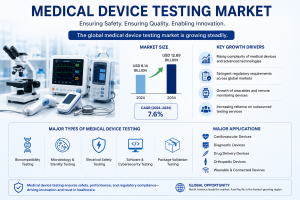
The global medical device testing market size is calculated at USD 10.76 billion in 2025 and is predicted to increase from USD 11.77 billion in 2026 to approximately USD 25.82 billion by 2035, expanding at a CAGR of 9.15% from 2026 to 2035. Stringent regulations and rising demand for safe, high-quality medical devices also drive the market.
Introduction
The medical device industry is one of the most highly regulated sectors in healthcare. From wearable health monitors and diagnostic imaging systems to implantable cardiac devices and surgical instruments, every medical device must undergo rigorous testing before reaching patients. Medical device testing plays a critical role in ensuring safety, effectiveness, reliability, and regulatory compliance.
As healthcare systems increasingly adopt advanced technologies such as artificial intelligence (AI), connected devices, robotics, and remote monitoring solutions, the complexity of medical devices continues to rise. Consequently, manufacturers are investing heavily in testing services to meet evolving regulatory requirements and maintain product quality.
Get Sample: https://www.precedenceresearch.com/sample/4429
Medical Device Testing Market Overview
Medical device testing encompasses a broad range of evaluations designed to verify that medical devices perform safely and effectively throughout their lifecycle. Testing activities include biocompatibility assessments, microbiological testing, sterility verification, chemical analysis, packaging validation, performance evaluation, and clinical testing.
Regulatory agencies worldwide require extensive testing before approving devices for commercial distribution. Organizations such as the U.S. Food and Drug Administration (FDA), European regulatory authorities under the Medical Device Regulation (MDR), and regulatory bodies in Asia-Pacific countries continue strengthening safety standards, creating sustained demand for testing services.
Growing prevalence of chronic diseases, aging populations, rising demand for minimally invasive procedures, and increasing adoption of connected healthcare technologies are further fueling market growth. Medical device manufacturers are increasingly outsourcing testing services to specialized laboratories and contract research organizations to reduce costs, accelerate approvals, and improve compliance efficiency.
Medical Device Testing Market Growth Analysis
Increasing Regulatory Complexity Driving Testing Demand
One of the strongest growth drivers is the increasing complexity of global medical device regulations. Manufacturers must comply with multiple standards, including ISO 13485, FDA requirements, European MDR regulations, and country-specific compliance frameworks.
The regulatory landscape has become more demanding as authorities emphasize patient safety, post-market surveillance, risk management, cybersecurity, and software validation. These requirements necessitate extensive testing and documentation before product approval. Industry studies show that regulatory complexity remains one of the primary factors influencing market growth.
Rising Innovation in Medical Technologies
The emergence of digital health technologies, wearable devices, AI-powered diagnostics, robotic surgery platforms, and implantable monitoring systems has significantly increased testing requirements. Modern medical devices often integrate hardware, software, cloud connectivity, and data analytics, requiring comprehensive validation procedures.
As device complexity increases, testing providers are expanding their capabilities to include cybersecurity assessments, software verification, electromagnetic compatibility testing, and AI algorithm validation. This trend is expected to sustain strong market growth throughout the next decade.
Major Medical Device Testing Market Trends
AI-Powered Testing Solutions
Artificial intelligence is transforming medical device testing by automating test case generation, identifying defects, predicting failures, and improving testing efficiency. AI-driven systems can significantly increase automation coverage and reduce manual testing workloads.
Growth of Outsourced Testing Services
Many manufacturers increasingly rely on specialized testing laboratories and contract research organizations (CROs) to conduct regulatory testing. Outsourcing enables companies to access advanced expertise while reducing operational costs and accelerating product approvals.
Expansion of Connected Medical Devices
The rapid adoption of Internet of Medical Things (IoMT) devices has created new testing requirements related to cybersecurity, software validation, data privacy, and interoperability.
Harmonization of Global Quality Standards
The adoption of international quality standards such as ISO 13485 and FDA’s new Quality Management System Regulation (QMSR) is encouraging greater consistency in testing procedures worldwide. The FDA’s alignment with ISO 13485 creates opportunities for streamlined global compliance strategies.
Medical Device Testing Market Dynamics
Driver
Stringent Regulatory Requirements
Healthcare regulators continuously update safety and quality requirements to protect patients. Medical device manufacturers must perform extensive testing to demonstrate compliance with evolving standards. Regulatory pressure remains one of the most significant growth drivers in the market.
Opportunity
Growth of Personalized and Smart Medical Devices
Personalized healthcare solutions, implantable sensors, wearable monitoring devices, and AI-enabled diagnostic platforms are creating substantial testing opportunities. These products require sophisticated validation processes that specialized testing providers can offer.
Challenge
High Testing Costs and Long Approval Timelines
Medical device testing can be expensive and time-consuming, particularly for Class II and Class III devices. Comprehensive testing requirements may delay product launches and increase development costs, especially for small and medium-sized manufacturers.
Market Segmentation
By Service Type
- Biocompatibility Testing
- Chemistry Testing
- Microbiology and Sterility Testing
- Package Validation
By Testing Phase
- Preclinical Testing
- Small Animal Research
- Large Animal Research
- Clinical Testing
By Device Class
- Class I Devices
- Class II Devices
- Class III Devices
By Sourcing
- In-house Testing
- Outsourced Testing
By Region
- North America
- Europe
- Asia Pacific
- Latin America
- Middle East & Africa
Applications of Medical Device Testing
Medical device testing is essential across numerous healthcare sectors. In cardiovascular medicine, testing ensures the safety and effectiveness of pacemakers, stents, and heart valves. In orthopedics, implants undergo rigorous mechanical and biocompatibility evaluations. Diagnostic imaging systems require electromagnetic compatibility and performance testing, while wearable health devices demand software validation and cybersecurity assessments.
The growing use of connected medical devices has expanded testing applications into network security, cloud integration, and real-time monitoring systems. As healthcare becomes increasingly digital, testing providers play a critical role in ensuring device reliability and patient safety.
Read Also: In Vitro Diagnostics Market
Regional Analysis
Asia Pacific
Asia Pacific currently represents the largest market share due to expanding healthcare infrastructure, increasing medical device manufacturing activities, and supportive government initiatives. Countries such as China, India, Japan, and South Korea are investing heavily in healthcare innovation and regulatory modernization. Asia Pacific accounted for approximately 42% of market revenue in 2025.
North America
North America is expected to be the fastest-growing region during the forecast period. The presence of major medical device manufacturers, advanced healthcare infrastructure, strong regulatory oversight, and increasing adoption of innovative healthcare technologies contribute to market growth.
Europe
Europe remains a significant market due to stringent MDR regulations and strong emphasis on post-market surveillance. Countries such as Germany, France, and the United Kingdom continue investing in medical technology innovation and compliance infrastructure.
Latin America
Latin America is witnessing growing demand for testing services as countries strengthen Good Manufacturing Practice (GMP) requirements and align regulations with international standards. Brazil has emerged as a key regional market due to increasing healthcare investments and regulatory modernization.
Competitive Landscape
The medical device testing market is highly competitive, with global testing organizations expanding capabilities through acquisitions, laboratory expansion, and technological innovation.
Key companies include:
- SGS SA
- Eurofins Scientific
- Intertek Group plc
- Charles River Laboratories
- TÜV SÜD
- NAMSA
- Laboratory Corporation of America Holdings
These companies continue investing in AI-enabled testing solutions, regulatory expertise, and global laboratory networks to meet growing industry demand.
Case Study AI Integration in Medical Device Testing
A growing number of medical device manufacturers are implementing AI-powered testing platforms to improve efficiency and reliability. AI systems can automatically generate test cases, identify software defects, predict potential failures, and optimize validation workflows.
Industry analyses indicate that AI-based testing can significantly increase automation coverage and reduce manual intervention, enabling faster product development cycles while maintaining regulatory compliance. This trend is particularly important for software-driven medical devices and connected healthcare technologies.
Future Outlook
The future of the medical device testing market appears highly promising. The continued expansion of digital health technologies, connected medical devices, AI-enabled diagnostics, and personalized healthcare solutions will create new testing requirements and opportunities.
Regulatory authorities worldwide are expected to strengthen quality and safety standards, further increasing demand for comprehensive testing services. Outsourcing trends, adoption of AI-powered testing platforms, and harmonization of international quality standards will continue shaping market evolution.
As healthcare systems prioritize patient safety, cybersecurity, and device reliability, medical device testing will remain a foundational component of the global medical technology ecosystem. With strong regulatory support and sustained innovation, the market is poised for substantial growth through 2035.
