
What is the Materials for Bone Implants Market Size in 2026?
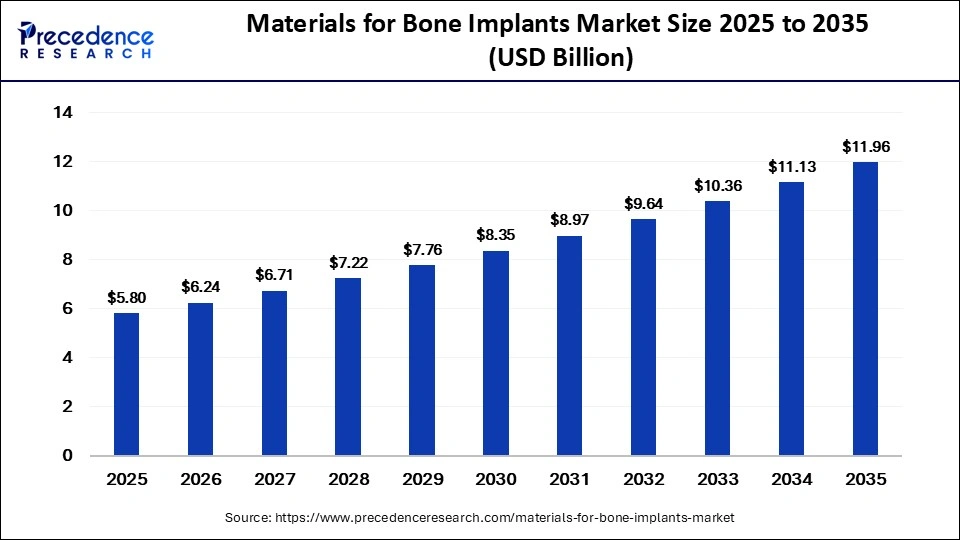
The global materials for bone implants market size accounted for USD 5.80 billion in 2025 and is predicted to increase from USD 6.24 billion in 2026 to approximately USD 11.96 billion by 2035, expanding at a CAGR of 7.50% from 2026 to 2035. The market is driven by the increasing cases of bone injury and dental problems and advancements in material modification.
Key Takeaways
- North America led the materials for bone implants market in 2025 with a 38% share.
- Asia Pacific is expected to grow at the fastest CAGR of 9% between 2026 and 2035.
- By material type, the titanium & titanium alloys segment led the market with a 35% share in 2025.
- By material type, the polyetheretherketone (PEEK) segment is observed to grow at the fastest CAGR of about 7% in the coming years.
- By implant type, the orthopedic plates & screws segment held the largest revenue share of 30% in 2025.
- By implant type, the dental implants segment is expected to expand at the fastest CAGR of 6.2% during the forecast period.
- By end-user, the hospitals segment held the highest revenue share of 55% in 2025.
- By end-user, the orthopedic & dental clinics segment is expected to grow at the fastest CAGR of 7% in the foreseeable period.
Market Overview
The Materials for Bone Implants Market is experiencing significant growth due to the rising prevalence of orthopedic disorders, increasing cases of fractures and traumatic injuries, and the growing demand for advanced implant technologies. Bone implant materials play a critical role in orthopedic, dental, and reconstructive surgeries by providing structural support, promoting bone regeneration, and improving patient mobility.
Modern bone implants are manufactured using a variety of materials, including metals, ceramics, polymers, and composite biomaterials. Titanium and its alloys remain widely used due to their excellent strength, corrosion resistance, and biocompatibility. Meanwhile, bioactive ceramics, biodegradable polymers, and next-generation composite materials are gaining popularity for their ability to enhance osseointegration and support natural bone healing.
The increasing aging population worldwide, coupled with the growing incidence of osteoporosis, osteoarthritis, and sports-related injuries, continues to drive demand for innovative bone implant materials. Additionally, advancements in additive manufacturing and personalized healthcare are opening new opportunities for customized implant solutions.
AI Impact on the Materials for Bone Implants Market
Artificial Intelligence (AI) is transforming the development, manufacturing, and clinical application of bone implant materials.
AI-powered material discovery platforms enable researchers to analyze thousands of biomaterial combinations and predict their mechanical properties, biocompatibility, and long-term performance. This significantly reduces development timelines and accelerates innovation.
In implant design, AI-driven simulations help optimize implant structures for improved load distribution, durability, and patient-specific anatomical compatibility. Machine learning algorithms are also assisting manufacturers in enhancing quality control, detecting defects during production, and improving process efficiency.
AI is increasingly integrated with 3D printing technologies, enabling the creation of customized implants tailored to individual patient requirements. Furthermore, predictive analytics support surgeons in selecting the most suitable implant materials based on patient characteristics, expected outcomes, and recovery profiles. As AI adoption expands across healthcare and manufacturing ecosystems, it is expected to play a pivotal role in advancing next-generation bone implant materials.
Market Trends
Growing Adoption of Biodegradable Implant Materials
The industry is witnessing increasing interest in biodegradable metals and polymers that gradually dissolve after supporting the healing process. These materials reduce the need for secondary surgeries and promote natural bone regeneration.
Expansion of 3D-Printed Bone Implants
Advanced additive manufacturing technologies are enabling the production of patient-specific implants with complex porous structures that closely mimic natural bone architecture and improve tissue integration.
Rising Demand for Bioactive Materials
Healthcare providers are increasingly adopting bioactive ceramics and composite materials that stimulate bone growth and accelerate healing while reducing the risk of implant failure.
Increasing Focus on Personalized Orthopedics
The shift toward precision medicine is driving demand for customized implants designed according to patient anatomy, age, lifestyle, and clinical requirements.
Development of Hybrid Biomaterials
Researchers are exploring hybrid materials that combine the strength of metals with the regenerative properties of biodegradable components, creating implants that offer both structural support and biological functionality.
Market Scope
| Report Coverage | Details |
| Market Size in 2025 | USD 5.80 Billion |
| Market Size in 2026 | USD 6.24 Billion |
| Market Size by 2035 | USD 11.96 Billion |
| Market Growth Rate from 2026 to 2035 | CAGR of 7.50% |
| Dominating Region | North America |
| Fastest Growing Region | Asia Pacific |
| Base Year | 2025 |
| Forecast Period | 2026 to 2035 |
| Segments Covered | Material Type, Implant Type, End-User, and Region |
| Regions Covered | North America, Europe, Asia-Pacific, Latin America, and Middle East & Africa |
Segment Insights
By Material Type
- Metals continue to dominate the market due to their superior mechanical strength, durability, and extensive use in orthopedic and trauma implants. Titanium and titanium alloys remain the preferred choice for many surgical procedures.
- Ceramics are gaining traction because of their excellent biocompatibility and ability to promote bone bonding. Materials such as hydroxyapatite and bioactive glass are widely used in bone regeneration applications.
- Polymers are witnessing increasing adoption in biodegradable implant applications. Their flexibility and compatibility make them suitable for temporary fixation devices and tissue engineering solutions.
- Composites are emerging as a high-growth segment, offering a balance of strength, lightweight properties, and enhanced biological performance.
By Application
Orthopedic implants account for a substantial share of market demand due to increasing hip, knee, and spinal surgeries globally. Dental implants continue to represent a significant application area as the demand for restorative dental procedures rises. Trauma fixation devices are witnessing strong growth due to increasing accident-related injuries and sports trauma cases. Bone graft substitutes and regenerative medicine applications are also expanding rapidly as healthcare providers seek alternatives to traditional grafting techniques.
By End User
Hospitals remain the primary end users due to the high volume of orthopedic and reconstructive procedures performed annually. Specialized orthopedic clinics are experiencing growth as outpatient surgical procedures become more common. Research institutions and academic centers continue to drive innovation through biomaterials research and clinical development programs.
Regional Insights
North America remains a leading market for bone implant materials due to advanced healthcare infrastructure, high adoption of innovative medical technologies, and increasing orthopedic procedure volumes. Strong investments in biomaterials research and regenerative medicine further support market growth.
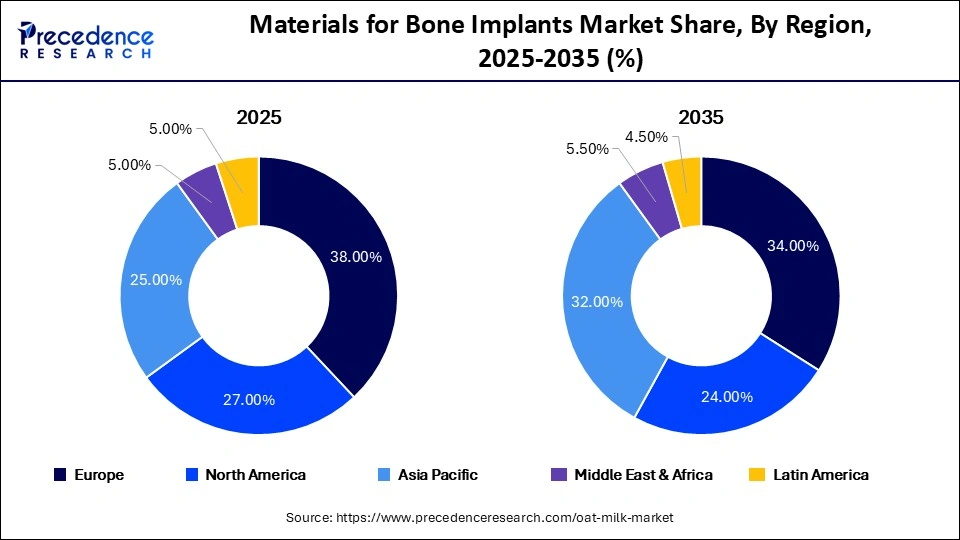
Europe represents a mature market driven by an aging population, rising prevalence of musculoskeletal disorders, and favorable healthcare reimbursement systems. The region is also at the forefront of biomaterials innovation and sustainable medical device development.
Asia Pacific is expected to witness the fastest growth during the forecast period. Rapid urbanization, improving healthcare access, increasing healthcare expenditure, and growing awareness of advanced orthopedic treatments are driving regional demand. Countries such as China, India, Japan, and South Korea are emerging as important markets for implant technologies.
The market in Latin America is expanding due to improvements in healthcare infrastructure, growing medical tourism activities, and increasing adoption of advanced orthopedic procedures.
The Middle East & Africa region is experiencing gradual growth supported by healthcare modernization initiatives, rising investments in medical facilities, and increasing demand for orthopedic treatments among aging populations.
Conclusion
The Materials for Bone Implants Market is entering a new phase of innovation driven by advanced biomaterials, artificial intelligence, regenerative medicine, and additive manufacturing technologies. As healthcare providers seek solutions that improve patient outcomes, reduce recovery times, and enhance implant longevity, demand for next-generation bone implant materials is expected to accelerate. Continuous research into biodegradable, bioactive, and hybrid materials will further reshape the future of orthopedic and reconstructive care worldwide.
Materials for Bone Implants Market Key Players
- Stryker Corporation
- Zimmer Biomet Holdings, Inc.
- Medtronic plc
- Smith & Nephew plc
- DePuy Synthes (Johnson & Johnson)
- Globus Medical, Inc.
- NuVasive, Inc.
- B. Braun Melsungen AG
- Arthrex, Inc.
- LivaNova PLC
- Conmed Corporation
- Invibio Ltd.
- Orthofix Medical Inc.
- Amedica Corporation
- Cook Medical
Recent Developments
- In March 2026, at Georgetown, Styliani Alimperti, an associate professor of biochemistry and molecular and cellular biology in the School of Medicine, began developing 3D‑printed bone grafts made from natural materials to make implant procedures safer and more effective. It is based on natural materials and could significantly improve the safety and effectiveness of implants.
- In May 2026, a study reported that scientists had developed a new metal implant designed to support healing while slowly degrading inside the body. The implant is a hybrid structure that combines a strong titanium alloy framework with zinc, a metal that gradually dissolves over time. This design allows the implant to provide mechanical support during the healing process while steadily making room for new bones to grow.
Segment Covered in the Report
By Material Type
- Titanium & Titanium Alloys
- Commercially Pure Titanium
- Titanium 6Al-4V Alloy
- Stainless Steel
- 316L Stainless Steel
- Martensitic Stainless Steel
- Cobalt-Chromium Alloys
- Co-Cr-Mo Alloy
- Co-Cr Alloy
- Polyetheretherketone (PEEK)
- Reinforced PEEK
- Standard PEEK
- Ceramic-based Material
- Alumina
- Zirconia
- Biodegradable Polymer
- Polylactic Acid (PLA)
- Polyglycolic Acid (PGA)
By Implant Type
- Orthopedic Plates & Screws
- Locking Plates
- Non-locking Plates
- Cortical Screws
- Cancellous Screws
- Intramedullary Nail
- Titanium Nails
- Stainless Steel Nails
- Joint Prosthese
- Hip Prostheses
- Knee Prostheses
- Shoulder Prostheses
- Spinal Implants
- Rods
- Screws
- Interbody Cages
- Bone Cements & Fillers
- PMMA Cements
- Calcium Phosphate Cements
- Dental Implants
- Endosseous Implants
- Subperiosteal Implants
By End-user
- Hospitals
- Ambulatory Surgical Centers
- Orthopedic & Dental Clinics
- Research & Academic Institutes
By Region
- North America
- Latin America
- Europe
- Asia-pacific
- Middle and East Africa
Get Sample Link : https://www.precedenceresearch.com/sample/8438
Also Read : 1,5-Hexadiene Market

- Farm Management Software Market: Digital Agriculture Driving Smarter and More Sustainable Farming - July 9, 2026
- AI in CGT Manufacturing Market: Artificial Intelligence Accelerating the Future of Cell and Gene Therapy Production - July 9, 2026
- 3T MRI System Market: Advanced Imaging Technology Transforming Modern Diagnostics - July 9, 2026