
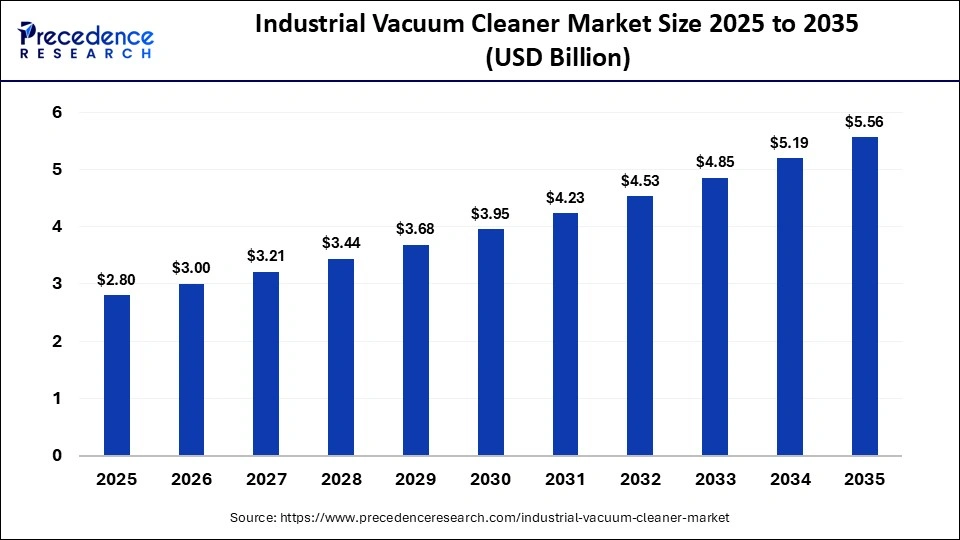
The global industrial vacuum cleaner market size was valued at USD 2.80 billion in 2025 and is projected to increase from USD 3.00 billion in 2026 to approximately USD 5.56 billion by 2035, expanding at a CAGR of 7.10% during the forecast period. The market is gaining momentum as industries increasingly prioritize worker safety, contamination control, and operational efficiency. Industrial vacuum cleaners are becoming indispensable in sectors such as manufacturing, automotive, food processing, pharmaceuticals, mining, and chemicals, where conventional cleaning methods are not sufficient.
Industrial vacuum cleaners are designed to remove hazardous dust, liquid spills, powders, and debris from industrial environments. These systems not only improve cleanliness but also help reduce worker exposure to harmful particles, extend machinery lifespan, and ensure compliance with environmental and occupational safety regulations. As industries continue to automate operations and adopt more sophisticated cleaning technologies, demand for industrial vacuum systems is expected to remain strong over the next decade.
Read Also: Network Diagnostic Tool Market
Quick Insights
- The industrial vacuum cleaner market was valued at USD 2.80 billion in 2025 and is projected to reach USD 5.56 billion by 2035.
- The market is expected to grow at a CAGR of 7.10% between 2026 and 2035.
- North America led the market with a 35% share in 2025.
- Asia Pacific is forecast to witness the fastest growth, expanding at a CAGR of 9% through 2035.
- Dry industrial vacuum cleaners dominated the market with a 50% share in 2025.
- Electric-powered industrial vacuum cleaners held a 75% share in 2025.
- Manufacturing and industrial plants represented 40% of total demand in 2025.
- Heavy industries accounted for 45% of the market in 2025.
Industrial Vacuum Cleaner Market Revenue Snapshot
| Metric | Value |
|---|---|
| Market Size in 2025 | USD 2.80 Billion |
| Market Size in 2026 | USD 3.00 Billion |
| Forecast Market Size in 2035 | USD 5.56 Billion |
| CAGR (2026-2035) | 7.10% |
| Largest Regional Market | North America |
| Fastest Growing Region | Asia Pacific |
How Is Artificial Intelligence Influencing the Industrial Vacuum Cleaner Market?
Artificial intelligence is gradually transforming industrial vacuum cleaner systems through predictive maintenance, smart monitoring, and automated cleaning capabilities. AI-powered sensors can detect dust concentrations, filter health, airflow efficiency, and equipment wear in real time. This allows operators to identify maintenance needs before failures occur, minimizing downtime and improving productivity.
The integration of AI with IoT infrastructure is also helping industrial facilities centralize cleaning operations. Facility managers can monitor performance remotely, optimize maintenance schedules, track equipment usage, and improve workplace safety. These smart cleaning technologies are increasingly becoming part of broader Industry 4.0 initiatives across manufacturing plants and warehouses.
What Are the Major Growth Drivers Supporting the Industrial Vacuum Cleaner Market?
The increasing focus on worker health and safety is one of the most important drivers of market growth. Industrial sites often generate dust, metal shavings, powders, and hazardous particles that can damage machinery and affect employee health. Industrial vacuum cleaners help companies maintain safer work environments and comply with stricter safety regulations.
Another major growth factor is the increasing adoption of automation in industrial cleaning. Manufacturing plants are moving toward automated systems to improve efficiency, reduce labor costs, and minimize contamination risks. This is especially important in industries such as pharmaceuticals, electronics, food processing, and chemicals, where cleanliness directly impacts product quality and regulatory compliance.
The rising popularity of cordless and battery-operated systems is also supporting market expansion. These systems provide greater flexibility and mobility, particularly in remote industrial sites, warehouses, and construction areas where access to power sources may be limited. Advanced filtration technologies such as HEPA and multi-stage filters are also helping industries improve air quality and comply with environmental standards.
Why Are Dry Industrial Vacuum Cleaners Dominating the Market?
Dry industrial vacuum cleaners led the market with a 50% share in 2025 due to their widespread use in dust-intensive industries such as manufacturing, cement, construction, mining, and metal processing. These systems are highly effective in removing dry debris, powders, and fine dust particles from industrial environments. Their strong suction power, durable filters, and large storage capacity make them well suited for harsh operating conditions.
Dry industrial vacuum cleaners are also becoming increasingly popular because they can be customized with explosion-proof and high-efficiency filtration systems. This makes them particularly useful in hazardous environments where combustible dust or volatile particles are common.
What Opportunities Are Emerging from Smart and Portable Cleaning Systems?
The rise of smart factories is creating new growth opportunities for industrial vacuum cleaner manufacturers. Industrial facilities are increasingly looking for cleaning systems that can integrate with digital platforms, production lines, and remote monitoring software. Smart industrial vacuum systems are becoming especially valuable in contamination-sensitive industries such as pharmaceuticals, food processing, and electronics.
Portable and battery-powered vacuum systems are also creating new opportunities. Businesses want flexible equipment capable of handling dry debris, liquid spills, and hard-to-reach cleaning areas. Industry trends indicate strong demand for cordless and mobile cleaning systems because they improve convenience and reduce dependency on fixed power infrastructure. Community discussions around vacuum technology also highlight growing interest in battery-powered platforms and advanced robotic cleaning solutions.
Which Product and Power Source Segments Are Leading the Market?
Dry industrial vacuum cleaners held a dominant 50% share in 2025 because of their extensive use across manufacturing, mining, and construction facilities. Wet industrial vacuum cleaners accounted for 30% of the market and remain important for handling liquid spills, sludge, and moist waste materials, particularly in food processing and beverage facilities. Combined wet-and-dry vacuum cleaners are expected to grow steadily because they offer more versatile cleaning capabilities.
Electric-powered industrial vacuum cleaners dominated the power source segment with a 75% share in 2025 because they offer high reliability, low maintenance, and strong performance across different industrial settings. Pneumatic-powered vacuum cleaners held a 25% share and are expected to grow at a CAGR of 8% due to their explosion-proof construction and suitability for hazardous environments.
Why Does Manufacturing Continue to Lead the Market?
Manufacturing and industrial plants accounted for 40% of the industrial vacuum cleaner market in 2025 because they require continuous dust removal, debris management, and equipment cleaning. Industrial vacuum systems help manufacturers extend equipment life, reduce maintenance costs, and prevent production disruptions caused by dust buildup.
The automotive segment held a 15% market share in 2025 and is expected to continue growing because vehicle manufacturing requires precise cleaning of machinery, paint booths, and vehicle components. Food processing is also emerging as one of the fastest-growing applications because of rising hygiene requirements and food safety standards. Industrial vacuum cleaners are widely used to clean packaging lines, food production areas, and storage facilities.
Why Is North America Leading the Global Market?
North America dominated the global industrial vacuum cleaner market with a 35% share in 2025 due to its strong industrial base, widespread adoption of advanced cleaning technologies, and strict workplace safety regulations. The region’s well-developed manufacturing, automotive, healthcare, hospitality, and retail sectors are driving strong demand for industrial cleaning systems.
The United States remains the largest country-level market because of strong demand across manufacturing, construction, retail, healthcare, and food processing industries. OSHA regulations and workplace safety standards are also encouraging industries to invest in modern cleaning equipment. Asia Pacific is expected to record the fastest growth because of rapid industrialization, infrastructure development, and increasing safety regulations in countries such as China and India.
What Are the Latest Innovations and Breakthroughs in the Market?
Manufacturers are increasingly focusing on cordless systems, battery-powered units, robotic vacuum cleaners, and advanced HEPA filtration technologies. Smart features such as IoT connectivity, predictive maintenance, automated start-stop functions, and remote monitoring are becoming more common in industrial cleaning systems.
The industry is also seeing greater adoption of multi-stage filtration systems and explosion-proof vacuum cleaners designed for hazardous environments. Leading manufacturers such as Nilfisk, Kärcher, Tennant Company, American Vacuum Company, and Tiger-Vac are expanding their product portfolios with more energy-efficient and intelligent cleaning solutions.
What Challenges Could Restrict Market Growth?
Despite its positive outlook, the industrial vacuum cleaner market faces several challenges. High upfront costs remain a key barrier, especially for small and medium-sized businesses. Advanced industrial vacuum systems often require specialized filters, explosion-proof designs, and durable materials, increasing ownership costs.
Maintenance costs and filter replacement expenses also remain major concerns for end users. Additionally, some industrial facilities are hesitant to adopt modern automated systems because of integration complexity and limited budgets. Rising raw material prices for steel, copper, and specialized components may also put pressure on manufacturer margins over the coming years.
Case Study: Food Processing Facilities Increase Adoption of HEPA Vacuum Systems
Food processing facilities are increasingly adopting industrial vacuum cleaners equipped with HEPA and multi-stage filtration systems to improve sanitation and comply with strict food safety regulations. These systems help remove dust, food particles, and liquid spills from production environments, reducing contamination risks and supporting higher hygiene standards. The growing demand for processed foods is expected to further boost the adoption of advanced industrial vacuum systems in the food and beverage sector.
Get Sample Link: https://www.precedenceresearch.com/sample/8314
For inquiries regarding discounts, bulk purchases, or customization requests, please contact us at [email protected]
