
Why Stabilize Chromium?
-
Chromium (Cr³⁺ and Cr⁶⁺) is a heavy metal widely found in industrial waste from leather tanning, electroplating, steel production, and chemical manufacturing.
-
While Cr³⁺ is less toxic than Cr⁶⁺, under certain environmental conditions it can oxidize into the highly toxic and carcinogenic hexavalent form (Cr⁶⁺).
-
To prevent this, scientists focus on immobilizing Cr³⁺ in forms that are chemically stable, water-insoluble, and resistant to environmental changes.
This is where phosphate cement comes in.
The Innovation: Iron-Slag-Derived Phosphate Cement
The study introduced a phosphate cement made from industrial byproduct—iron-rich slag (a waste material from steel production). Instead of disposing of slag, researchers used it to create a cement binder that can lock chromium inside its structure.
Process Overview
-
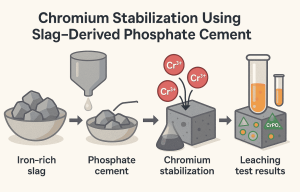
Raw Material: Iron-rich slag is combined with phosphoric acid to form phosphate cement.
-
Chromium Addition: Chromium in the form of Cr³⁺ is introduced during cement preparation.
-
Stabilization Mechanism:
-
Cr³⁺ reacts with phosphate ions, forming chromium phosphate (CrPO₄) crystals.
-
Some Cr³⁺ enters into co-precipitates with iron, creating mixed chromium–iron phosphate phases.
-
These phases are physically encapsulated in the dense cement matrix, making them resistant to leaching.
-
Download the Sample Copy of the Report: https://www.precedenceresearch.com/sample/6652
Key Findings from the Study
-
Formation of Stable Phases
-
X-ray diffraction (XRD) and electron microscopy showed the presence of crystalline CrPO₄ and mixed Fe–Cr–PO₄ compounds.
-
These structures are stable under environmental pH conditions.
-
-
Superior Immobilization Efficiency
-
Leaching tests (simulating acid rain and groundwater exposure) confirmed that >95% of chromium remained immobilized.
-
Chromium concentrations in leachates were below regulatory limits.
-
-
Synergy with Iron
-
The iron in slag plays a dual role:
-
It provides structural strength to the cement.
-
It participates in co-precipitation, strengthening chromium’s fixation.
-
-
-
Cost-Effectiveness & Sustainability
-
Since slag is an industrial waste, using it for cement is both economical and eco-friendly.
-
The process converts two waste streams (slag and chromium-contaminated residues) into a stable, safe material.
-
Why This Matters
-
Environmental Remediation: This approach can be applied in polluted soil, sludge, and wastewater treatment, especially in areas near steel plants and tanneries.
-
Circular Economy: Turns industrial byproducts into functional materials instead of landfill waste.
-
Long-Term Safety: Locks chromium in mineral-like structures, reducing the risk of future contamination.
Real-World Applications
-
Stabilization of chromium-rich sludge from electroplating factories.
-
Safe disposal of tannery waste containing Cr³⁺.
-
Cement-based solidification for contaminated construction materials.
-
Potential expansion to stabilize other heavy metals like lead, cadmium, and arsenic.
This study demonstrates a breakthrough in green remediation technologies. By leveraging slag-derived phosphate cement, chromium can be converted into stable chromium phosphate and iron–chromium phosphate co-precipitates, effectively immobilizing the metal and preventing its re-entry into the environment. The approach is low-cost, sustainable, and scalable, making it highly relevant for industries and governments tackling heavy metal pollution.
You can place an order or ask any questions, please feel free to contact us at [email protected] |+1 804 441 9344

- ESG Software Market 2025: Comprehensive Company Ecosystem and Revenue Overview - May 20, 2026
- ESG Software Market Surges Toward USD 31.96 Billion by 2035 as AI-Powered Compliance and Sustainability Reporting Transform Global Enterprises - May 20, 2026
- Hematopoietic Stem Cell Transplantation Market Surges Toward USD 24.32 Billion by 2035 as Precision Medicine and AI Reshape Blood Cancer Treatment - May 20, 2026