
What is the Artificial Intelligence (AI) Market Size in 2026?
The global artificial intelligence (AI) market size was USD 757.58 billion in 2025, calculated at USD 900.00 billion in 2026, and is expected to reach around USD 4,216.29 billion by 2035, expanding at a CAGR of 18.73% from 2026 to 2035.

Market Highlights
- North America accounted for the largest market share, at 36.92% in 2025.
- The Asia Pacific region is expected to grow at a notable CAGR of 19.8% from 2026 to 2035.
- By solution, the software segment held the biggest market share of 51.40% in 2025.
- By solution, the services segment is projected to expand at a significant CAGR of 18.30% from 2026 to 2035.
- By technology, the machine learning segment dominated the market with the largest share of 36.70% in 2025.
- By technology, the generative AI segment is expected to grow at a significant CAGR of 22.90% from 2026 to 2035.
- By function, the operations segment led the market with a major market share of 21.80% in 2026.
- By function, the cybersecurity segment is expected to grow at a significant CAGR of 20.40% over the projected period.
- By end-use, the BFSI segment led the market share of 19.60% in 2025.
- By end-use, the healthcare segment is expected to grow at a significant CAGR of 19.10% over the projected period.
Market Overview
The global Artificial Intelligence (AI) market is experiencing rapid expansion as organizations across industries increasingly integrate intelligent technologies into their operations, products, and customer experiences. Artificial intelligence refers to computer systems and software capable of performing tasks that traditionally require human intelligence, including decision-making, speech recognition, natural language processing, visual perception, predictive analytics, and problem-solving. AI technologies are being widely adopted across sectors such as healthcare, finance, retail, manufacturing, automotive, telecommunications, education, and cybersecurity to improve efficiency, automate workflows, and accelerate innovation. The growing availability of big data, advancements in cloud computing, and increasing computational power are significantly driving AI adoption worldwide.
The emergence of generative AI, multimodal AI, and agentic AI systems is transforming the market landscape by enabling more advanced automation and intelligent decision-making capabilities. Businesses are increasingly deploying AI-powered tools for customer service automation, content generation, fraud detection, predictive maintenance, software development, and enterprise analytics. Companies are also investing heavily in AI infrastructure, including GPUs, AI accelerators, cloud platforms, and data centers, to support large-scale AI model training and deployment. Major technology companies such as Microsoft, Google, NVIDIA, IBM, Amazon, and OpenAI continue to accelerate AI innovation through strategic partnerships, research initiatives, and infrastructure investments.
Artificial intelligence is also reshaping enterprise operations by enabling predictive analytics, intelligent automation, personalized user experiences, and real-time data-driven decision-making. AI-powered platforms are increasingly being used to optimize supply chains, automate industrial operations, enhance cybersecurity monitoring, and support smart manufacturing initiatives. The adoption of AI in edge computing, robotics, autonomous systems, and intelligent virtual assistants is further expanding the market’s growth potential. In addition, advancements in natural language processing and conversational AI are driving increased deployment of AI assistants and enterprise copilots across business environments.
Artificial Intelligence (AI) Market Growth Factors
The rapid expansion of digital technologies, cloud computing, and internet connectivity has played a major role in accelerating the growth of the global artificial intelligence (AI) market. Increasing investments by major technology companies in research and development activities are continuously driving innovation across multiple industries. The growing demand for AI-powered solutions in sectors such as automotive, healthcare, banking and finance, manufacturing, retail, logistics, and food & beverages is expected to further strengthen market growth in the coming years. As businesses continue prioritizing automation and data-driven decision-making, AI technologies are becoming an essential component of modern enterprise operations.
The rising adoption of advanced medical technologies and autonomous vehicle features is also contributing significantly to market expansion. AI-powered healthcare systems are improving diagnostics, patient monitoring, robotic surgeries, and personalized treatment solutions, while the automotive sector is increasingly integrating AI into self-driving systems, intelligent navigation, and driver-assistance technologies. In addition, the global shift toward digital transformation and smart infrastructure development is positively influencing the adoption of artificial intelligence across both developed and emerging economies.
Leading technology companies such as Google, Microsoft, IBM, Amazon, and Apple are significantly increasing their investments in AI infrastructure, software platforms, and next-generation intelligent applications. Their continued focus on expanding access to AI tools, cloud-based AI services, and generative AI technologies is expected to create substantial growth opportunities for the global market during the forecast period.
Government support and national digitalization initiatives are further accelerating AI adoption worldwide. Several countries are investing heavily in artificial intelligence research, innovation ecosystems, and smart technology programs to strengthen economic growth and technological competitiveness. For example, the Government of India increased investments under its Digital India initiative to support the development of AI, machine learning, robotics, cybersecurity, big data, and Internet of Things (IoT) technologies. Such favorable government policies and funding initiatives are expected to positively impact long-term industry growth.
The banking, financial services, and insurance (BFSI) sector is anticipated to witness strong AI adoption due to increasing applications in fraud detection, cybersecurity, risk assessment, customer analytics, and automated financial services. Organizations across industries are integrating artificial intelligence into their business processes to improve operational efficiency, reduce costs, and enhance customer experiences. The growing adoption of AI technologies is also encouraging startups and new market entrants to develop specialized AI-based products and niche application solutions. Additionally, strategic partnerships, mergers, acquisitions, and industry collaborations are becoming increasingly common as companies seek to strengthen their market position and gain competitive advantages in the rapidly evolving AI ecosystem.
Market Scope
| Report Coverage | Details |
| Market Size in 2025 | USD 757.58 Billion |
| Market Size in 2026 | USD 900.00 Billion |
| Market Size by 2035 | USD 4,216.29 Billion |
| Growth Rate from 2026 to 2035 | CAGR of 18.73% |
| Base Year | 2025 |
| Forecast Period | 2026 to 2035 |
| Segments Covered | Technology, Solution, End Use, and Regions |
| Regions Covered | North America, Asia Pacific, Europe, Latin America, Middle East and Africa |
Market Dynamics
Drivers
Rising implementation from the finance sector
The global finance sector is witnessing a major shift with the rapid acceptance of artificial intelligence technology. The rising implementation of artificial intelligence in the finance sector is transforming industry in several ways. Artificial intelligence is being used for algorithmic trading, fraud detection and credit risk assessment. It enables quicker and more accurate data analysis, leading to better investment decisions along with risk management. AI carries the ability to process large amounts of data and also aids in identifying patterns and trends that human agents might miss. Overall, artificial intelligence is enhancing operational efficiency, reducing costs and improving customer experience in the finance sector.
Restraint
Transparency in decision making
Artificial intelligence models and algorithms are generally complex. The complex nature of models makes it difficult to understand the process of decision making. Artificial intelligence-based solutions often generate outcomes that come up with black box nature, this can lead to lack of trust and accountability. This is particularly concerning in critical areas such as finance and healthcare. These industries or end users have a delicate need for transparency in order to protect the proprietary. Thus, transparency issues in decision making hamper the growth of the market.
Opportunity
Rising acceptance from research scientists
Research scientists are increasingly embracing artificial intelligence technology due to its transformative capabilities. This trend is expected to be continued in the upcoming years while offering an opportunity for the artificial intelligence market to expand. Technology accelerates data analysis, identifies patterns and aids in complex stimulations, enabling breakthroughs across diverse sectors. Ai-powered tools streamline repetitive tasks, liberating scientists to focus on innovation. In many fields, research scientists have started appreciating the importance and potential of AI to predict outcomes, discover hidden insights and optimize experiments. Overall, the scientific community recognizes AIs role in amplifying research efficiency and driving new discoveries, leading to a more symbiotic relationship between technology and human expertise.
Regional Insights
North America remains one of the most advanced and influential regions in the global artificial intelligence market due to the strong presence of leading technology companies, advanced digital infrastructure, and high investments in AI research and development. The United States continues to drive regional growth through widespread AI adoption across healthcare, finance, retail, cybersecurity, manufacturing, and autonomous vehicle technologies. Enterprises across the region are increasingly integrating generative AI, machine learning, and cloud-based AI platforms to improve operational efficiency and business automation. Rising investments in AI data centers, semiconductor technologies, and enterprise AI applications are further strengthening the market across North America.
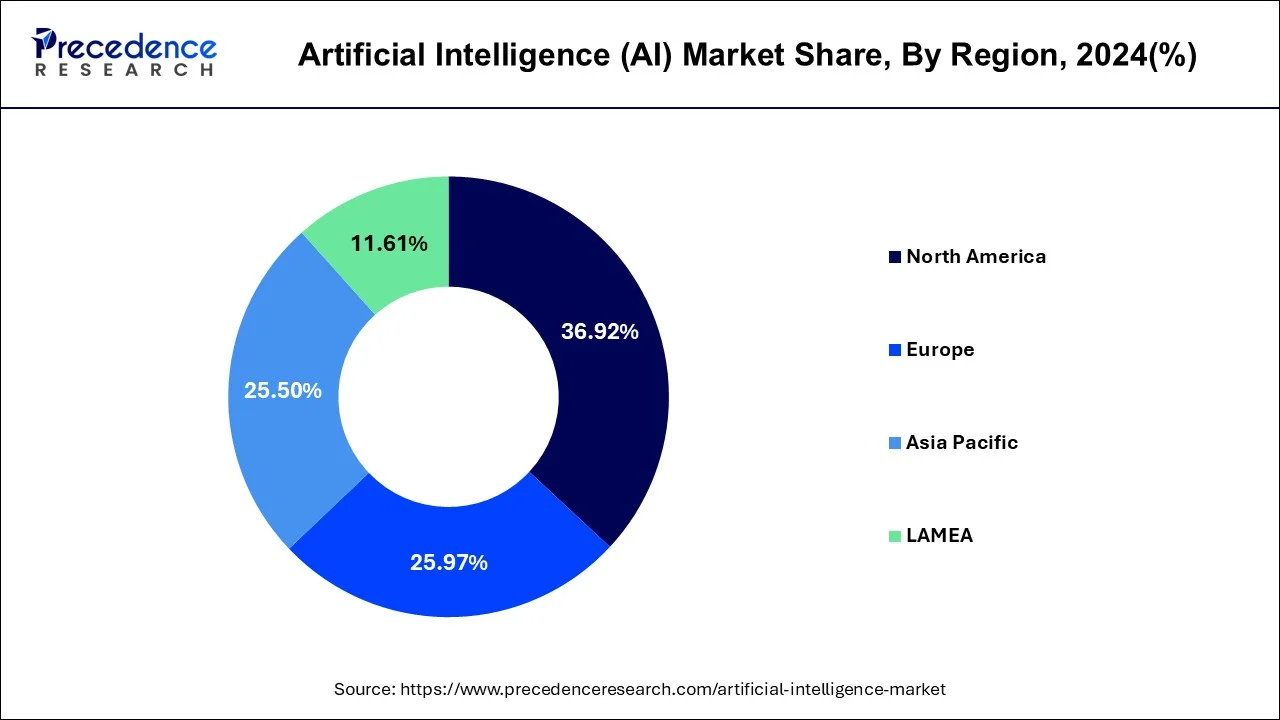
Europe is experiencing steady growth in the artificial intelligence market, supported by increasing digital transformation initiatives, industrial automation, and government-backed AI development programs. Countries such as Germany, the United Kingdom, France, and the Netherlands are investing heavily in AI innovation across manufacturing, automotive, healthcare, and financial services industries. The region is also focusing strongly on ethical AI development, regulatory compliance, and data privacy frameworks to promote responsible AI adoption. Growing deployment of AI-powered analytics, smart manufacturing solutions, and enterprise automation tools is contributing to market expansion throughout Europe.
Asia Pacific is emerging as one of the fastest-growing regions in the artificial intelligence market due to rapid industrialization, increasing internet penetration, expanding cloud infrastructure, and rising investments in digital technologies. Countries including China, India, Japan, South Korea, and Singapore are aggressively investing in AI research, smart city initiatives, robotics, and intelligent manufacturing systems. The growing adoption of AI-powered applications in e-commerce, healthcare, telecommunications, automotive, and fintech sectors is accelerating regional market growth. In addition, government support for AI innovation and the increasing presence of startups and technology hubs are creating strong growth opportunities across Asia Pacific.
Latin America is witnessing growing adoption of artificial intelligence technologies as businesses and governments increasingly focus on digital modernization and automation strategies. Countries such as Brazil, Mexico, Chile, and Colombia are integrating AI solutions into banking, retail, customer service, logistics, and public sector operations to improve efficiency and enhance decision-making capabilities. The increasing use of AI-powered analytics, chatbots, and cybersecurity solutions is supporting market development across the region. Expanding internet connectivity and rising cloud adoption are also contributing to the growth of AI applications in Latin America.
The Middle East & Africa region is experiencing increasing demand for artificial intelligence solutions due to rapid digital transformation initiatives, smart city development programs, and growing investments in emerging technologies. Countries such as the UAE, Saudi Arabia, South Africa, and Israel are actively promoting AI adoption across healthcare, finance, energy, transportation, and government services. The expansion of cloud computing infrastructure, rising deployment of intelligent automation systems, and increasing focus on economic diversification are further driving AI market growth across the region. Additionally, governments are launching national AI strategies and innovation programs to strengthen regional technological competitiveness and attract global technology investments.
Artificial Intelligence (AI) Market Companies
- Intel Corporation
- Microsoft
- IBM
- Amazon Web Services
- Baidu, Inc.
- NVIDIA Corporation
- H2O.ai.
- Lifegraph
- Sensely, Inc.
- Enlitic, Inc.
- AiCure
- HyperVerge, Inc.
- Arm Limited
- Clarifai, Inc.
Recent Developments
- In May 2025, to support AI and the 5G network in the state, new infrastructure is being developed as per the announcement made by Manik Saha, Tripura’s chief minister. Enhanced efficiency, speed, and cost savings can be achieved with the help of AI as it reduces operational complexity with the use of algorithms, similarly the information can be transferred quickly with 5G network, which was further highlighted.
- In May 2025, in targeted government projects and the detection of IAS officers for domain-specific postings, the use of AI was suggested by Union Minister Jitendra Singh. During the launch event of an e-book that is, electronic civil list, which is a digital compendium of serving Indian Administrative Service (IAS) officers throughout the country, the suggestion of the minister for the use of AI was highlighted.
Get Sample Link: https://www.precedenceresearch.com/sample/1635
Also Read Our Latest Post : Project and Portfolio Management Software Market

- Farm Management Software Market: Digital Agriculture Driving Smarter and More Sustainable Farming - July 9, 2026
- AI in CGT Manufacturing Market: Artificial Intelligence Accelerating the Future of Cell and Gene Therapy Production - July 9, 2026
- 3T MRI System Market: Advanced Imaging Technology Transforming Modern Diagnostics - July 9, 2026