
What is the AI in Omics Studies Market Size in 2026?
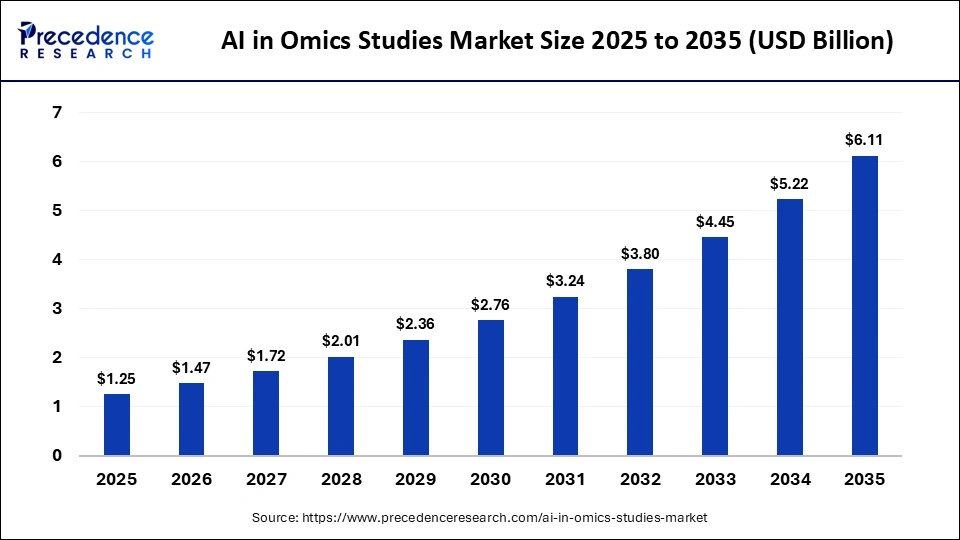
The global AI in omics studies market size accounted for USD 1.25 billion in 2025 and is predicted to increase from USD 1.47 billion in 2026 to approximately USD 6.11 billion by 2035, expanding at a CAGR of 17.20% from 2026 to 2035. The market is rapidly growing due to the increasing demand for precision medicine, accelerated drug development to combat rare disease burden, rapid AI adoption by the healthcare industry, and advancements in AI technologies.
Key Takeaways
- North America held the largest market share of 42% in 2025.
- The Asia Pacific is expected to grow at the fastest CAGR of 19.5% between 2026 and 2035.
- By omics type, the genomics segment dominated the market with a 40% share in 2025.
- By omics type, the proteomics segment is the second-largest shareholder and is expected to grow at a significant CAGR of 17.5% between 2026 and 2035.
- By component, the software segment dominated the market with a 55% share in 2025.
- By component, the services segment is the second-largest shareholder and is expected to grow at a significant CAGR of 16.5% between 2026 and 2035.
- By application, the drug discovery segment dominated the market with a 35% share in 2025.
- By application, the precision medicine segment is the second-largest shareholder and is expected to grow at the fastest CAGR of 18.5% between 2026 and 2035.
- By end use, the pharmaceutical & biotechnology companies segment dominated the market with a 50% share in 2025.
- By end use, the research institute segment is the second-largest shareholder and is expected to grow at a significant CAGR of 17.5% between 2026 and 2035.
Market Overview
AI in omics studies focuses on using advanced technologies to analyze large and complex biological data, such as genomics, transcriptomics, proteomics, and metabolomics. These datasets help researchers understand how genes, proteins, and other biological factors interact in the human body. The goal is to identify important patterns that can support faster biomarker discovery and enable personalized medicine.
Artificial Intelligence, especially Machine Learning (ML) and Deep Learning (DL), plays a key role in this process. ML is widely used to manage and analyze diverse and complex datasets, while DL is more effective in areas like drug discovery, disease classification, and understanding biological mechanisms. By combining multiple layers of biological data—such as DNA mutations, RNA expression, and protein activity AI provides a more complete view of diseases. This helps researchers develop more targeted treatments and improve drug development.
The AI in omics studies market is growing rapidly due to several factors. The increasing availability of big data in the biotechnology sector, rising demand for personalized healthcare, and the growing use of AI in advanced fields like spatial biology are major drivers. There is also a shift from traditional data analysis methods to more predictive and advanced modeling approaches. This change is helping researchers gain deeper insights and develop more accurate, data-driven solutions for disease treatment and drug discovery.
AI in Omics Studies Market Trends
One of the key trends in this market is the development of AI systems that can analyze multiple layers of disease-related data and suggest approved drugs that target those specific conditions. This approach helps speed up the treatment process, especially for rare and complex diseases.
Another important trend is the improvement in how AI models are trained. Instead of focusing only on statistical patterns, these models are now designed to identify biologically meaningful connections. This ensures that the results are not just accurate but also relevant from a scientific perspective.
There is also a growing shift in the biotech industry from “black box” AI systems, where results are hard to interpret, to more transparent “glass box” models. Researchers are increasingly using Explainable AI (XAI) to clearly show how AI arrives at its conclusions. This improves trust, supports clinical decision-making, and helps meet regulatory requirements.
Market Scope
| Report Coverage | Details |
| Market Size in 2025 | USD 1.25 Billion |
| Market Size in 2026 | USD 1.47 Billion |
| Market Size by 2035 | USD 6.11 Billion |
| Market Growth Rate from 2026 to 2035 | CAGR of 17.20% |
| Dominating Region | North America |
| Fastest Growing Region | Asia Pacific |
| Base Year | 2025 |
| Forecast Period | 2026 to 2035 |
| Segments Covered | Omics Type, Omics Type, Application, End-Use, and Region |
| Regions Covered | North America, Europe, Asia-Pacific, Latin America, and Middle East & Africa |
Market Dynamics
Drivers
Growing Demand for Precision Medicine
A major factor driving the AI in omics studies market is the increasing demand for personalized medications, which tailors treatments to individuals based on their unique medical history, rather than relying on a one-size-fits-all approach. Traditional statistical methods, which have been used for years, are incapable of analyzing high-dimensional data and the complexities of real-time decision-making. AI models, such as ML DL, play a crucial role in processing large datasets and identifying disease-related biomarkers, enabling the shift toward hyper-personalized medical treatments that are more effective and precise.
Restraint
Lack of Standardization
The market is witnessing a barrier due to the inability to easily analyze and integrate data produced by various labs, technologies, and data heterogeneity. AI models like deep learning need clean, well-annotated, and structured data to effectively train and deliver reliable results, especially when exposed to different data types. However, the lack of standardization slows down the AI adoption in clinical settings, as the performance of models may vary significantly depending on the specific conditions and datasets they encounter.
Opportunity
Unify Multiple Omics Layers
The AI in omics studies market is witnessing a significant opportunity as AI has the ability to unify and analyze multiple layers of data at the same time, providing a comprehensive view of biological systems. AI tools like Graph Neural Networks, generative AI , and deep learning can merge various datasets to offer a system-level understanding of disease that would not be fully possible with single-comics studies. This creates a massive opportunity for uncovering the true causes of complex diseases like sepsis or cancer, where traditional approaches may fall short in identifying underlying mechanisms.
Regional Insights
North America dominates the AI in omics studies market due to its strong biotechnology ecosystem and early adoption of advanced technologies. The region has a high concentration of research institutions, pharmaceutical companies, and AI startups actively working on genomics and precision medicine. Government support, funding for life sciences research, and the availability of large healthcare datasets are further accelerating the use of AI in omics studies. The growing focus on personalized medicine and drug discovery is also driving demand in this region.
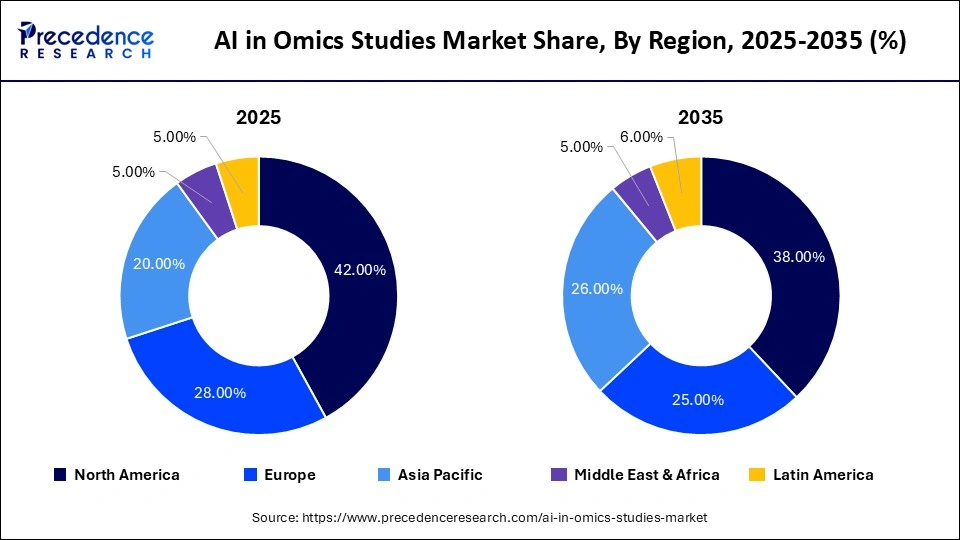
Europe is steadily expanding in the AI in omics market, supported by strong research infrastructure and collaborative projects across countries. Governments and research organizations are investing in genomics programs and digital healthcare initiatives. The region also emphasizes ethical AI use and data privacy, which is shaping the development of more transparent and reliable AI solutions. Increasing partnerships between biotech firms and academic institutions are further contributing to market growth.
Asia-Pacific is witnessing rapid growth, driven by increasing investments in biotechnology and artificial intelligence. Countries like China, Japan, and India are focusing on expanding their genomics research capabilities and adopting AI for healthcare innovation. Rising healthcare demand, a large patient population, and government initiatives to support digital health and precision medicine are key growth drivers. The region is also emerging as a hub for clinical research and data generation, which supports AI-driven omics studies.
Latin America is gradually adopting AI in omics studies, with growing interest in improving healthcare systems and research capabilities. While the market is still developing, increasing investments in biotechnology and collaborations with global research organizations are helping drive progress. The need for better disease diagnosis and treatment solutions is encouraging the use of AI-driven approaches in omics research.
Middle East & Africa is an emerging market, supported by growing awareness of advanced healthcare technologies and government efforts to modernize healthcare infrastructure. Some countries in the Middle East are investing in genomics and precision medicine initiatives, while parts of Africa are beginning to explore AI applications in healthcare research. The demand for innovative and cost-effective healthcare solutions is expected to support future growth in this region.
AI in Omics Studies Market Key Players
- Illumina, Inc.
- Thermo Fisher Scientific Inc.
- QIAGEN N.V.
- Agilent Technologies, Inc.
- NVIDIA Corporation
- IBM Corporation
- Microsoft Corporation
- Google (Alphabet Inc.)
- Benevolent AI
- Insilico Medicine
- Deep Genomics
- SOPHiA GENETICS
- DNAnexus, Inc.
- Tempus Labs, Inc.
- Genedata AG
Recent Developments
- In January 2026, FAU’s College of Engineering and Computer Science introduced the Center for Omics Technologies and Data Engineering. This research hub is particularly established to develop scalable and interpretable computational methods to extract insights from biological and environmental data. It is vital for biological and biomedical discovery.
- In September 2025, Mayo Clinic announced that it is moving from diagnosis to personalized treatment for children by integrating rapid whole-genome sequencing, AI, and functional omics with the new BabyFORce program launch.
Segments Covered in the Report
By Omics Type
- Genomics
- Proteomics
- Transcriptomics
- Metabolomics
Others
By Component
- Software
- Services
- Hardware
By Application
- Drug Discovery
- Precision Medicine
- Biomarker Discovery
- Clinical Diagnostics
- Others
By End-Use
- Pharmaceutical & Biotechnology Companies
- Research Institutes
- Hospitals & Clinics
- Others
By Region
- North America
- Latin America
- Europe
- Asia-pacific
- Middle and East Africa
Get Sample Link: https://www.precedenceresearch.com/sample/8296
Also Read Our Latest Report: https://www.businesswebwire.com/5g-customer-premises-equipment-market/

- Farm Management Software Market: Digital Agriculture Driving Smarter and More Sustainable Farming - July 9, 2026
- AI in CGT Manufacturing Market: Artificial Intelligence Accelerating the Future of Cell and Gene Therapy Production - July 9, 2026
- 3T MRI System Market: Advanced Imaging Technology Transforming Modern Diagnostics - July 9, 2026