
Driven by Surging Demand for Emotional Support and Personalized Interactions at 31% CAGR
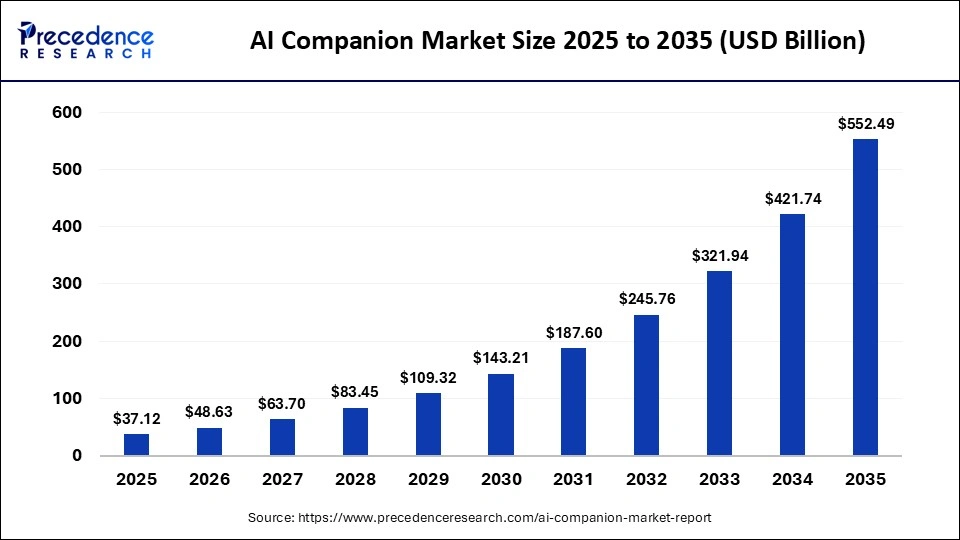
The global AI companion market reached USD 37.12 billion in 2025 and projects explosive growth to USD 552.49 billion by 2035, fueled by a robust CAGR of 31.00% from 2026 to 2035. Loneliness epidemics, mental health crises, and tech advancements in multimodal AI drive this surge, positioning companions as essential for social interaction and productivity.
Key Insights
- North America dominates with a 33.96% market share in 2025, boasting USD 12.61 billion valuation.
- Text-based AI companions lead by type at 44% share, while the consumer vertical captures 38% overall.
- Asia Pacific emerges as the fastest-growing region, propelled by AI innovation hubs in China and Japan.
- Social interaction applications hold the top spot, addressing isolation amid rising mental health needs.
AI Companion Market Scope Overview
| Report Coverage | Details |
|---|---|
| Market Size in 2025 | USD 37.12 Billion |
| Market Size in 2026 | USD 48.63 Billion |
| Market Size by 2035 | USD 552.49 Billion |
| CAGR 2026-2035 | 31.00% |
| Largest Region | North America |
| Fastest Region | Asia Pacific |
Artificial intelligence forms the backbone of AI companions, leveraging natural language processing, reinforcement learning, and neural networks for human-like conversations and emotional modeling. These systems adapt to user behavior, process multimodal inputs like voice and images, and deliver context-aware responses, bridging gaps in human connectivity.
Advancements in generative AI and agentic systems enable longitudinal learning, where companions evolve with users for personalized coaching and behavioral nudges. Cloud computing and computer vision further enhance scalability and immersion, making AI indispensable for mental health and daily assistance.
What Fuels AI Companion Market Growth?
Rising loneliness and mental health issues worldwide propel demand, as AI companions offer 24/7 judgment-free support via platforms like Replika. Smartphone penetration and smart device integration accelerate adoption, especially in tech-savvy regions. Investors like SoftBank Vision Fund and Google pour funds into startups, fostering innovation in emotional AI.
What Opportunities and Trends Shape the Future?
Multi-modal AI companions surge with voice, gesture, and visual integration for richer interactions, outpacing text-based models. Sustainability trends emphasize ethical AI, energy-efficient hardware like TPUs, and eco-friendly deployment. Businesses leverage companions for task automation, yielding high ROI in sectors like retail and healthcare.
AI Companion Market Regional Dynamics
North America leads with USD 12.61 billion in 2025, driven by OpenAI, Microsoft innovations, and 68 FCC-approved AI devices. The U.S. alone hits USD 8.70 billion, with Replika’s 30 million users.
Asia Pacific races ahead at 31.02% CAGR to USD 131.85 billion, fueled by China’s rapid launches and Grok’s ANI.
Europe grows to USD 137.24 billion via EU AI Act compliance and DFKI’s ethical frameworks in Germany.
Middle East & Africa advances with Saudi Arabia’s 1GW AI infrastructure and Humain’s Arabic model Allam.
AI Companion Market Segmentation
Type Insights
Text-Based AI Companions:
The text-based AI companions segment accounted for the largest market share in 2025, driven by its high accessibility, ease of use, and broad device compatibility. Text interfaces enable continuous 24/7 engagement while supporting deep personalization, long-term context retention, and consistent conversational accuracy. These companions are particularly effective at fostering anthropomorphic connections, facilitating casual conversations, and providing task management, reminders, and productivity guidance without requiring specialized hardware or high bandwidth. Their reliability and scalability make them the preferred choice for mass adoption.
Multi-Modal AI Companions:
The multi-modal AI companions segment is expected to register the fastest CAGR over the forecast period. Growth is fueled by the ability to integrate multiple interaction formats—including text, voice, visual inputs, gesture recognition, and behavioral signals—enabling richer, context-aware user experiences. By combining speech patterns, facial cues, and visual data with linguistic analysis, multi-modal companions deliver more emotionally responsive and situationally adaptive interactions. For instance, computer vision can assess facial expressions or posture to adjust tone, while text analysis captures mood and intent, resulting in more natural and human-like engagement.
Application Insights
Social Interaction and Companionship:
The social interaction and companionship segment held the largest market share in 2025, driven by increasing global concerns around loneliness, social isolation, and emotional well-being. Companion-based AI applications provide consistent, judgment-free interaction, making them particularly appealing for users seeking emotional support. Many platforms now integrate cognitive behavioral therapy (CBT) techniques, enabling personalized emotional guidance and coping strategies without the barriers associated with traditional mental health services.
Mental Health Support:
The mental health support segment is projected to grow at the fastest CAGR over the forecast period. Rising mental health challenges linked to modern lifestyles, digital fatigue, and social disconnection are accelerating adoption. Additionally, persistent stigma around seeking professional mental health care is prompting users to turn to AI companions as accessible mental health coaches that offer personalized, private, and continuous support.
Industry Vertical Insights
Consumer:
The consumer segment dominated the AI companion market in 2025, driven by strong demand for personalized and emotionally intelligent digital companions. AI companions help address a broad range of social and emotional challenges, including chronic loneliness, anxiety, depression, and reduced social confidence. Users increasingly value secure, adaptive, and non-judgmental interactions that align with their emotional states and daily routines. Features such as structured reflection, habit formation, routine reminders, conversation practice, and emotional regulation tools have made AI companions highly attractive as stigma-free, on-demand support solutions.
Businesses:
The business segment is expected to grow at a strong CAGR during the forecast period, driven by the high return on investment offered by AI companions in enterprise environments. Businesses deploy AI companions to automate repetitive tasks, streamline workflows, and enhance employee productivity, allowing teams to focus on strategic and complex initiatives that require human judgment. Unlike general AI applications, enterprise AI companions are purpose-built for specific operational needs, making them easier to train, deploy, and scale across business functions.
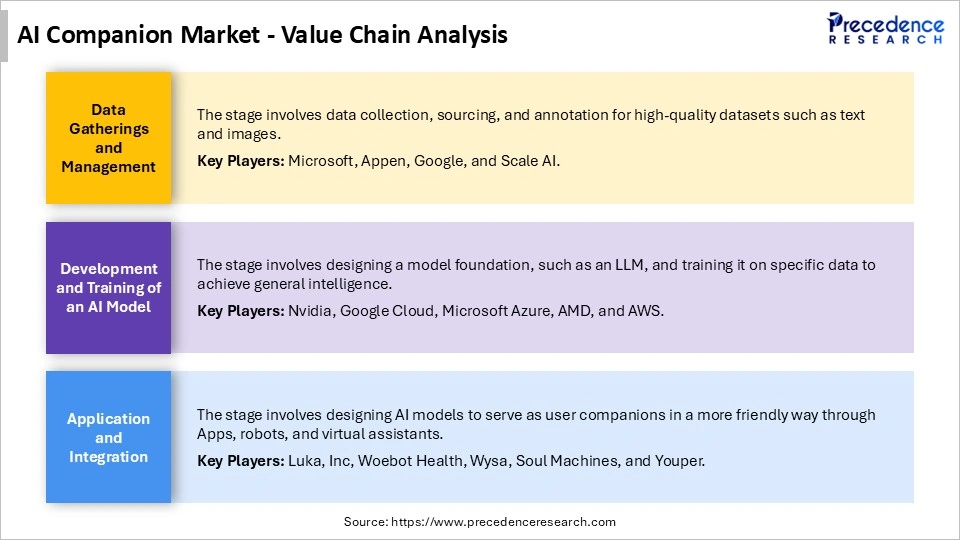
AI Companion Market Value Chain
AI Companion Market Companies
- Nomi AI, Inc.
- Google LLC
- Luka, Inc.
- Soul Machines
- International Business Machines Corporation
- Character.AI, Inc.
- Zoom Video Communications, Inc.
- KNIME
- Amazon.com, Inc.
- OpenAI, LP
Segments Covered in the Report
By Type
- Text-based AI Companions
- Voice-based AI Companions
- Multi-modal AI Companions
By Application
- Mental Health Support
- Social Interaction and Companionship
- Education and Learning Aid
- Personal Assistance
By Industry Vertical
- Consumer
- Businesses
- Healthcare
- Education
- Others
By Region
- North America
- Europe
- Asia-Pacific
- Latin America
- Middle East and Africa
Get this report to explore global market size, share, CAGR, and trends, featuring detailed segmental analysis and an insightful competitive landscape overview @ https://www.precedenceresearch.com/sample/7244
You can place an order or ask any questions, please feel free to contact us at [email protected] |+1 804 441 9344

- ESG Software Market 2025: Comprehensive Company Ecosystem and Revenue Overview - May 20, 2026
- ESG Software Market Surges Toward USD 31.96 Billion by 2035 as AI-Powered Compliance and Sustainability Reporting Transform Global Enterprises - May 20, 2026
- Hematopoietic Stem Cell Transplantation Market Surges Toward USD 24.32 Billion by 2035 as Precision Medicine and AI Reshape Blood Cancer Treatment - May 20, 2026