
The healthcare industry is entering a new era where advanced therapies are transforming the treatment of complex and life-threatening diseases. Cell and gene therapies (CGTs) have emerged as groundbreaking treatment approaches, offering the potential to address genetic disorders, cancers, and rare diseases at their source. However, manufacturing these therapies is highly complex, requiring precision, consistency, and strict quality control. This is where artificial intelligence (AI) is making a significant impact.
The AI in CGT Manufacturing Market is gaining momentum as pharmaceutical companies, biotechnology firms, and contract manufacturing organizations increasingly adopt AI-powered technologies to improve production efficiency, optimize manufacturing processes, and ensure product quality. From predictive analytics and intelligent automation to real-time process monitoring, AI is helping manufacturers overcome production challenges while accelerating the commercialization of advanced therapies.
AI in CGT Manufacturing Market Size and Forecast 2026 to 2035
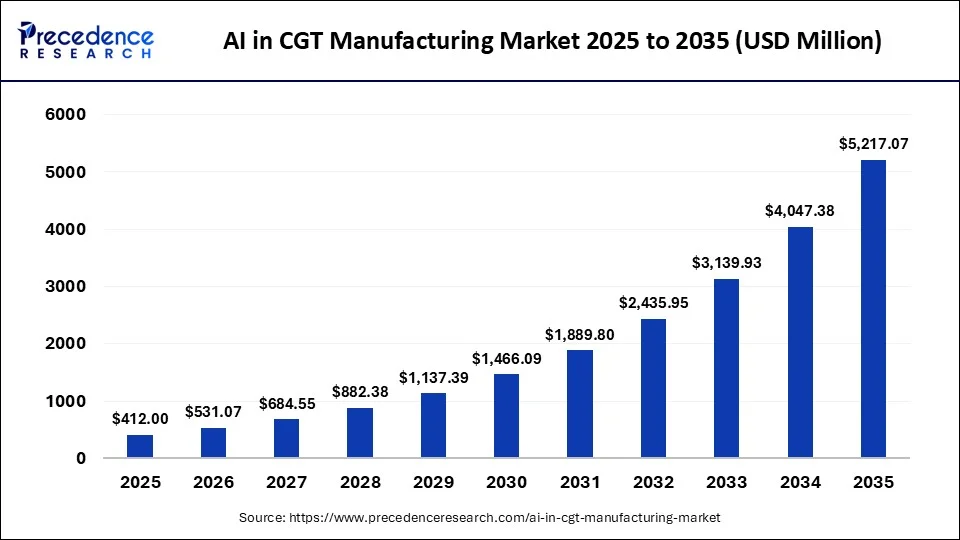
The global AI in CGT manufacturing market size accounted for USD 412.00 million in 2025 and is predicted to increase from USD 531.07 million in 2026 to approximately USD 5,217.07 million by 2035, expanding at a CAGR of 28.90% from 2026 to 2035. Market growth is attributed to the increasing commercialization of cell and gene therapies and growing investments in AI-driven process optimization across advanced therapy production facilities.
Market Highlights
- North America dominated the AI in CGT manufacturing market with 44% of the market share in 2025.
- Asia-Pacific is expected to register the fastest growth of 34.6% CAGR during 2026 and 2035.
- By component, the software segment contributed the highest market share of 72% in 2025.
- By component, the service segment is expected to grow at a rapid CAGR of 30.8% between 2026 and 2035.
- By deployment mode, the cloud-based segment held a major market share of 51% in 2025 and is expected to register the fastest growth of 31.8% CAGR during 2026 and 2035.
- By deployment mode, the on-premises segment held the second-largest market share with a 34% share in 2025.
- By technology, the machine learning (ML) segment contributed the highest AI in CGT manufacturing market share of 34% in 2025.
- By technology, the generative AI segment is estimated to grow at a strong CAGR of 35.8% over the projected period.
- By manufacturing stage, the cell expansion segment contributed the highest market share of 21% in 2025.
- By manufacturing stage, the gene editing and vector production segment is expected to grow at the fastest CAGR of 31.5% between 2026 and 2035.
- By therapy type, the cell therapy segment contributed the highest market share of 62% in 2025.
- By therapy type, the gene therapy segment is expected to grow at the fastest CAGR of 30.1% between 2026 and 2035.
- By end user, the biopharmaceutical companies segment held a major market share of 46% in 2025.
- By end user, the contract development and manufacturing organizations (CDMOs) segment is expected to register the fastest growth of 32.4% CAGR during 2026 and 2035.
Understanding AI in CGT Manufacturing
Cell and gene therapy manufacturing involves multiple complex stages, including cell isolation, genetic modification, cell expansion, purification, quality testing, and final product release. Each stage generates vast amounts of process data that must be analyzed to maintain product consistency and regulatory compliance.
Artificial intelligence enables manufacturers to analyze this data in real time, identify production trends, predict equipment failures, optimize manufacturing parameters, and reduce process variability. Instead of relying solely on manual monitoring, manufacturers can use AI-driven systems to make faster and more informed decisions throughout the production cycle.
By integrating AI into manufacturing operations, companies can improve productivity, minimize production delays, and increase the success rate of highly valuable cell and gene therapy products.
Why Is the AI in CGT Manufacturing Market Growing?
Several factors are driving the rapid adoption of AI across CGT manufacturing facilities.
One of the primary growth drivers is the increasing number of cell and gene therapies entering clinical development. As more therapies progress toward commercialization, manufacturers require scalable and efficient production systems capable of meeting growing demand while maintaining product quality.
Manufacturing complexity is another important factor. Unlike conventional pharmaceutical products, cell and gene therapies often involve patient-specific materials, making every production batch unique. AI helps manage this complexity by continuously monitoring production variables and recommending process adjustments in real time.
Growing investments in digital biomanufacturing are also supporting market growth. Pharmaceutical companies are increasingly modernizing manufacturing facilities with smart sensors, robotics, cloud computing, and AI-based analytics platforms to improve operational efficiency.
Regulatory agencies are encouraging greater process transparency and quality assurance, prompting manufacturers to adopt advanced digital technologies that support data integrity and continuous process verification.
How Is Artificial Intelligence Transforming CGT Manufacturing?
Artificial intelligence is becoming an essential component of next-generation biomanufacturing.
Machine learning algorithms analyze large volumes of manufacturing data to identify patterns that would be difficult for humans to detect. These insights help manufacturers optimize cell culture conditions, improve yield, and reduce production variability.
Predictive analytics enables companies to forecast equipment maintenance requirements before failures occur, minimizing costly production interruptions and reducing downtime.
AI-powered computer vision systems automate quality inspections by identifying abnormalities in cell morphology, culture conditions, and manufacturing equipment. These systems improve inspection accuracy while reducing manual labor.
Digital twins are another emerging innovation. By creating virtual models of manufacturing processes, companies can simulate production scenarios, evaluate process changes, and optimize manufacturing strategies before implementing them in real-world operations.
Natural language processing technologies also simplify documentation, regulatory reporting, and manufacturing record management, reducing administrative workload while improving compliance.
Emerging Market Trends
The AI in CGT Manufacturing Market continues to evolve as companies embrace digital transformation.
One of the most important trends is the adoption of smart manufacturing platforms that integrate AI, automation, robotics, and cloud computing into unified production environments. These platforms provide real-time visibility into manufacturing operations while enabling faster decision-making.
Another key trend is the growing use of predictive quality analytics. Rather than identifying quality issues after production is complete, AI systems continuously monitor manufacturing parameters to detect deviations before they affect product quality.
Companies are also investing in autonomous manufacturing systems capable of adjusting production conditions automatically based on AI-generated recommendations.
The expansion of cloud-based manufacturing execution systems is improving collaboration across global manufacturing networks by providing secure access to production data from multiple facilities.
Additionally, AI is supporting personalized medicine by helping manufacturers efficiently produce patient-specific therapies while maintaining high quality standards.
Market Report Coverage and Key Metrics
| Report Coverage | Details |
| Market Size in 2025 | USD 412.00 Million |
| Market Size in 2026 | USD 531.07 Million |
| Market Size by 2035 | USD 5,217.07 Million |
| Market Growth Rate from 2026 to 2035 | CAGR of 28.90% |
| Dominating Region | North America |
| Fastest Growing Region | Asia Paicfic |
| Base Year | 2025 |
| Forecast Period | 2026 to 2035 |
| Segments Covered | Component, Deployment Mode, Technology, Manufacturing Stage, Therapy Type, Application, End User, Organization Size, and Region |
| Regions Covered | North America, Europe, Asia-Pacific, Latin America, and Middle East & Africa |
Market Challenges
Despite its significant potential, the AI in CGT Manufacturing Market faces several challenges.
Implementing AI technologies requires substantial investment in digital infrastructure, software platforms, and skilled personnel. Smaller biotechnology companies may face financial constraints when adopting advanced AI solutions.
Data quality remains another important challenge. AI systems depend on accurate and consistent manufacturing data to generate reliable insights. Incomplete or inconsistent datasets can reduce model performance and affect production decisions.
Regulatory compliance also presents challenges. Manufacturers must demonstrate that AI systems operate reliably, maintain data integrity, and comply with evolving regulatory guidelines governing pharmaceutical manufacturing.
Cybersecurity is becoming increasingly important as manufacturing facilities become more connected through digital platforms and cloud technologies.
Regional Outlook
North America currently leads the AI in CGT Manufacturing Market due to its strong biotechnology ecosystem, advanced research infrastructure, and substantial investments in artificial intelligence and precision medicine. The presence of leading pharmaceutical companies, biotechnology firms, and contract manufacturing organizations continues to drive regional innovation.
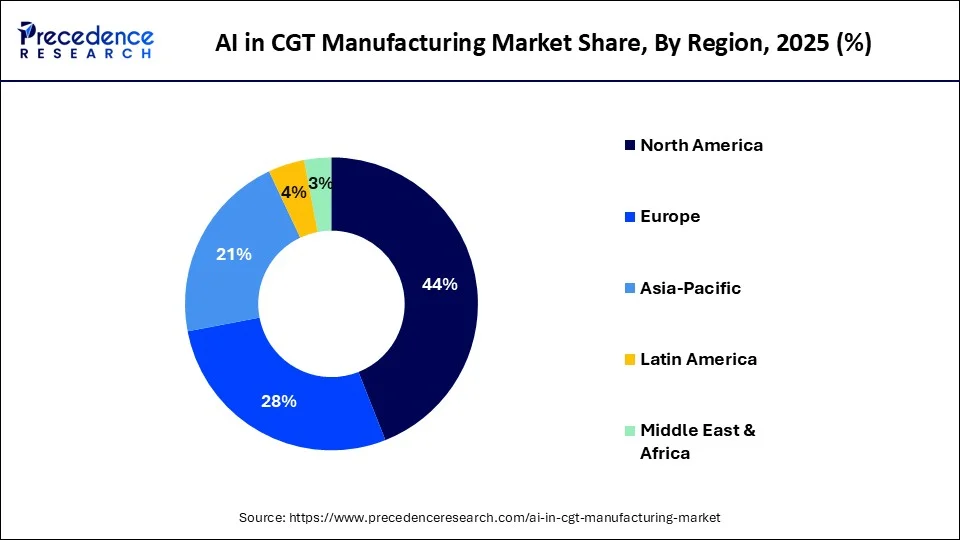
Europe represents another major market, supported by robust life sciences research, favorable regulatory initiatives, and increasing collaboration between academic institutions and biotechnology companies. Countries such as Germany, the United Kingdom, Switzerland, and France continue investing in advanced biomanufacturing technologies.
Asia Pacific is expected to witness the fastest growth during the forecast period. Expanding biotechnology industries, increasing government support for healthcare innovation, growing pharmaceutical manufacturing capabilities, and rising investments in AI technologies are creating significant opportunities across China, Japan, South Korea, Singapore, and India.
Latin America and the Middle East & Africa are gradually adopting digital biomanufacturing technologies as healthcare infrastructure and pharmaceutical production capabilities continue to improve.
Competitive Landscape
The AI in CGT Manufacturing Market is highly dynamic, with technology companies, pharmaceutical manufacturers, biotechnology firms, and software providers collaborating to develop intelligent manufacturing solutions.
Companies are investing heavily in machine learning, advanced analytics, cloud computing, robotics, and automation platforms that improve manufacturing efficiency while supporting regulatory compliance.
Strategic partnerships between AI technology providers and cell and gene therapy manufacturers are becoming increasingly common, enabling faster deployment of intelligent manufacturing solutions across commercial production facilities.
Research collaborations with academic institutions are also accelerating innovation in AI algorithms designed specifically for advanced therapy manufacturing.
Future Outlook
The future of the AI in CGT Manufacturing Market is highly promising as artificial intelligence becomes increasingly integrated into every stage of cell and gene therapy production.
Advancements in machine learning, digital twins, autonomous manufacturing, robotics, and predictive analytics will continue improving production efficiency while reducing manufacturing costs and accelerating product commercialization.
As more cell and gene therapies receive regulatory approval, manufacturers will require scalable and intelligent production systems capable of meeting growing global demand. AI will play a critical role in enabling this transition by improving quality, increasing productivity, and supporting personalized medicine.
The continued convergence of artificial intelligence, biotechnology, automation, and digital health is expected to redefine advanced therapy manufacturing over the coming decade.
Conclusion
Artificial intelligence is transforming the future of cell and gene therapy manufacturing by making production more efficient, data-driven, and reliable. From predictive maintenance and intelligent quality control to automated process optimization and digital manufacturing platforms, AI is helping manufacturers overcome many of the challenges associated with producing advanced therapies.
As investments in precision medicine continue to grow, AI-powered manufacturing will become an increasingly important competitive advantage for pharmaceutical and biotechnology companies. Organizations that successfully integrate artificial intelligence into their manufacturing operations will be better positioned to accelerate innovation, improve patient access to life-saving therapies, and shape the future of advanced biopharmaceutical manufacturing.
AI in CGT Manufacturing Market Companies
- Bluebird Bio Inc.
- Boehringer Ingelheim
- Catalent Inc.
- Cellular Therapeutics
- F. Hoffmann-La Roche Ltd
- Hitachi Chemical Co., Ltd.
- Lonza
- Merck KGaA
- Miltenyi Biotec
- Novartis AG
- Samsung Biologics
- Takara Bio Inc.
- Thermo Fisher Scientific
- Wuxi Advanced Therapies
Get Sample Link : https://www.precedenceresearch.com/sample/8541
Recent Developments
- In June 2026, Merck (MSD outside the U.S. and Canada) entered a collaboration with Protillion Biosciences to utilize Protillion’s Prot-MaP technology for AI-driven drug design. This partnership combines Protillion’s ability to generate vast training datasets with Merck’s expertise in discovering new therapeutic candidates. Protillion’s approach allows for high-throughput protein library analysis, leading to optimized biologics with enhanced therapeutic profiles. Protillion will receive an upfront payment and potential milestone payments totaling up to $510 million.
- In June 2026, Catalent Inc. launched Qai, an enterprise AI tool aimed at improving quality management systems across its network. Qai uses Catalent’s enterprise data to enhance quality processes, accelerate insights, and support better decision-making. This launch marks Catalent’s first enterprise AI solution, showcasing the company’s commitment to integrating advanced technologies to improve operations and patient support.
Segments Covered in the Report
By Component
- Software
- Machine Learning Platforms
- Predictive Analytics Software
- Digital Twin Software
- Process Control & Optimization Software
- Computer Vision Software
- Services
- Consulting Services
- Implementation & Integration Services
- Support & Maintenance Services
By Deployment Mode
- Cloud-based
- On-premises
- Hybrid
By Technology
- Machine Learning (ML)
- Deep Learning
- Computer Vision
- Natural Language Processing (NLP)
- Reinforcement Learning
- Generative AI
By Manufacturing Stage
- Upstream Processing
- Cell Expansion
- Gene Editing and Vector Production
- Downstream Processing
- Fill and Finish
- Quality Control and Release Testing
By Therapy Type
- Cell Therapy
- CAR-T Cell Therapy
- Stem Cell Therapy
- TCR-T Cell Therapy
- NK Cell Therapy
- Gene Therapy
- In Vivo Gene Therapy
- Ex Vivo Gene Therapy
By Application
- Process Optimization
- Predictive Maintenance
- Quality Assurance and Quality Control
- Process Monitoring
- Batch Release Optimization
- Supply Chain and Inventory Management
- Regulatory Compliance
- Digital Twin Simulation
By End User
- Biopharmaceutical Companies
- Contract Development and Manufacturing Organizations
- Research Institutes
- Academic Institutions
- Hospitals and Cell Therapy Centers
By Organization Size
- Large Enterprises
- Small and Medium-sized Enterprises
By Region
- North America
- Latin America
- Europe
- Asia-pacific
- Middle and East Africa
Get Sample Link : 3T MRI System Market

- Farm Management Software Market: Digital Agriculture Driving Smarter and More Sustainable Farming - July 9, 2026
- AI in CGT Manufacturing Market: Artificial Intelligence Accelerating the Future of Cell and Gene Therapy Production - July 9, 2026
- 3T MRI System Market: Advanced Imaging Technology Transforming Modern Diagnostics - July 9, 2026