
Medical imaging has become one of the most important pillars of modern healthcare, enabling physicians to detect diseases earlier, monitor treatment progress, and make informed clinical decisions. Among the latest innovations in diagnostic imaging, 3 Tesla (3T) Magnetic Resonance Imaging (MRI) systems have emerged as a preferred choice for hospitals, diagnostic centers, and research institutions. Offering higher image resolution, faster scan times, and improved diagnostic accuracy than conventional MRI systems, 3T MRI technology is playing a significant role in improving patient outcomes across various medical specialties.
The global 3T MRI System Market is witnessing substantial growth as healthcare providers increasingly invest in advanced imaging technologies. Rising demand for early disease diagnosis, growing prevalence of neurological and musculoskeletal disorders, technological advancements, and expanding healthcare infrastructure are creating favorable opportunities for market growth. Additionally, the integration of artificial intelligence (AI), cloud-based imaging, and automated workflow solutions is further enhancing the capabilities of modern MRI systems.
What is the 3T MRI System Market Size?
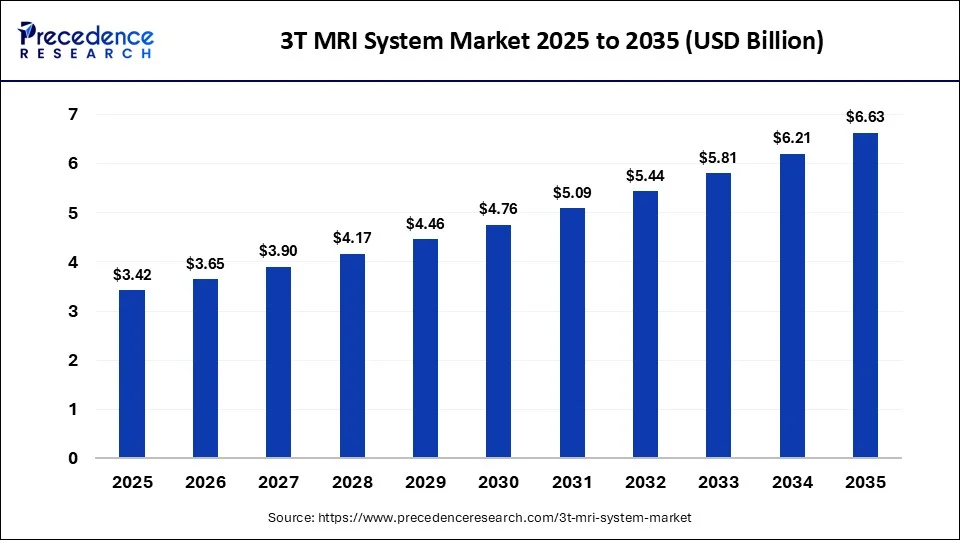
The global 3T MRI system market size accounted for USD 3.42 billion in 2025 and is predicted to increase from USD 3.65 billion in 2026 to approximately USD 6.63 billion by 2035, expanding at a CAGR of 6.85% from 2026 to 2035. The market is driven by the increasing prevalence of neurological disorders, like Alzheimer’s and Parkinson’s, and complex cancers, which need the superior spatial resolution and tissue contrast offered by 3T systems for early, highly accurate diagnosis.
Market Highlights
- North America led the 3T MRI system market by holding a major share of 37% in 2025.
- Asia-Pacific held a 26% share of the market in 2025 and is expected to grow at the fastest CAGR of 8.6% during the projection period.
- By product type, the closed-bore 3T MRI systems segment held a dominant position in the market with a 62% share in 2025.
- By product type, the wide-bore 3T MRI systems segment held a 33% share of the market in 2025 and is expected to grow at the fastest CAGR of 8% during the projection period.
- By application, the cardiology segment held an 11% share of the market in 2025 and is expected to grow at the fastest CAGR of 8.1% during the projection period.
- By end user, the academic and research institutes segment held a 7% share of the market in 2025 and is expected to grow at the fastest CAGR of 7.8% during the projection period.
- By installation type, the fixed MRI systems segment held a dominant position in the market with a 94% share in 2025 and is expected to sustain its dominance with a CAGR of 6.9% during the forecast period.
- By installation type, the mobile MRI systems segment held a 6% share of the market in 2025 and is expected to grow at a CAGR of 4.8% during the projection period.
- By distribution channel, the direct sales segment dominated the market with a share of 68% in 2025 and is expected to grow at the fastest CAGR of 7.1% in the coming years.
Understanding the 3T MRI System Market
A 3T MRI system is a high-field magnetic resonance imaging device that operates at a magnetic field strength of three Tesla, delivering significantly greater image clarity compared to traditional 1.5T MRI systems. The stronger magnetic field improves signal quality, allowing clinicians to capture detailed images of soft tissues, blood vessels, joints, organs, and the brain.
These systems are widely used for diagnosing neurological disorders, cardiovascular diseases, cancer, musculoskeletal injuries, and abdominal conditions. Their ability to produce highly detailed images makes them particularly valuable for complex medical cases where diagnostic precision is essential.
As healthcare systems continue to prioritize accurate diagnosis and personalized treatment planning, the adoption of 3T MRI systems is steadily increasing across developed and emerging markets.
Why Is the 3T MRI System Market Growing?
One of the primary growth drivers is the increasing prevalence of chronic diseases. Neurological disorders, cardiovascular diseases, cancer, and orthopedic conditions require advanced imaging for accurate diagnosis and ongoing patient monitoring. The superior imaging capabilities of 3T MRI systems enable physicians to detect abnormalities at earlier stages, supporting better treatment decisions.
Another important factor is the growing emphasis on preventive healthcare. Patients and healthcare providers are increasingly focusing on early diagnosis, where advanced MRI technology plays a crucial role. Routine health screenings, sports medicine, and preventive neurological assessments are expanding the use of high-performance MRI systems.
Healthcare infrastructure development is also contributing to market expansion. Governments and private healthcare organizations continue investing in new hospitals, imaging centers, and specialized diagnostic facilities equipped with advanced MRI technologies.
The increasing demand for minimally invasive diagnostic procedures further supports market growth, as MRI provides highly detailed internal images without exposing patients to ionizing radiation.
How Is Artificial Intelligence Transforming 3T MRI Systems?
Artificial intelligence is revolutionizing MRI technology by making imaging faster, more accurate, and more efficient.
AI-powered image reconstruction significantly reduces scan times while maintaining exceptional image quality. Faster imaging improves patient comfort and allows hospitals to examine more patients each day without compromising diagnostic accuracy.
Machine learning algorithms assist radiologists by automatically identifying abnormalities, highlighting suspicious regions, and supporting clinical decision-making. These intelligent tools reduce interpretation time while improving diagnostic consistency.
AI also enhances workflow automation by scheduling examinations, optimizing scanning protocols, reducing motion artifacts, and improving image processing. These capabilities enable radiology departments to improve operational efficiency while reducing the workload on healthcare professionals.
As AI technology continues to evolve, future 3T MRI systems are expected to deliver increasingly personalized imaging protocols tailored to each patient’s anatomy and clinical condition.
Emerging Trends in the 3T MRI System Market
- One of the most significant trends is the development of AI-assisted imaging platforms that accelerate image acquisition and improve diagnostic confidence. These systems enable clinicians to obtain high-quality images in shorter examination times.
- Another important trend is the growing adoption of quantitative imaging. Instead of simply producing anatomical images, modern MRI systems provide measurable biomarkers that help physicians monitor disease progression and evaluate treatment effectiveness.
- Remote imaging services and cloud-connected MRI platforms are also becoming more common. These technologies allow radiologists to review images from different locations, improving collaboration between hospitals and specialists.
- Manufacturers are also focusing on improving patient comfort through wider MRI bores, quieter scanning environments, and shorter examination times. These improvements help reduce patient anxiety and minimize motion during imaging.
- Additionally, sustainability has become an important consideration. New-generation MRI systems are designed to consume less energy while delivering higher performance, supporting hospitals’ environmental and operational goals.
Market Report Coverage and Key Metrics
| Report Coverage | Details |
| Market Size in 2025 | USD 3.42 Billion |
| Market Size in 2026 | USD 3.65 Billion |
| Market Size by 2035 | USD 6.63 Billion |
| Market Growth Rate from 2026 to 2035 | CAGR of 6.85% |
| Dominating Region | North America |
| Fastest Growing Region | Asia Paicfic |
| Base Year | 2025 |
| Forecast Period | 2026 to 2035 |
| Segments Covered | Product Type, Architecture, Application, End User, Installation Type, Field Configuration, Patient Type, Distribution Channel, and Region |
| Regions Covered | North America, Europe, Asia-Pacific, Latin America, and Middle East & Africa |
Market Challenges
Despite strong growth prospects, several challenges continue to influence the 3T MRI System Market.
The high cost of purchasing and installing 3T MRI systems remains one of the biggest barriers, particularly for smaller hospitals and healthcare facilities in developing regions. These advanced imaging systems require significant capital investment along with specialized infrastructure.
Maintenance expenses and the need for highly trained radiologists and MRI technicians also increase operational costs. Regular equipment servicing, software upgrades, and quality assurance programs are essential to maintain optimal system performance.
Patient-related limitations may also affect adoption. Some individuals with implanted medical devices, severe claustrophobia, or certain medical conditions may not be suitable candidates for MRI examinations.
Regional Outlook
North America currently leads the global 3T MRI System Market due to its advanced healthcare infrastructure, high healthcare spending, and rapid adoption of innovative medical technologies. Hospitals across the United States and Canada continue investing in AI-enabled MRI platforms to improve diagnostic capabilities and patient outcomes.
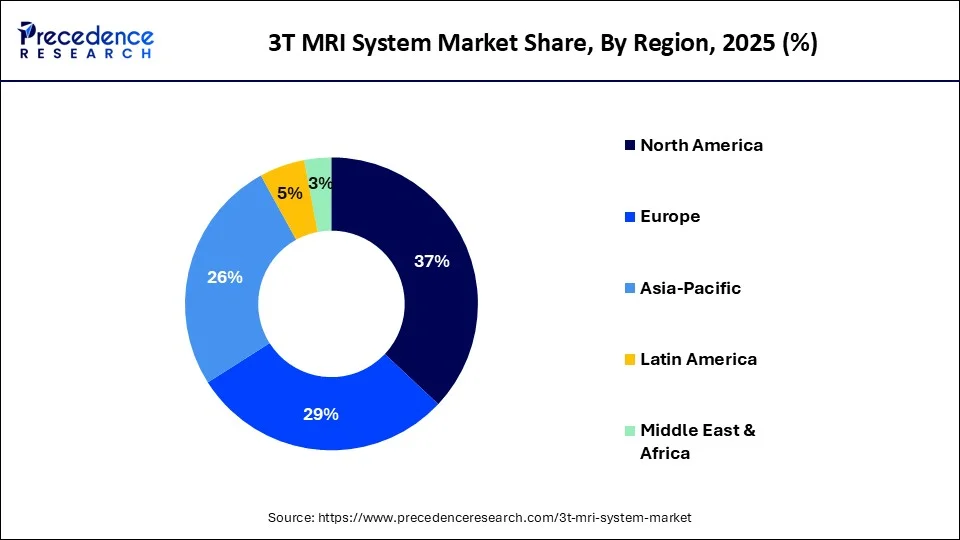
Europe represents another significant market, supported by strong public healthcare systems, ongoing research activities, and increasing investments in precision medicine. Countries such as Germany, France, the United Kingdom, and Italy continue expanding access to advanced imaging technologies.
Asia Pacific is expected to experience the fastest growth during the forecast period. Rising healthcare investments, expanding hospital networks, increasing awareness of early disease diagnosis, and growing demand for high-quality medical imaging are driving market expansion across China, India, Japan, South Korea, and Southeast Asian countries.
Latin America and the Middle East & Africa are also witnessing gradual growth as governments modernize healthcare infrastructure and improve access to advanced diagnostic services.
Competitive Landscape
The global 3T MRI System Market is highly competitive, with leading medical technology companies focusing on innovation, digital transformation, and AI integration.
Manufacturers continue investing in faster image acquisition technologies, intelligent workflow automation, improved gradient performance, and advanced imaging software. Strategic collaborations with hospitals, research institutions, and healthcare providers are helping companies expand their global presence.
Product innovation remains a major competitive strategy as manufacturers introduce MRI systems offering enhanced image quality, improved patient comfort, lower energy consumption, and greater clinical versatility.
The growing emphasis on precision medicine and personalized healthcare is encouraging companies to develop MRI solutions capable of delivering quantitative imaging biomarkers that support more accurate diagnosis and treatment planning.
Future Outlook
The future of the 3T MRI System Market appears highly promising as healthcare providers increasingly adopt advanced imaging technologies to improve diagnostic precision and patient care.
Artificial intelligence, cloud connectivity, automation, and quantitative imaging will continue transforming MRI systems into intelligent diagnostic platforms capable of delivering faster, more accurate, and data-driven clinical insights.
Growing investments in healthcare infrastructure, increasing demand for early disease detection, and continuous technological innovation are expected to create significant opportunities for manufacturers and healthcare providers worldwide.
As medical imaging continues evolving, 3T MRI systems will play a critical role in supporting personalized medicine, improving clinical outcomes, and advancing the future of diagnostic healthcare.
Conclusion
The global 3T MRI System Market is entering a new phase of innovation driven by advancements in imaging technology, artificial intelligence, and precision diagnostics. Healthcare providers are increasingly recognizing the value of high-field MRI systems for delivering superior image quality, improved workflow efficiency, and more accurate disease detection.
With continued technological progress, expanding healthcare investments, and growing demand for early diagnosis, the adoption of 3T MRI systems is expected to accelerate across hospitals, diagnostic centers, and research institutions. Companies that continue investing in AI-powered imaging, patient-centric design, and sustainable healthcare technologies will be well-positioned to shape the future of advanced medical imaging.
3T MRI System Market Companies
- Siemens Healthineers
- GE HealthCare
- Koninklijke Philips N.V.
- Canon Medical Systems
- FUJIFILM Corporation
- Krsnaa Diagnostics Ltd.
- Shanghai United Imaging Healthcare (UIH)
- Neusoft Medical Systems
- Magnetica
Get Sample Link : https://www.precedenceresearch.com/sample/8540
Recent Developments
- In May 2026, AiM Medical Robotics declared a partnership agreement with Siemens Healthineers for the implementation of an interface enabling AiM’s robotic platform to function with MRI systems from Siemens Healthineers.
- In May 2026, Royal Philips declared Titanion MR, its ultra-high-gradient 3.0T MRI, the leading worldwide forum for magnetic resonance research. Titanion is programmed to advance MRI beyond anatomical and functional imaging by allowing clinicians and researchers to apply quantitative and even biologically informative imaging approaches.
Segments Covered in the Report
By Product Type
- Closed-Bore 3T MRI Systems
- Wide-Bore 3T MRI Systems
- Open 3T MRI Systems
By Architecture
- Superconducting MRI Systems
- Permanent Magnet MRI Systems
By Application
- Neurology
- Orthopedics
- Cardiology
- Oncology
- Breast Imaging
- Abdominal Imaging
- Musculoskeletal Imaging
- Vascular Imaging
- Whole Body Imaging
- Others
By End User
- Hospitals
- Diagnostic Imaging Centers
- Ambulatory Surgical Centers (ASCs)
- Academic and Research Institutes
- Specialty Clinics
By Installation Type
- Fixed MRI Systems
- Mobile MRI Systems
By Field Configuration
- Horizontal Field MRI Systems
- Vertical Field MRI Systems
By Patient Type
- Adult
- Pediatric
- Geriatric
By Distribution Channel
- Direct Sales
- Medical Equipment Distributors
- Third-party Procurement and Leasing
By Region
- North America
- Latin America
- Europe
- Asia-pacific
- Middle and East Africa
Also Read Our Latest Article : Electric Breast Pumps Market

- Farm Management Software Market: Digital Agriculture Driving Smarter and More Sustainable Farming - July 9, 2026
- AI in CGT Manufacturing Market: Artificial Intelligence Accelerating the Future of Cell and Gene Therapy Production - July 9, 2026
- 3T MRI System Market: Advanced Imaging Technology Transforming Modern Diagnostics - July 9, 2026