
Breastfeeding is widely recognized as one of the best ways to support an infant’s growth and development. However, balancing breastfeeding with work, travel, and daily responsibilities can be challenging for many mothers. This has increased the demand for electric breast pumps, which offer a convenient and efficient way to express and store breast milk. As healthcare awareness grows and technology continues to improve, electric breast pumps are becoming an essential part of modern maternal care.
The global electric breast pumps market is experiencing significant growth, driven by rising awareness of maternal and infant health, increasing employment among women, and continuous innovation in breastfeeding technology. Portable, wearable, and app-connected breast pumps are transforming the breastfeeding experience, making it more comfortable, discreet, and efficient. These advancements are encouraging more mothers to choose electric breast pumps as part of their daily routine.
Electric Breast Pumps Market Size and Forecast 2026 to 2035
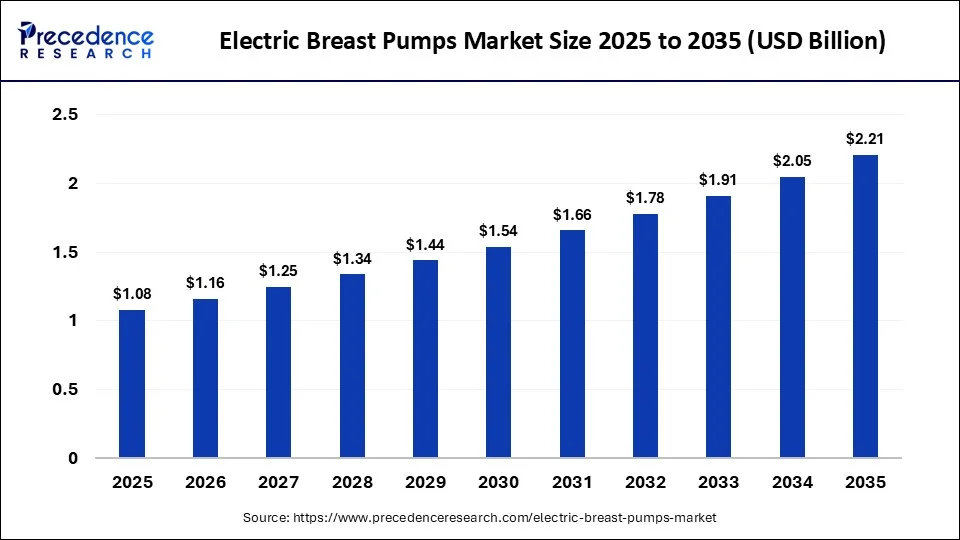
The global electric breast pumps market size accounted for USD 1.08 billion in 2025 and is predicted to increase from USD 1.16 billion in 2026 to approximately USD 2.21 billion by 2035, expanding at a CAGR of 7.40% from 2026 to 2035. The market is driven by growing participation of women in the worldwide workforce, which is accelerating the need for efficient, portable, and time-saving pumping solutions.
Market Highlights
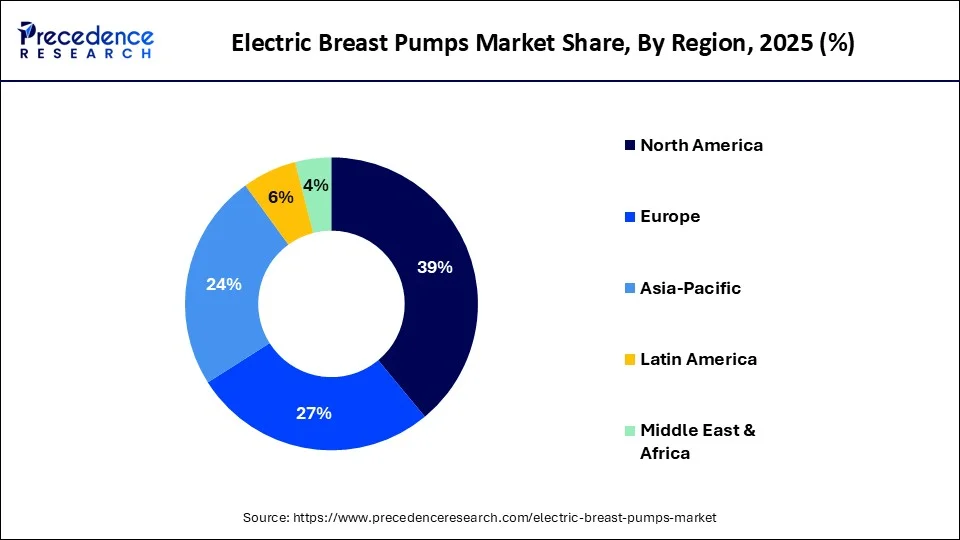
- North America led the electric breast pumps market by holding a major share of 39% in 2025.
- Asia-Pacific held a 24% share of the market in 2025 and is expected to grow at the fastest CAGR of 9.2% during the projection period.
- By product type, the double electric breast pumps segment held a dominant position in the market with a 39% share in 2025.
- By technology, the closed system breast pumps segment dominated the market with a share of 72% in 2025 and is expected to grow at the fastest CAGR of 8.5% in the coming years.
- By technology, the open system breast pumps segment held a 28% share of the market in 2025 and is expected to grow at a CAGR of 3.8% during the projection period.
- By application, the personal use segment held a dominant position in the electric breast pumps market with a 79% share in 2025 and is expected to sustain its dominance with a CAGR of 7.8% over the studied period.
- By end user, the individual mothers segment held a dominant position in the market with a 76% share in 2025 and is expected to grow at the highest CAGR of 7.9% in the coming years.
- By distribution channel, the e-commerce segment dominated the market with a share of 39% in 2025 and is expected to grow at the fastest CAGR of 10.2% in the coming years.
Understanding the Electric Breast Pumps Market
An electric breast pump is a device designed to help mothers express breast milk using an electric motor. Compared to manual pumps, electric models are faster, more efficient, and require less physical effort. They are particularly beneficial for working mothers, mothers of premature babies, and women who need to maintain or increase their milk supply.
The market includes single electric breast pumps, double electric breast pumps, hospital-grade pumps, wearable breast pumps, and smart breast pumps equipped with mobile connectivity. As consumer preferences evolve, manufacturers are focusing on developing quieter, lighter, and more portable devices that improve convenience without compromising performance.
Why Is the Electric Breast Pumps Market Growing?
Several factors are contributing to the growing demand for electric breast pumps worldwide.
One of the biggest growth drivers is the increasing participation of women in the workforce. Many mothers return to work within a few months after childbirth, making breast pumps an essential tool for continuing breastfeeding while maintaining professional commitments. Electric breast pumps allow mothers to express milk quickly and store it safely for later use.
Growing awareness of the health benefits of breastfeeding is another important factor. Healthcare organizations around the world actively promote breastfeeding because it provides essential nutrients, strengthens infant immunity, and supports healthy development. As awareness increases, more mothers are investing in quality breast pumping solutions.
Government initiatives supporting maternal healthcare and breastfeeding education are also encouraging market growth. Hospitals, maternity clinics, and healthcare professionals increasingly recommend breast pumps for mothers experiencing breastfeeding challenges or requiring flexible feeding schedules.
The rapid expansion of online retail platforms has further improved product accessibility. Consumers can now compare products, read reviews, and purchase breast pumps from the comfort of their homes, contributing to higher adoption rates globally.
How Is Technology Transforming Electric Breast Pumps?
Technology has significantly improved the functionality and user experience of electric breast pumps. Modern devices are quieter, lighter, and designed with comfort in mind. Adjustable suction settings, rechargeable batteries, and ergonomic designs make pumping more convenient for mothers throughout the day.
One of the most notable innovations is the emergence of wearable breast pumps. These hands-free devices fit comfortably inside a nursing bra, allowing mothers to pump discreetly while performing daily activities. This level of convenience has made wearable pumps increasingly popular among busy parents.
Many premium electric breast pumps now include smartphone connectivity through Bluetooth-enabled mobile applications. These apps allow mothers to monitor pumping sessions, track milk production, set reminders, and receive personalized insights to support breastfeeding goals.
Artificial intelligence is also beginning to influence product development. Smart breast pumps can analyze pumping patterns, recommend optimal settings, and provide data-driven recommendations that help mothers improve pumping efficiency and maintain healthy milk production.
Emerging Market Trends
The electric breast pumps market continues to evolve as manufacturers introduce new features to meet changing consumer expectations.
Wearable and hands-free breast pumps have become one of the fastest-growing product categories. Their portability and discreet design make them especially attractive for working mothers and frequent travelers.
Rechargeable battery-powered devices are replacing traditional plug-in models, giving users greater flexibility and convenience. Many manufacturers are also focusing on reducing pump noise, making the pumping experience more comfortable in both home and workplace environments.
Sustainability is becoming another important trend. Companies are increasingly using recyclable materials, BPA-free components, and environmentally friendly packaging to appeal to health-conscious and environmentally aware consumers.
The growth of telehealth and digital maternal care platforms is also supporting market expansion. Healthcare professionals can now provide virtual lactation consultations, helping mothers select appropriate breast pumps and receive guidance on effective breastfeeding practices.
Market Challenges
Despite strong growth prospects, the electric breast pumps market faces several challenges.
The high cost of advanced wearable and smart breast pumps remains a significant barrier for many consumers, particularly in developing countries. Premium devices often include sophisticated technologies that increase product prices, limiting accessibility for price-sensitive buyers.
Limited awareness in rural and underserved regions also affects market growth. In some areas, mothers continue to rely on traditional breastfeeding methods due to limited education about available pumping solutions.
Additionally, concerns related to hygiene, cleaning, and proper maintenance require manufacturers to provide clear instructions and user-friendly designs that promote safe usage.
Regional Outlook
North America currently represents the largest market for electric breast pumps due to high healthcare spending, favorable insurance coverage, and widespread awareness of breastfeeding benefits. The presence of leading manufacturers and advanced healthcare infrastructure also contributes to regional market leadership.
Europe continues to experience steady growth, supported by strong maternal healthcare programs, government initiatives promoting breastfeeding, and increasing adoption of innovative healthcare products.
Asia Pacific is expected to witness the fastest growth during the coming years. Rapid urbanization, rising disposable incomes, expanding healthcare infrastructure, and increasing participation of women in the workforce are creating significant opportunities for manufacturers throughout the region.
Latin America and the Middle East & Africa are also emerging as promising markets as awareness of maternal healthcare improves and access to healthcare products continues to expand.
Competitive Landscape
The electric breast pumps market is highly competitive, with manufacturers continuously investing in product innovation, research, and digital technology. Companies are focusing on improving comfort, portability, battery performance, and smart connectivity while expanding their presence through online retail channels and strategic partnerships.
Several leading manufacturers are introducing wearable breast pumps with improved suction technology, lightweight designs, and smartphone integration to meet the growing demand for convenient breastfeeding solutions.
As competition increases, businesses are also emphasizing product quality, safety certifications, customer support, and educational resources to strengthen brand loyalty and enhance the overall customer experience.
Future Outlook
The future of the electric breast pumps market appears highly promising. Advances in wearable technology, artificial intelligence, digital health applications, and personalized maternal care are expected to reshape the industry over the next decade.
Future products are likely to become even more compact, intelligent, and user-friendly, enabling mothers to manage breastfeeding with greater flexibility and confidence. Smart health ecosystems that integrate breast pumps with mobile health applications and healthcare providers will further improve maternal support and infant care.
As awareness of breastfeeding continues to grow worldwide, electric breast pumps will play an increasingly important role in helping mothers balance family, work, and personal well-being while ensuring optimal nutrition for their infants.
Conclusion
The electric breast pumps market is evolving rapidly as technology, healthcare awareness, and changing lifestyles drive demand for more efficient breastfeeding solutions. From wearable devices and AI-powered mobile applications to quieter and more portable designs, innovation is transforming how mothers express and manage breast milk.
With continued investments in product development, expanding healthcare initiatives, and growing global awareness of maternal and infant health, the market is well-positioned for sustained growth. Companies that prioritize comfort, convenience, affordability, and smart technology will be best equipped to meet the changing needs of modern parents and contribute to the future of maternal healthcare.
Electric Breast Pumps Market Companies
- Medela AG
- Koninklijke Philips NV
- Pigeon Corporation
- Ameda Inc.
- Willow Innovations
- Elvie
- Spectra Baby
- LuvLap
- Royal Philips
- Promom
- Momcozy
Get Sample Link : https://www.precedenceresearch.com/sample/8539
Recent Developments
- In March 2026, Medela declared the Canadian start of two new innovative breast pumps: Pump In Style Pro+ and Freestyle™ Mini Hands-free. These new solutions reflect Medela’s continued commitment to science-backed, mother-centric design by combining trusted performance with modern convenience for today’s families.
- In August 2025, Philips declared the launch of its biggest innovation – the Philips Avent Hands-free Breast Pump – in India. Further, it was unveiled at an exclusive event in the presence of Masaba Gupta – a renowned fashion designer, actor, entrepreneur, and new mother herself – who is the face of this campaign.
Segments Covered in the Report
By Product Type
- Single Electric Breast Pumps
- Double Electric Breast Pumps
- Hospital-grade Electric Breast Pumps
- Wearable Electric Breast Pumps
By Technology
- Closed System Breast Pumps
- Open System Breast Pumps
By Portability
- Corded Electric Breast Pumps
- Battery-powered Electric Breast Pumps
- Rechargeable Electric Breast Pumps
By Application
- Personal Use
- Hospital Use
- NICU (Neonatal Intensive Care Unit)
By End User
- Individual Mothers
- Hospitals & Maternity Centers
- Lactation Clinic
- Neonatal Care Centers
By Distribution Channel
- Retail Pharmacies
- Hospital Pharmacies
- Specialty Baby Stores
- E-commerce
- Direct Sales
By Price Range
- Economy
- Mid-range
- Premium
By Region
- North America
- Latin America
- Europe
- Asia-pacific
- Middle and East Africa
Also Read Our Latest Article : Endpoint Security Market

- Farm Management Software Market: Digital Agriculture Driving Smarter and More Sustainable Farming - July 9, 2026
- AI in CGT Manufacturing Market: Artificial Intelligence Accelerating the Future of Cell and Gene Therapy Production - July 9, 2026
- 3T MRI System Market: Advanced Imaging Technology Transforming Modern Diagnostics - July 9, 2026