
The global medical carts and workstations market reached USD 5.15 billion in 2025 and is anticipated to witness significant growth over the coming years. The market is forecast to increase from USD 6.13 billion in 2026 to approximately USD 28.11 billion by 2035, registering a CAGR of 18.50% throughout the forecast period from 2026 to 2035.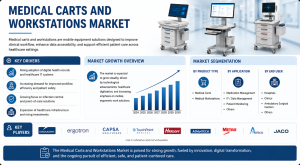
What Are Medical Carts and Workstations?
Medical carts and workstations are mobile or stationary platforms specifically designed to support healthcare professionals in delivering safe, efficient, and organized patient care. These units combine storage, computing technology, power systems, and medical equipment into a single workstation that can easily move throughout hospitals, clinics, ambulatory surgical centers, and long-term care facilities.
Unlike traditional carts used solely for transporting medical supplies, modern workstations function as complete mobile healthcare centers. They enable physicians, nurses, pharmacists, and other healthcare professionals to access patient records, administer medications, review laboratory reports, document clinical information, and communicate with other departments without leaving the patient’s bedside.
Get Sample Link: https://www.precedenceresearch.com/sample/1920
The Evolution of Mobile Healthcare Technology
The healthcare industry has experienced remarkable technological advancements over the past few decades, transforming the way medical professionals deliver patient care. Traditionally, healthcare workers relied on paper records, stationary computers, and manual documentation, which often resulted in delayed access to patient information and increased administrative workloads. As hospitals expanded and patient volumes grew, there was a clear need for mobile solutions that could bring essential medical tools and digital information directly to the point of care.
How Digital Transformation Is Reshaping Healthcare Workflows
Digital transformation is fundamentally changing healthcare delivery by replacing traditional paper-based processes with connected, data-driven systems. Hospitals worldwide are investing in advanced healthcare technologies to improve patient safety, increase operational efficiency, and enhance collaboration among healthcare professionals. Medical carts and workstations play a central role in this transformation by providing clinicians with mobile access to digital tools and patient information wherever care is delivered.
The integration of electronic health records (EHRs) has eliminated the need for manual documentation and significantly reduced paperwork. Healthcare professionals can instantly access patient histories, laboratory reports, diagnostic images, medication records, and treatment plans using mobile workstations. This real-time access enables faster clinical decisions, minimizes documentation errors, and improves communication between multidisciplinary care teams.
Different Types of Medical Carts and Their Clinical Applications
Medical carts are available in a variety of configurations, each designed to meet the specific needs of healthcare professionals and clinical environments. Choosing the right type of cart improves workflow efficiency, enhances patient safety, and supports specialized medical procedures.
- Mobile Computing Carts: Mobile computing carts are among the most widely used workstations in hospitals. They provide healthcare professionals with portable access to electronic health records, laboratory reports, imaging systems, and clinical documentation software. These carts are commonly used by physicians and nurses during bedside patient care, allowing real-time documentation and faster decision-making.
- Medication Carts: Medication carts are specifically designed to store, organize, and securely transport medications throughout healthcare facilities. Equipped with lockable drawers, barcode scanners, and medication administration software, these carts help reduce medication errors and improve patient safety. They are widely used in hospitals, nursing homes, and long-term care facilities.
- Emergency (Crash) Carts: Emergency carts contain life-saving medications, emergency medical equipment, defibrillators, airway management tools, and intravenous supplies. These carts are strategically placed in emergency departments, intensive care units, and operating rooms to provide immediate access during medical emergencies.
- Anesthesia Carts: Anesthesia carts are designed for surgical environments and contain medications, airway management equipment, syringes, catheters, and monitoring devices required during surgical procedures. Organized storage compartments enable anesthesiologists to access critical supplies quickly and efficiently.
- Procedure Carts: Procedure carts support minor surgeries, wound care, catheterization, and various clinical procedures. They help organize medical instruments and disposable supplies while allowing easy transportation between patient rooms and treatment areas.
- Telemedicine Carts: Telemedicine carts integrate high-definition cameras, microphones, monitors, and secure communication systems to facilitate virtual consultations. These workstations enable remote diagnosis, specialist collaboration, and patient monitoring, making healthcare more accessible in rural and underserved areas.
Sustainability Trends in Medical Cart Manufacturing
Environmental sustainability has become an important priority for healthcare organizations and medical equipment manufacturers. Hospitals are increasingly seeking products that reduce environmental impact while maintaining high standards of quality, durability, and patient safety. As a result, manufacturers are incorporating sustainable materials, energy-efficient technologies, and environmentally responsible manufacturing processes into medical cart production.
Many modern medical carts are constructed using recyclable aluminum, stainless steel, and eco-friendly polymers that reduce waste and extend product life. Modular designs allow individual components to be replaced or upgraded without replacing the entire workstation, reducing electronic waste and lowering long-term ownership costs.
How Medical Carts Improve Hospital Workflow Efficiency
Workflow efficiency is critical in healthcare environments where timely decision-making directly affects patient outcomes. Medical carts and workstations improve operational efficiency by enabling healthcare professionals to complete multiple clinical tasks without repeatedly traveling between patient rooms and nursing stations.
One of the primary benefits of mobile workstations is real-time access to electronic health records. Clinicians can review patient histories, update treatment plans, document clinical observations, and access diagnostic reports immediately at the bedside. This eliminates duplicate documentation, reduces administrative burden, and allows more time for direct patient care.
Recent Innovations and Product Developments
The medical carts and workstations market continues to evolve rapidly through technological innovation. Manufacturers are developing increasingly sophisticated solutions that integrate advanced computing, connectivity, automation, and ergonomic design to support modern healthcare environments.
Artificial intelligence is emerging as a valuable addition to mobile workstations, providing clinical decision support, predictive analytics, automated documentation, and intelligent workflow management. AI-powered systems help clinicians prioritize patient care while reducing administrative workloads.
The Internet of Things (IoT) is enabling connected medical carts that communicate with hospital information systems, patient monitoring devices, and asset management platforms. Real-time equipment tracking, battery monitoring, and predictive maintenance improve operational reliability while reducing equipment downtime.
Medical Carts and Workstations Market Challenges
Despite strong growth prospects, the market faces several challenges.
- High Capital Investment: Advanced medical workstations require significant upfront investment, limiting adoption among smaller healthcare facilities.
- Maintenance Costs: Battery replacement, software updates, equipment servicing, and cybersecurity maintenance increase long-term ownership costs.
- Cybersecurity Risks: Connected medical carts handle sensitive patient information, requiring robust cybersecurity measures such as encryption, secure authentication, and remote device management.
Read More: Electrophoresis Reagents Market
Medical Carts and Workstations Market Competitive Landscape
The market is highly competitive, with manufacturers focusing on innovation, ergonomic design, digital integration, and battery technologies.
Leading companies include:
- Ergotron
- Capsa Healthcare
- Advantech
- Enovate Medical
- Harloff Manufacturing
- TouchPoint Medical
- JACO Inc.
- Medline Industries
- McKesson Medical-Surgical
- ITD GmbH
Future Outlook
The future of the medical carts and workstations market remains highly promising. Growing investments in digital healthcare, artificial intelligence, IoT, cloud computing, and smart hospitals will continue driving demand for intelligent mobile workstations.
Healthcare providers increasingly recognize that mobile clinical workstations improve productivity, reduce medical errors, enhance patient safety, and support better healthcare outcomes. As healthcare systems continue evolving toward connected and patient-centered care, medical carts will become even more sophisticated, integrating predictive analytics, autonomous navigation, remote diagnostics, and real-time clinical decision support.
𝐘𝐨𝐮 𝐜𝐚𝐧 𝐩𝐥𝐚𝐜𝐞 𝐚𝐧 𝐨𝐫𝐝𝐞𝐫 𝐨𝐫 𝐚𝐬𝐤 𝐚𝐧𝐲 𝐪𝐮𝐞𝐬𝐭𝐢𝐨𝐧𝐬, 𝐩𝐥𝐞𝐚𝐬𝐞 𝐟𝐞𝐞𝐥 𝐟𝐫𝐞𝐞 𝐭𝐨 𝐜𝐨𝐧𝐭𝐚𝐜𝐭 𝐮𝐬 𝐚𝐭 𝐬𝐚𝐥𝐞𝐬@𝐩𝐫𝐞𝐜𝐞𝐝𝐞𝐧𝐜𝐞𝐫𝐞𝐬𝐞𝐚𝐫𝐜𝐡.𝐜𝐨𝐦
