
The global multiomics market was valued at USD 3.24 billion in 2025 and is projected to grow from USD 3.70 billion in 2026 to around USD 13.20 billion by 2035. This growth reflects a robust CAGR of 15.18% during the forecast period from 2026 to 2035.
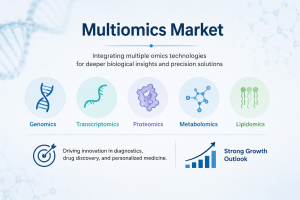
Multiomics Market Overview
The global multiomics market was valued at approximately USD 3.24 billion in 2025 and is projected to reach around USD 13.20 billion by 2035, expanding at a CAGR of 15.18% during the forecast period. The rapid growth reflects increasing demand for precision medicine, advancements in sequencing technologies, and rising investments in biomedical research.
As healthcare transitions from generalized treatment approaches to personalized therapies, multiomics technologies are becoming essential tools for understanding patient-specific biological variations and developing targeted interventions.
Get Sample: https://www.precedenceresearch.com/sample/6406
What is Multiomics?
Multiomics refers to the integration of data from multiple biological disciplines, including:
- Genomics – Study of DNA and genetic variations
- Transcriptomics – Analysis of RNA expression
- Proteomics – Examination of protein structures and functions
- Metabolomics – Assessment of metabolic pathways and metabolites
- Epigenomics – Investigation of gene regulation mechanisms
By combining these datasets, scientists gain a holistic understanding of biological systems and disease progression.
How Multiomics is Revolutionizing Cancer Research
Cancer remains one of the most significant areas of multiomics adoption. Traditional diagnostic methods often focus on genetic mutations alone, but tumors are influenced by multiple biological processes that evolve over time. Multiomics enables researchers to analyze genomic alterations, protein expression, metabolic pathways, and immune responses simultaneously.
This integrated approach helps identify cancer subtypes more accurately, predict treatment responses, and discover novel therapeutic targets. Researchers are increasingly using multiomics to support the development of personalized cancer therapies and improve patient survival rates.
The rise of immunotherapy has further accelerated demand for multiomics technologies, as understanding tumor-immune system interactions requires comprehensive molecular profiling.
The Growing Importance of Bioinformatics
One of the biggest challenges in multiomics research is managing and interpreting enormous volumes of biological data. A single multiomics study can generate terabytes of information that require sophisticated computational tools for analysis.
Bioinformatics platforms are becoming indispensable for:
- Data integration and management
- Biomarker discovery
- Disease pathway analysis
- Predictive modeling
- Clinical decision support
As a result, demand for skilled bioinformaticians, data scientists, and computational biologists continues to increase globally.
Role of Cloud Computing in Multiomics
Cloud computing has emerged as a critical enabler of multiomics research. Traditional on-premise infrastructure often struggles to process large-scale omics datasets efficiently.
Cloud-based platforms offer:
- Scalable storage capabilities
- Faster data processing
- Real-time collaboration
- Enhanced security measures
- Cost-effective computational resources
Major technology providers are increasingly partnering with healthcare organizations and research institutions to support large-scale genomic and multiomics projects.
Multiomics and Rare Disease Diagnosis
Rare diseases affect hundreds of millions of people worldwide, yet many patients experience years of diagnostic uncertainty.
Multiomics is helping address this challenge by enabling researchers to identify complex molecular signatures associated with rare genetic disorders. By combining genomic, transcriptomic, and proteomic data, clinicians can uncover disease-causing mechanisms that may remain undetected through conventional testing methods.
This approach is significantly improving diagnostic accuracy and supporting the development of targeted therapies for previously understudied conditions.
Integration of Multiomics with Digital Health Technologies
The convergence of multiomics and digital health is creating new opportunities for proactive healthcare management.
Wearable devices, remote patient monitoring systems, and electronic health records are generating vast amounts of health-related data. When combined with molecular information from multiomics analyses, these technologies can provide a more comprehensive understanding of individual health status.
Future healthcare systems may leverage this integration to predict disease risks, monitor treatment effectiveness, and deliver highly personalized care recommendations.
Government Initiatives Supporting Multiomics Research
Governments around the world are investing heavily in genomics and precision medicine programs that directly support multiomics adoption.
Notable initiatives include:
- The All of Us Research Program in the United States
- Genomics England initiatives in the United Kingdom
- China’s Precision Medicine Initiative
- European Union-funded genomics and biomedical research projects
These programs aim to create large-scale biological databases that accelerate disease research and improve healthcare outcomes.
Multiomics Market Segment Analysis
By Platform
Genomics currently represents the largest market segment due to its foundational role in multiomics studies and widespread adoption of sequencing technologies. However, proteomics is projected to witness rapid growth as researchers seek deeper insights into protein interactions and disease pathways.
By Application
Oncology remains the dominant application area because cancer is a highly complex disease requiring comprehensive molecular analysis. Multiomics helps researchers understand tumor heterogeneity, identify therapeutic targets, and develop personalized treatment plans.
Neurology is also emerging as a high-growth segment due to increasing efforts to understand neurodegenerative diseases such as Alzheimer’s and Parkinson’s disease.
By End User
Academic and research institutions currently account for a significant share of market revenue due to extensive investments in biomedical research. However, pharmaceutical and biotechnology companies are expected to experience faster growth as they expand multiomics-based drug discovery programs.
Read Also: Health and Wellness Market
Regional Insights
North America
North America dominates the global multiomics market due to:
- Strong healthcare infrastructure
- Advanced research facilities
- Significant government funding
- Presence of leading biotechnology companies
The United States remains the primary innovation hub for multiomics technologies and precision medicine initiatives.
Europe
Europe continues to witness strong adoption of multiomics technologies through government-supported genomics programs and collaborative research initiatives.
Countries such as Germany, the United Kingdom, and France are investing heavily in biomedical innovation and personalized healthcare.
Asia-Pacific
Asia-Pacific is expected to register the fastest growth rate during the forecast period.
Factors supporting regional growth include:
- Expanding healthcare infrastructure
- Rising biotechnology investments
- Increasing genomics research
- Government support for precision medicine
China, Japan, South Korea, and India are emerging as important contributors to global multiomics research.
Challenges Facing the Industry
Despite its promising future, the multiomics market faces several challenges:
- Data Complexity: Integrating and interpreting massive multiomics datasets requires advanced computational tools and specialized expertise.
- High Costs: Although sequencing costs have declined, comprehensive multiomics studies remain expensive, limiting adoption among smaller institutions.
- Lack of Standardization: Differences in data collection methods, analytical platforms, and interpretation frameworks can create inconsistencies across studies.
- Data Privacy and Security Concerns: The growing use of patient genomic data raises important questions regarding privacy, data ownership, and regulatory compliance.
Future Outlook
The future of the multiomics market appears exceptionally promising. Continued advances in artificial intelligence, cloud computing, sequencing technologies, and bioinformatics will further improve the accessibility and effectiveness of multiomics platforms.
As healthcare systems increasingly embrace personalized medicine, multiomics is expected to become a cornerstone of disease diagnosis, treatment selection, and preventive healthcare.
The convergence of genomics, proteomics, metabolomics, and AI-driven analytics will create new opportunities for innovation, enabling researchers and clinicians to unlock deeper biological insights and transform patient care worldwide.
𝐘𝐨𝐮 𝐜𝐚𝐧 𝐩𝐥𝐚𝐜𝐞 𝐚𝐧 𝐨𝐫𝐝𝐞𝐫 𝐨𝐫 𝐚𝐬𝐤 𝐚𝐧𝐲 𝐪𝐮𝐞𝐬𝐭𝐢𝐨𝐧𝐬, 𝐩𝐥𝐞𝐚𝐬𝐞 𝐟𝐞𝐞𝐥 𝐟𝐫𝐞𝐞 𝐭𝐨 𝐜𝐨𝐧𝐭𝐚𝐜𝐭 𝐮𝐬 𝐚𝐭 𝐬𝐚𝐥𝐞𝐬@𝐩𝐫𝐞𝐜𝐞𝐝𝐞𝐧𝐜𝐞𝐫𝐞𝐬𝐞𝐚𝐫𝐜𝐡.𝐜𝐨𝐦
