
Market Growth Accelerates as Pharmaceutical Manufacturers Increase Adoption of High-Performance Excipients, AI-Driven Formulation Technologies, and Continuous Manufacturing Systems
The U.S. pharmaceutical excipients market is entering a transformative growth phase as pharmaceutical manufacturers increasingly focus on advanced drug formulations, biologics, specialty medicines, and patient-centric dosage forms.
The U.S. pharmaceutical excipients market size was valued at USD 3.08 billion in 2025 and is projected to grow from USD 3.28 billion in 2026 to approximately USD 5.58 billion by 2035, registering a CAGR of 6.12% during the forecast period from 2026 to 2035.
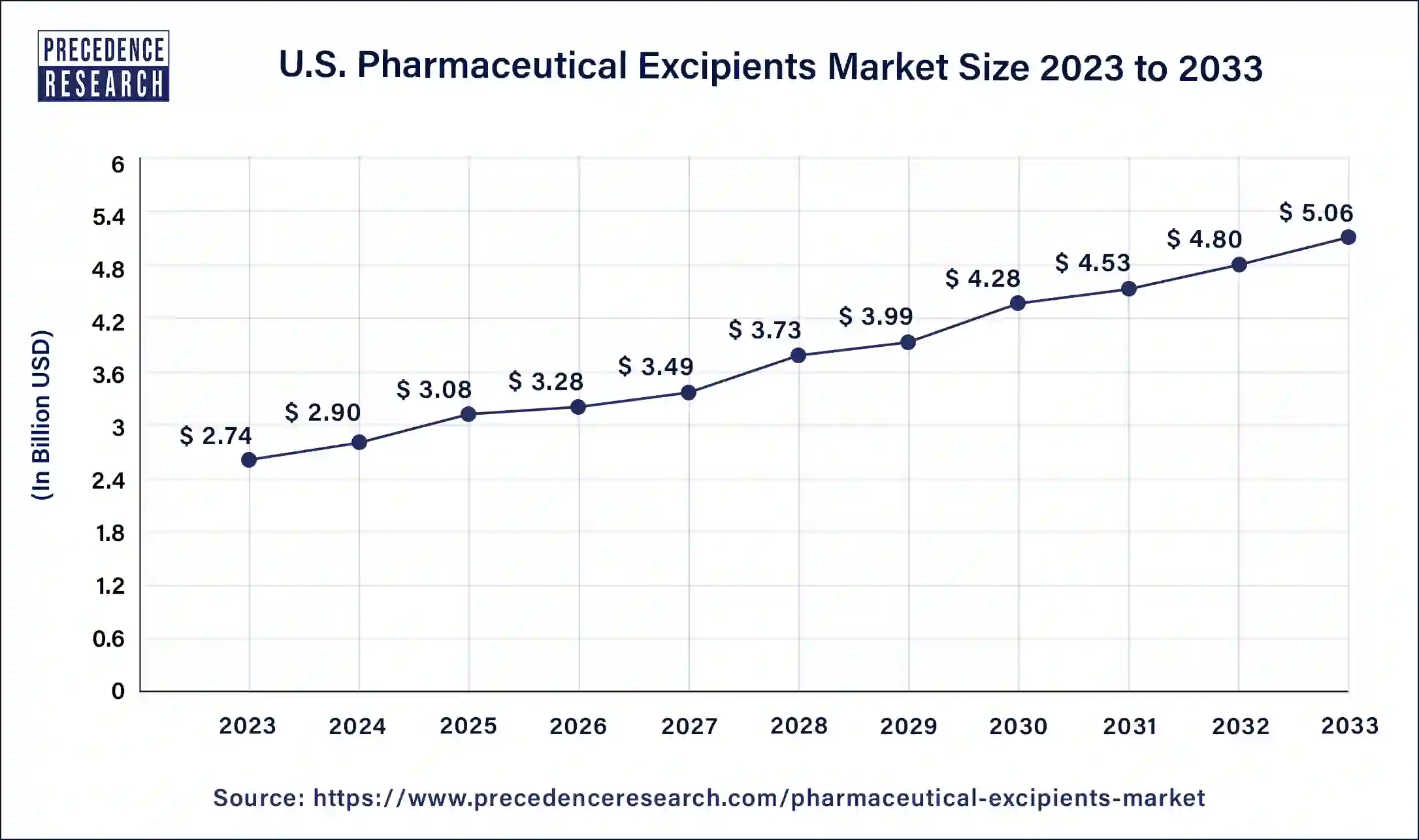
The market’s expansion is primarily driven by the increasing need for excipients that improve drug stability, manufacturability, bioavailability, dissolution rates, and therapeutic performance. As pharmaceutical companies continue to develop complex formulations and biologic therapies, the demand for multifunctional excipients capable of meeting stringent regulatory and performance requirements is expected to rise substantially.
US Pharmaceutical Excipients Market Key Highlights
- The U.S. pharmaceutical excipients market was valued at USD 3.08 billion in 2025 and is forecasted to reach USD 5.58 billion by 2035.
- The market is expected to expand at a healthy CAGR of 6.12% between 2026 and 2035.
- Fillers and diluents emerged as the largest functionality segment in 2025 due to their extensive use in tablet and capsule manufacturing.
- Lactose-based excipients accounted for the largest excipient type segment owing to their excellent compressibility and formulation versatility.
- Cellulose-based excipients are projected to witness significant growth during the forecast period due to rising demand for specialty and complex drug formulations.
- New Jersey continues to lead the U.S. market because of its dense concentration of pharmaceutical manufacturing and research facilities.
- Artificial intelligence is increasingly being adopted to optimize excipient selection, formulation development, and manufacturing quality control.
- Major industry participants include BASF SE, Ashland Global Holdings, Roquette, Evonik Industries, Croda International, DFE Pharma, Colorcon, JRS Pharma, and Lubrizol.
U.S. Pharmaceutical Excipients Market Revenue Outlook
| Metric | Value |
|---|---|
| Market Size 2025 | USD 3.08 Billion |
| Market Size 2026 | USD 3.28 Billion |
| Forecast Market Size 2035 | USD 5.58 Billion |
| CAGR (2026-2035) | 6.12% |
| Base Year | 2025 |
| Forecast Period | 2026-2035 |
Why Are Pharmaceutical Excipients Becoming More Important Than Ever?
Pharmaceutical excipients have evolved from being simple inactive ingredients to becoming essential components that directly influence drug performance, patient compliance, manufacturing efficiency, and product stability. In modern pharmaceutical formulations, excipients can account for nearly 90% of a drug’s composition.
As pharmaceutical innovation shifts toward biologics, specialty medicines, controlled-release products, and personalized therapies, the demand for high-quality excipients continues to increase. Manufacturers are increasingly investing in advanced excipient technologies that improve solubility, enhance absorption, and ensure consistency across production batches.
The emergence of complex oral formulations, injectable therapies, and RNA-based therapeutics is further reinforcing the critical role of pharmaceutical excipients across the healthcare ecosystem.
How Is Artificial Intelligence Transforming the Pharmaceutical Excipients Industry?
Artificial intelligence is rapidly becoming a strategic tool in pharmaceutical formulation development. AI-powered predictive models are helping researchers evaluate how various excipients impact drug stability, solubility, dissolution profiles, and bioavailability before physical testing begins.
By reducing the number of laboratory experiments required during formulation development, AI significantly shortens development timelines and lowers research costs. This enables pharmaceutical companies to accelerate product launches while maintaining quality standards.
AI is also enhancing manufacturing operations through real-time process monitoring, predictive maintenance, and quality assurance systems. These capabilities allow manufacturers to identify process deviations early, reducing waste and ensuring consistent product quality across large-scale production facilities.
US Pharmaceutical Excipients Market Growth Factors
Rising Demand for Advanced Drug Formulations
The pharmaceutical industry is increasingly focused on developing sophisticated therapies that require specialized excipients to optimize drug delivery and therapeutic effectiveness. This trend is generating significant demand for innovative excipient solutions.
Expansion of Biologics and Specialty Medicines
Biologic therapies require highly specialized formulation strategies to maintain stability and efficacy. As biologics continue gaining market share, demand for premium pharmaceutical excipients is expected to rise accordingly.
Growth of Novel Drug Delivery Systems
Innovations in controlled-release formulations, orally disintegrating tablets, injectables, and targeted delivery systems are creating new opportunities for excipient manufacturers.
Increasing Generic Drug Production
The growing generic pharmaceutical industry continues to rely heavily on proven and cost-effective excipients such as lactose and microcrystalline cellulose, further strengthening market demand.
US Pharmaceutical Excipients Market Opportunities
Can Continuous Pharmaceutical Manufacturing Create New Revenue Streams?
The growing adoption of continuous manufacturing technologies is creating substantial opportunities for excipient suppliers.
Continuous manufacturing requires excipients with highly consistent performance characteristics and superior processing efficiency. Manufacturers are increasingly seeking pharmaceutical-grade ingredients that can support uninterrupted production while maintaining product quality.
As pharmaceutical companies invest in smart factories and digital manufacturing technologies, demand for high-purity, multifunctional excipients is expected to increase significantly.
US Pharmaceutical Excipients Market Trends
Are Sustainable Excipients Becoming a Competitive Advantage?
Sustainability is emerging as a major differentiator in the pharmaceutical excipients sector. Manufacturers are increasingly prioritizing environmentally responsible production methods, traceability, and carbon reduction initiatives.
A notable example is DFE Pharma’s EcoLact 2030 initiative, which focuses on sustainable lactose production while maintaining pharmaceutical-grade quality standards. The company reports a significant reduction in carbon emissions across its lactose product portfolio, reflecting the industry’s broader shift toward sustainability-driven innovation.
Is Digital Formulation Development Changing Product Innovation?
Digital formulation tools, predictive analytics, and AI-powered simulation platforms are becoming increasingly integrated into pharmaceutical development programs. These technologies are accelerating innovation cycles and enabling faster commercialization of new therapies.
US Pharmaceutical Excipients Market Segmental Outlook
Functionality Insights
The fillers and diluents segment held the largest market share in 2025 due to its vital role in the production of solid oral dosage forms. These excipients ensure tablet weight consistency, dosage uniformity, and efficient large-scale manufacturing. Widely used ingredients such as lactose, microcrystalline cellulose, and mannitol remain the preferred choice for both prescription and over-the-counter medicines. The growing production of generic drugs in the U.S. further strengthened demand for cost-effective fillers and diluents.
The coating agents segment is expected to register significant growth between 2026 and 2035. Rising demand for improved drug stability, moisture protection, taste masking, and easier swallowing is driving the adoption of advanced coating technologies. Increasing development of differentiated pharmaceutical products is also expected to accelerate the use of innovative coating solutions.
Excipient Type Insights
The lactose-based excipients segment dominated the market in 2025 owing to its excellent compressibility, flow properties, and compatibility with a wide range of pharmaceutical formulations. Lactose is extensively used in tablets, capsules, dry powder inhalers, and combination drug products. Expanding pharmaceutical-grade lactose production across North America has further supported market growth.
In 2026, DFE Pharma introduced its EcoLact 2030 sustainability initiative, offering verified value chain traceability across its lactose portfolio. The company reported up to a 30% reduction in CO₂ emissions while maintaining pharmaceutical quality and regulatory compliance, reinforcing innovation in lactose-based excipients.
The cellulose-based excipients segment is projected to grow at a significant CAGR during the forecast period. Increasing development of complex drug formulations is boosting demand for microcrystalline cellulose and its derivatives due to their superior binding, filling, and disintegration properties. Their ability to improve tablet strength, uniformity, and manufacturing efficiency is expected to support continued growth as pharmaceutical companies focus on specialty medicines and advanced drug development.
Understanding the Pharmaceutical Excipients Value Chain
Raw Material Sourcing
Natural, synthetic, and semi-synthetic raw materials form the foundation of pharmaceutical excipient production.
Key participants include Ashland, Roquette, BASF, and Croda International.
Excipient Manufacturing and Processing
Raw materials undergo extensive processing under strict pharmaceutical quality standards.
Major companies include DFE Pharma, JRS Pharma, MEGGLE Pharma, and Evonik.
Formulation Integration and Quality Testing
Before integration into finished drug products, excipients undergo rigorous performance and compatibility testing.
Key participants include Colorcon, SPI Pharma, Lubrizol Life Science Health, and Roquette.
Pharmaceutical Manufacturing and Distribution
The final stage involves supplying pharmaceutical-grade excipients to commercial drug manufacturers.
Recent Industry Developments and Breakthroughs
Novartis Expands U.S. Manufacturing Footprint
In May 2026, Novartis announced the opening of a new manufacturing facility in Morrisville, North Carolina. The site will focus on active pharmaceutical ingredients for tablets, capsules, and RNA therapeutics, strengthening the company’s domestic manufacturing capabilities.
CordenPharma Acquires AmbioPharm
In May 2026, CordenPharma revealed plans to acquire AmbioPharm, a leading peptide API CDMO. The acquisition enhances CordenPharma’s peptide manufacturing platform and expands its ability to support complex peptide-based therapeutics.
Roquette Advances Pharmaceutical Coating Technologies
Roquette expanded its pharmaceutical coating technology portfolio in 2025, helping manufacturers improve oral drug performance and patient experience.
Evonik Strengthens Drug Delivery Innovation
Evonik increased investments in advanced drug delivery technologies, supporting the development of next-generation pharmaceutical formulations.
Leading Companies Operating in the U.S. Pharmaceutical Excipients Market
- BASF SE
- Ashland Global Holdings Inc.
- DuPont de Nemours Inc.
- Roquette Frères SA
- Evonik Industries AG
- Archer Daniels Midland Co.
- Kerry Group plc
- The Lubrizol Corporation
- Air Liquide SA
- Croda International plc
- Innophos Holdings Inc.
- Colorcon Inc.
- DFE Pharma GmbH & Co. KG
- JRS Pharma GmbH & Co. KG
- Eastman Chemical Company
- International Flavors & Fragrances Inc.
- Merck KGaA
- Dow Inc.
- Gattefossé SA
- Shin-Etsu Chemical Co. Ltd.
Segments Covered in the Report
By Functionality
- Fillers and Diluents
- Suspending and Viscosity Agents
- Coating Agents
- Binders
- Disintegrants
- Colorants
- Lubricants and Glidants
- Preservatives
- Emulsifying Agents
- Flavoring Agents and Sweeteners
- Other Functionalities
By Excipient Type
- Lactose-based Excipients
- α-lactose monohydrate
- Anhydrous α-lactose
- Anhydrous β-lactose
- Amorphous Lactose
- Cellulose-based
- Microcrystalline Cellulose (MCC)
- Cellulose Ethers
- Others
- Starches
- Carboxymethylcellulose Sodium (CCS)
- Sodium Starch Glycolate (SSG)
- Fine Chemicals
- Mannitol
- Biopharma Excipients
- Others
Read Also: Ethoxyquin Market Size to Exceed USD 446 Million by 2035
Get this report to explore global market size, share, CAGR, and trends, featuring detailed segmental analysis and an insightful competitive landscape overview @ https://www.precedenceresearch.com/sample/8492
You can place an order or ask any questions. Please feel free to contact us at sales@precedenceresearch.com |+1 804 441 9344

- U.S. Pharmaceutical Excipients Market Size to Reach USD 5.58 Billion by 2035 Amid Rising Demand for Biologics and Advanced Drug Formulations - June 18, 2026
- Vietnam Kombucha Market Size to Surpass USD 113.18 Billion by 2035 Amid Rising Demand for Functional Beverages - June 17, 2026
- Wind Turbine Market Size to AttainUSD 339.43 Billion by 2035 Amid Accelerating Global Shift Toward Renewable Energy - June 15, 2026