
The Open Banking Systems Market is reshaping the financial services industry through secure data sharing, API-driven innovation, and AI-powered personalization. As banks, fintech companies, and regulators embrace open banking frameworks, the market is creating new opportunities for digital payments, embedded finance, and customer-centric financial ecosystems.
What is the Open Banking Systems Market Size in 2026?
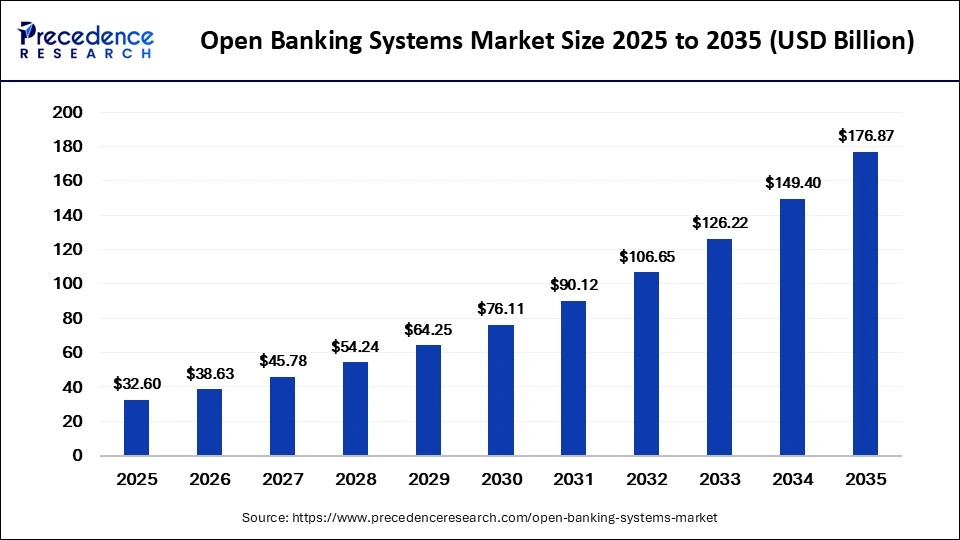
The global open banking systems market size was calculated at USD 32.60 billion in 2025 and is predicted to increase from USD 38.63 billion in 2026 to approximately USD 176.87 billion by 2035, expanding at a CAGR of 18.40% from 2026 to 2035. The market is rapidly growing due to the government’s critical regulation for open banking adoption and demand for personalized financial services with strict regulations of data security.
Market Highlights
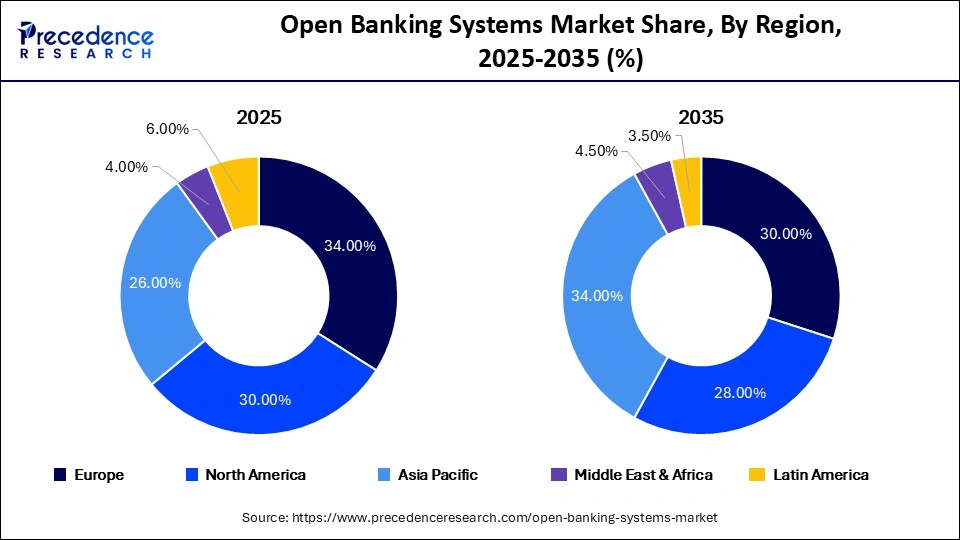
- Europe held the largest open banking systems market share of 34% in 2025.
- Asia-Pacific is expected to grow at the fastest CAGR of 24% during the foreseeable period.
- By solution type, the payments and transactions segment held the largest market share of 28% in 2025 and is expected to sustain its dominance with a CAGR of 20.5% during the forecast period.
- By solution type, the API management segment held the second-largest market share of 24% in 2025.
- By deployment mode, the cloud-based segment held the largest market share of 62% in 2025 and is expected to grow at the fastest CAGR of 22% in the coming years.
- By deployment mode, the on-premise segment held the second-largest open banking systems market share of 24% in 2025.
- By financial service, the banking and capital markets segment held the largest market share of 32% in 2025.
- By financial service, the payments segment held the second-largest market share of 24% in 2025 and is expected to grow at a CAGR of 22.5% during the foreseeable period.
- By end use, the retail banking segment held the largest market share of 38% in 2025.
- By end use, the corporate banking segment held the second-largest market share of 24% in 2025 and is projected to grow at a CAGR of 15.5% during the foreseeable period.
Market Overview
The Open Banking Systems Market is revolutionizing the global financial services landscape by enabling secure and consent-based sharing of customer financial data between banks and authorized third-party providers. Through the use of Application Programming Interfaces (APIs), open banking creates a connected ecosystem where consumers can access innovative financial products and services tailored to their needs.
Financial institutions are increasingly moving beyond traditional banking models and embracing digital transformation initiatives that prioritize customer experience, transparency, and operational efficiency. Open banking enables seamless integration between banks, fintech companies, payment providers, lenders, and digital commerce platforms, allowing users to manage their financial activities through unified digital interfaces.
The growing demand for personalized financial services, digital payments, embedded finance solutions, and real-time transaction capabilities is accelerating the adoption of open banking systems worldwide. Regulatory initiatives supporting data portability and customer-controlled financial information are further encouraging financial institutions to modernize their infrastructure and expand API-driven services.
As consumer expectations evolve and digital ecosystems continue to expand, open banking is emerging as a foundational component of the future financial services industry.
AI Impact on the Open Banking Systems Market
Artificial intelligence is playing a transformative role in the evolution of open banking by enhancing the way financial institutions analyze data, automate services, and engage with customers.
AI-powered analytics enable banks and fintech providers to process large volumes of customer transaction data and generate personalized financial recommendations. Intelligent systems can identify spending patterns, predict future financial needs, optimize savings strategies, and recommend tailored lending or investment products.
The integration of AI-driven virtual assistants and agentic banking platforms is creating a new generation of digital financial advisors capable of providing real-time financial guidance and automated decision-making support. These intelligent systems improve customer experiences while reducing operational complexity for financial institutions.
AI also strengthens fraud detection, risk management, and regulatory compliance efforts. Advanced machine learning algorithms can identify unusual transaction behaviors, detect suspicious activities, and enhance cybersecurity frameworks across open banking ecosystems.
As financial institutions increasingly leverage artificial intelligence, open banking platforms are evolving from simple data-sharing systems into intelligent financial ecosystems that proactively support consumers and businesses.
Growth Factors Driving the Open Banking Systems Market
Rising Demand for Personalized Financial Services
Consumers increasingly expect financial products and services that align with their unique needs and preferences. Open banking enables financial institutions to leverage customer data more effectively, creating customized experiences and improving customer engagement.
Expansion of Embedded Finance
Embedded finance is rapidly transforming digital commerce by integrating banking, lending, insurance, and payment services directly into non-financial platforms. Open banking provides the technological foundation required to support these seamless financial experiences.
Regulatory Support and Industry Modernization
Government regulations encouraging secure data sharing and consumer data ownership continue to drive open banking adoption. These frameworks promote competition, innovation, and transparency across financial services markets.
Growth of Digital Payments
The increasing popularity of digital wallets, account-to-account payments, and real-time transaction systems is accelerating demand for open banking infrastructure. Consumers and businesses are seeking faster, more secure, and cost-efficient payment methods.
Increasing Fintech-Bank Collaboration
Strategic partnerships between traditional banks and fintech companies are expanding innovation opportunities. Open banking allows organizations to combine technological agility with financial expertise, creating enhanced products and services for customers.
Cloud Adoption and API Ecosystems
The migration toward cloud-based financial infrastructure is improving scalability, flexibility, and integration capabilities. Modern API architectures enable financial institutions to quickly launch new services while maintaining high levels of security and compliance.
Emerging Trends in the Open Banking Systems Market
One of the most significant trends shaping the market is the expansion of open finance. Unlike traditional open banking models that primarily focus on banking data, open finance extends data-sharing capabilities to investments, pensions, insurance, and wealth management services. This broader ecosystem provides consumers with a comprehensive view of their financial health.
The rise of real-time payments is also transforming financial transactions. Consumers increasingly prefer direct account-to-account transfers that eliminate intermediaries and provide faster settlement times. Open banking is helping accelerate the adoption of these payment models across multiple industries.
Financial institutions are increasingly monetizing APIs by offering premium services such as identity verification, credit scoring, fraud prevention, and financial analytics. These value-added services are creating new revenue opportunities while strengthening fintech innovation.
Another important trend is the growing use of intelligent banking assistants powered by artificial intelligence. These digital agents can automate financial planning, optimize spending behavior, and provide proactive recommendations, significantly enhancing customer experiences.
Regional Insights
Europe remains one of the most mature open banking ecosystems globally due to its strong regulatory environment and early adoption of API-based financial services. Financial institutions across the region continue investing in digital transformation initiatives aimed at improving customer experiences, increasing competition, and expanding financial innovation. The widespread adoption of open banking frameworks has encouraged collaboration between banks and fintech companies, leading to the development of advanced payment solutions and personalized financial services.
North America is witnessing significant momentum in open banking adoption as financial institutions increasingly embrace digital-first business models. Banks and fintech providers are investing heavily in API platforms, cloud technologies, and artificial intelligence to create connected financial ecosystems. Growing consumer demand for digital banking experiences and innovative payment solutions is encouraging organizations to accelerate open banking implementation across the region.
Asia-Pacific is emerging as a major growth hub for open banking systems due to rapid digitalization, expanding fintech ecosystems, and increasing smartphone penetration. Countries across the region are promoting financial inclusion initiatives and encouraging innovation through supportive regulatory frameworks. The growing popularity of digital payments, super-app ecosystems, and embedded finance solutions is creating substantial opportunities for open banking adoption.
Latin America is experiencing growing interest in open banking as governments and financial institutions work to expand access to financial services. Digital banking platforms and fintech startups are helping transform the region’s financial landscape by offering more accessible and customer-centric solutions. Open banking is expected to play a critical role in improving financial inclusion and fostering innovation across underserved markets.
The Middle East and Africa region is steadily adopting open banking technologies as part of broader digital transformation strategies. Financial institutions are increasingly investing in digital infrastructure, cybersecurity, and customer-centric banking solutions. Government-led initiatives aimed at modernizing financial services and expanding digital economies are supporting the development of open banking ecosystems throughout the region.
Conclusion
The Open Banking Systems Market is reshaping the future of financial services by enabling secure data sharing, fostering innovation, and creating more personalized customer experiences. As artificial intelligence, embedded finance, real-time payments, and open finance continue to gain momentum, financial institutions are transforming into connected digital ecosystems capable of delivering smarter and more efficient services.
With strong regulatory support, increasing fintech collaboration, and growing consumer demand for digital financial solutions, open banking is positioned to become a cornerstone of the global financial industry. Organizations that successfully leverage open banking technologies and AI-driven capabilities will be better equipped to thrive in the rapidly evolving digital economy.
Open Banking Systems Market Key Players
- Plaid Inc
- Tink AB
- Yodlee Inc.
- Finicity
- Salt Edge
- TrueLayer
- Token.io
- Mastercard Open Banking
- Visa Open Banking
- Finastra
- Mambu
- Temenos AG
- Oracle Financial Services
- IBM Corporation
- Accenture plc
Recent Developments
- In March 2026, a leading global provider of payments and financial technology solutions, Fiserv, Inc., introduced AgentOS. It is an operating system designed to help financial institutions deploy, manage, and scale AI agents across their banking workflows.
- In December 2025, Regulated Open Banking went live in New Zealand to enable faster loan approvals, easier bill management, and personalized budgeting insights. Open Banking in New Zealand is supported by a set of regulations established under the Customer and Product Data Act 2025.
Segments Covered in the Report
By Solution Type
- API Management
- Payments and Transactions
- Digital Banking Platforms
- Data Analytics and Personal Finance Management
- Identity and Fraud Management
- Lending and Credit Solutions
By Deployment Mode
- Cloud-based
- On premises
- Hybrid
By Financial Service
- Banking and Capital Markets
- Payments
- Digital Wallets
- Personal Finance Management
- Insurance
- Lending Platforms
By End-use
- Retail Banking
- Corporate Banking
- Investment Banking
- Financial Institutions
- Government and Regulatory Bodies
By Region
- North America
- Latin America
- Europe
- Asia-pacific
- Middle and East Africa
Read Also : Neuroinflammation Market
Get Sample Link : https://www.precedenceresearch.com/sample/8436

- Farm Management Software Market: Digital Agriculture Driving Smarter and More Sustainable Farming - July 9, 2026
- AI in CGT Manufacturing Market: Artificial Intelligence Accelerating the Future of Cell and Gene Therapy Production - July 9, 2026
- 3T MRI System Market: Advanced Imaging Technology Transforming Modern Diagnostics - July 9, 2026