
What is the AI in Pharmaceutical Market Size?
The global AI in pharmaceutical market size is valued at USD 1.94 billion in 2025 and is predicted to increase from USD 2.51 billion in 2026 to approximately USD 18.99 billion by 2035, expanding at a CAGR of 25.62% from 2026 to 2035. The increasing demand for innovative and effective drugs, rising focus on regulatory compliance and safety, rising prevalence of chronic diseases, and rising use of AI in drug discovery & development are expected to drive the growth of the AI in pharmaceutical market during the forecast period.
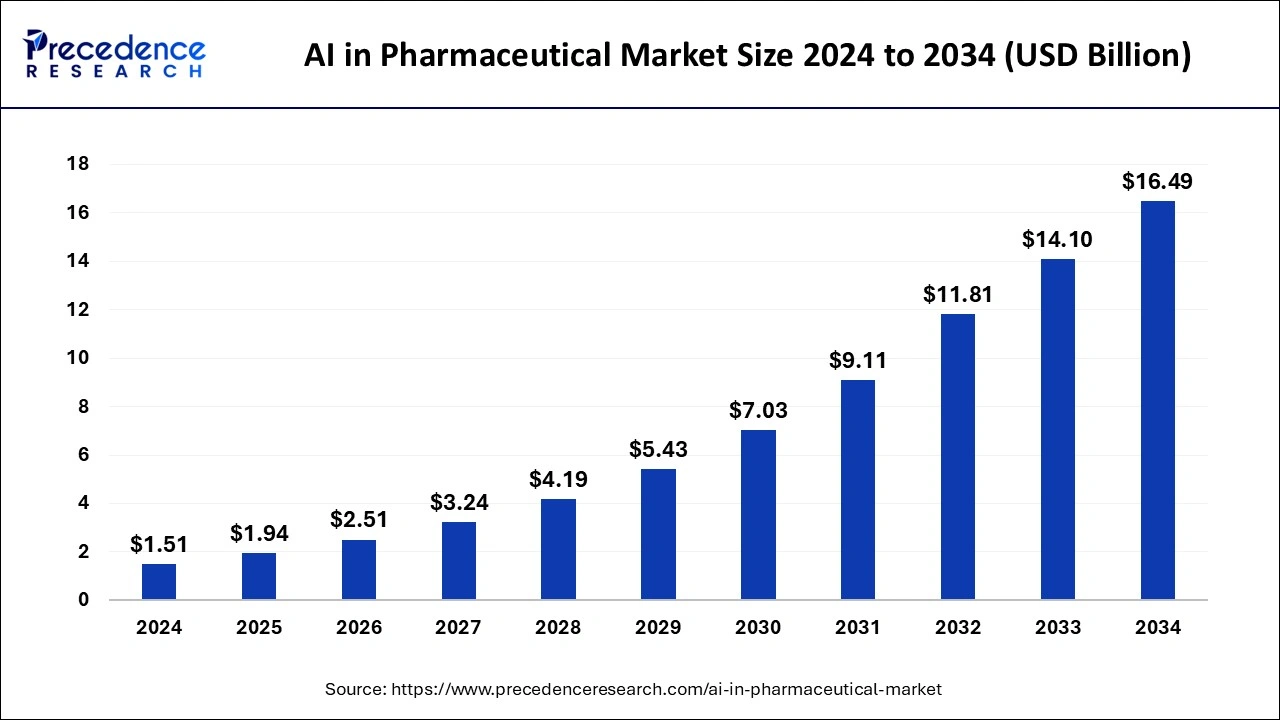
Market Highlights
- North America dominated the global AI in pharmaceutical market with the largest market share of 35% in 2025.
- Asia Pacific is projected to grow at the fastest CAGR during the forecast period.
- By drug type, the small molecules segment contributed the highest market share of 66% in 2025.
- By drug type, the large molecules segment is projected to grow at a solid during the forecast period.
- By technology, the deep learning segment accounted for the highest market share in 2025.
Market Overview
Artificial intelligence (AI) is rapidly transforming the pharmaceutical industry by streamlining drug discovery, improving clinical research, optimizing manufacturing operations, and enabling personalized medicine. Pharmaceutical companies are increasingly leveraging AI technologies to analyze massive healthcare datasets, accelerate drug development timelines, and improve decision-making across research and production processes. AI-powered systems are helping organizations identify potential drug candidates faster, reduce operational costs, and improve treatment effectiveness, reshaping the future of modern healthcare.
The growing integration of AI into pharmaceutical workflows is also enhancing supply chain management, predictive maintenance, and quality monitoring. Advanced machine learning algorithms can forecast market demand, optimize inventory management, and improve product quality assurance processes. As pharmaceutical companies continue to invest in digital transformation and intelligent automation, AI is becoming a critical technology driving innovation and operational efficiency across the global healthcare ecosystem.
AI in Pharmaceutical Market Growth Factors
One of the primary factors driving the market is the increasing adoption of AI in clinical trials. AI-based platforms help pharmaceutical companies identify suitable patient populations, predict adverse drug reactions, and improve trial efficiency through data-driven insights. These technologies significantly reduce the time and cost associated with traditional clinical research processes while improving success rates in drug development.
Rising healthcare expenditure, supportive government initiatives, and growing investments in healthcare digitalization are further accelerating the adoption of AI in the pharmaceutical industry. Pharmaceutical companies are increasingly collaborating with AI technology providers to strengthen drug discovery, genomics research, and manufacturing automation capabilities. The growing use of predictive analytics, virtual clinical trials, robotic process automation, and AI-powered research platforms is helping companies enhance operational performance and accelerate innovation.
Another key growth factor is the increasing deployment of AI-enabled robotics and automated systems in pharmaceutical manufacturing and logistics. These technologies improve production accuracy, minimize equipment downtime, optimize inventory management, and streamline distribution networks. AI-driven automation is also helping companies maintain regulatory compliance and improve supply chain resilience in an increasingly competitive pharmaceutical landscape.
Market Outlook
The AI in pharmaceutical market is expected to witness substantial growth over the coming years due to increasing investments in digital healthcare transformation and precision medicine initiatives. Strong economic growth, expanding healthcare infrastructure, and favorable government policies supporting AI innovation are creating new opportunities for pharmaceutical companies worldwide. AI technologies are expected to play a critical role in accelerating drug development pipelines, reducing research costs, and improving patient outcomes across various therapeutic areas.
North America continues to lead the market due to advanced healthcare infrastructure, strong AI research capabilities, and the presence of leading pharmaceutical and biotechnology companies. Europe is also witnessing increasing adoption of AI-powered healthcare technologies, supported by government-backed digital health initiatives and growing investments in pharmaceutical R&D. Meanwhile, Asia-Pacific is emerging as a rapidly growing region driven by expanding healthcare expenditure, rising biotechnology investments, and increasing adoption of AI-driven healthcare solutions in countries such as China, Japan, and India.
Competitive Landscape and Startup Ecosystem
Leading pharmaceutical companies including Pfizer, Novartis, AstraZeneca, and Johnson & Johnson are actively investing in AI technologies to improve drug discovery, manufacturing efficiency, and personalized treatment development. Strategic collaborations between pharmaceutical firms and AI startups are accelerating innovation in predictive modeling, genomics analysis, and automated clinical research.
The startup ecosystem in the AI pharmaceutical market is expanding rapidly, with emerging companies developing advanced AI algorithms, bioinformatics platforms, and machine learning solutions for drug discovery and precision medicine applications. These startups are helping pharmaceutical companies reduce research timelines, improve clinical trial success rates, and unlock new opportunities in next-generation healthcare innovation.
Market Scope
| Report Coverage | Details |
| Market Size in 2025 | USD 1.94 Billion |
| Market Size in 2026 | USD 2.51 Billion |
| Market Size by 2035 | USD 18.99 Billion |
| Growth Rate from 2026 to 2035 | 25.62% |
| Largest Market | North America |
| Base Year | 2025 |
| Forecast Period | 2026 to 2035 |
| Segment Covered | Technology, Drug Type, Application, and Region |
| Regions Covered | North America, Europe, Asia-Pacific, Latin America, and the Middle East & Africa |
Opportunity
Rising demand for personalized medicine
The growing demand for personalized medicine is projected to offer lucrative growth opportunities to the market players in the coming years. AI holds great potential for personalized medicine, to improve the treatment of various chronic diseases. Leveraging AI algorithms assists in using genomic data and past medical histories to identify patterns and make appropriate predictions to personalize patient treatments which often results in becoming more effective therapies with lessening side effects. For instance, the usage of AI can aid in determining the exact dosage of drugs based on the patient’s unique genetic makeup, thus raising the treatment efficacy and minimizing risks.
In October 2024, BioNTech and its AI subsidiary InstaDeep unveiled their AI strategy at an event called “AI Day.” The companies plan to use new models and supercomputers to accelerate the development of vaccines and cancer therapies. With InstaDeep as its in-house AI specialist, BioNTech aims to advance the use of AI in developing personalized vaccines and targeted treatments. A key focus is the DeepChain platform, which uses various omics data for drug design
Regional Insights
North America remains a leading region in the AI in pharmaceutical market due to the strong presence of global pharmaceutical companies, advanced healthcare infrastructure, and significant investments in artificial intelligence research. The region is witnessing rapid adoption of AI-powered drug discovery platforms, predictive analytics, and virtual clinical trial technologies. Increasing collaborations between pharmaceutical firms, biotechnology companies, and AI startups are accelerating innovation in precision medicine and personalized treatment development. Additionally, supportive regulatory initiatives and rising healthcare digitalization are further strengthening market growth across the region.
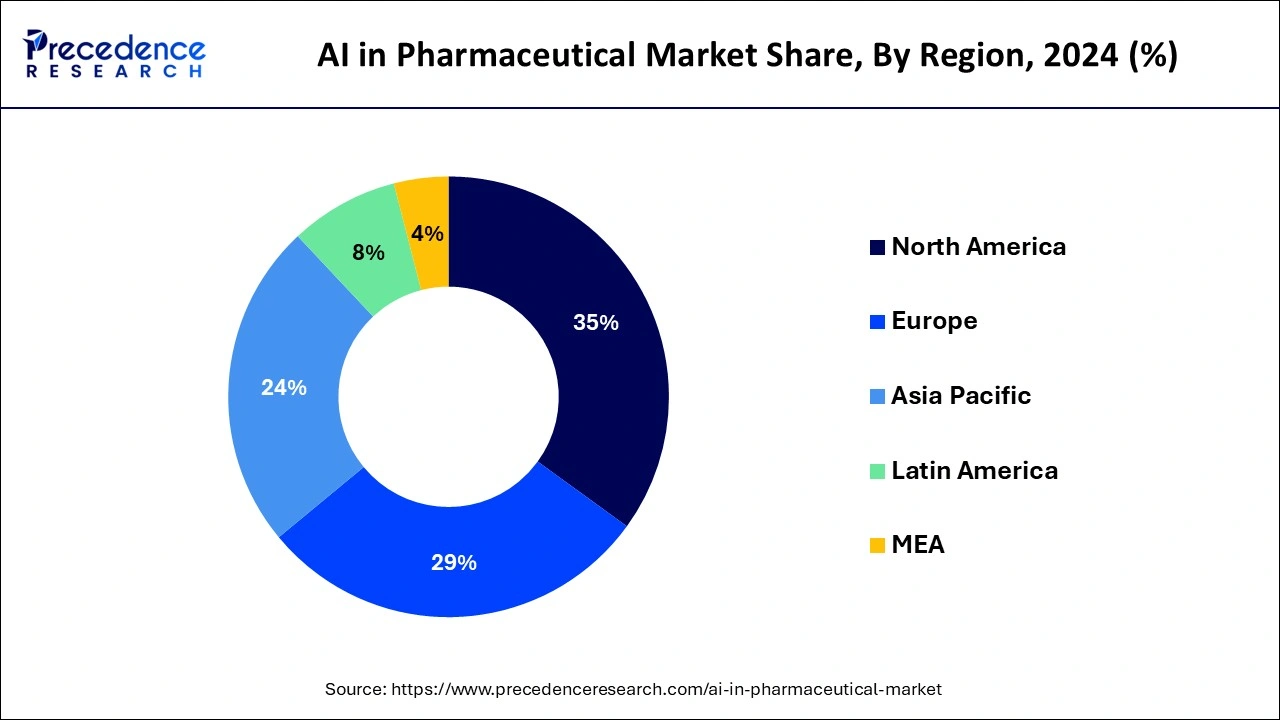
Europe is experiencing substantial growth in the AI pharmaceutical market driven by increasing investments in healthcare technology, expanding pharmaceutical research activities, and supportive government policies promoting digital healthcare transformation. Countries such as Germany, the United Kingdom, and France are focusing on integrating AI into clinical research, genomics, and pharmaceutical manufacturing processes. The region is also witnessing growing adoption of AI-powered diagnostics, robotic automation, and real-world data analytics to improve drug development efficiency and patient care outcomes.
Asia-Pacific is emerging as one of the fastest-growing regions in the AI pharmaceutical market due to rising healthcare expenditure, rapid advancements in biotechnology, and increasing adoption of digital healthcare solutions. Countries including China, Japan, and India are investing heavily in AI research, pharmaceutical innovation, and smart healthcare infrastructure. The growing pharmaceutical manufacturing sector, expanding clinical trial activities, and rising government support for AI-driven healthcare technologies are significantly contributing to regional market expansion. Additionally, the increasing prevalence of chronic diseases and demand for precision medicine are accelerating AI adoption across the healthcare ecosystem.
The AI pharmaceutical market in Latin America is gradually expanding as pharmaceutical companies and healthcare providers increasingly adopt digital technologies to improve operational efficiency and patient care. Countries such as Brazil and Mexico are witnessing growing investments in healthcare modernization, AI-based diagnostics, and pharmaceutical research. The rising focus on improving clinical trial efficiency and drug development processes is expected to create new opportunities for AI integration across the regional pharmaceutical sector.
The Middle East & Africa region is witnessing steady growth in the AI pharmaceutical market due to increasing investments in healthcare infrastructure, digital transformation initiatives, and smart healthcare technologies. Governments across the Gulf region are actively promoting AI adoption in healthcare and pharmaceutical research to improve medical services and operational efficiency. Growing partnerships between healthcare providers, pharmaceutical companies, and technology firms are expected to support the adoption of AI-driven drug discovery, diagnostics, and supply chain management solutions in the coming years.
AI in Pharmaceutical Market Companies
- IBM Corporation
- Exscientia
- Deep Genomics
- Cloud Pharmaceuticals, Inc.
- Microsoft Corporation
- NVIDIA Corporation
- Insilico Medicine
- Alphabet Inc.
- Atomwise, Inc.
- Biosymetrics
- Euretos
- BenevolentAI
Recent Developments
- In September 2024, Silver Touch Technologies Limited incorporated a new subsidiary, AI4Pharma Tech Limited, to develop artificial intelligence solutions for the pharmaceutical industry. AI4Pharma Tech Limited aims to create AI-based tools for regulatory submissions, monitoring, and compliance within the pharmaceutical sector.
- In January 2025, Absci Corporation, a data-first generative AI drug creation company, and Owkin, a TechBio that uses agentic AI to unlock complex targets for drug discovery, development, and diagnostics, announced a partnership bringing together two leading AI platforms to rapidly discover and design novel therapeutics for patients.
Segments Covered in the Report
By Technology
- Natural Language Processing
- Context-Aware Processing
- Deep Learning
- Querying Method
By Drug Type
- Large Molecules
- Small Molecules
By Application
- Drug Discovery
- Clinical Trial
- Research & Development
- Others
By Region
- North America
- Latin America
- Europe
- Asia-pacific
- Middle and East Africa
Also Read : Payment Security Market
Get Sample Link : https://www.precedenceresearch.com/sample/1485

- Farm Management Software Market: Digital Agriculture Driving Smarter and More Sustainable Farming - July 9, 2026
- AI in CGT Manufacturing Market: Artificial Intelligence Accelerating the Future of Cell and Gene Therapy Production - July 9, 2026
- 3T MRI System Market: Advanced Imaging Technology Transforming Modern Diagnostics - July 9, 2026