
The global generative AI in coding market is projected to grow from USD 50.25 million in 2025 to USD 479.71 million by 2035, driven by AI coding assistants, low-code development, software automation, and rising enterprise adoption of AI-powered programming tools.
Generative AI in Coding Market: AI Coding Assistants Transforming the Future of Software Development
The global generative AI in coding market is witnessing rapid expansion as organizations increasingly adopt AI-powered coding assistants, automated software development tools, and intelligent code-generation platforms to accelerate productivity and improve software delivery efficiency. Enterprises, startups, and development teams are integrating generative AI technologies into coding workflows to automate repetitive programming tasks, enhance code quality, and reduce development timelines.
According to Precedence Research, the global generative AI in coding market size was valued at USD 50.25 million in 2025 and is projected to reach approximately USD 479.71 million by 2035, growing at a CAGR of 25.31% from 2026 to 2035.
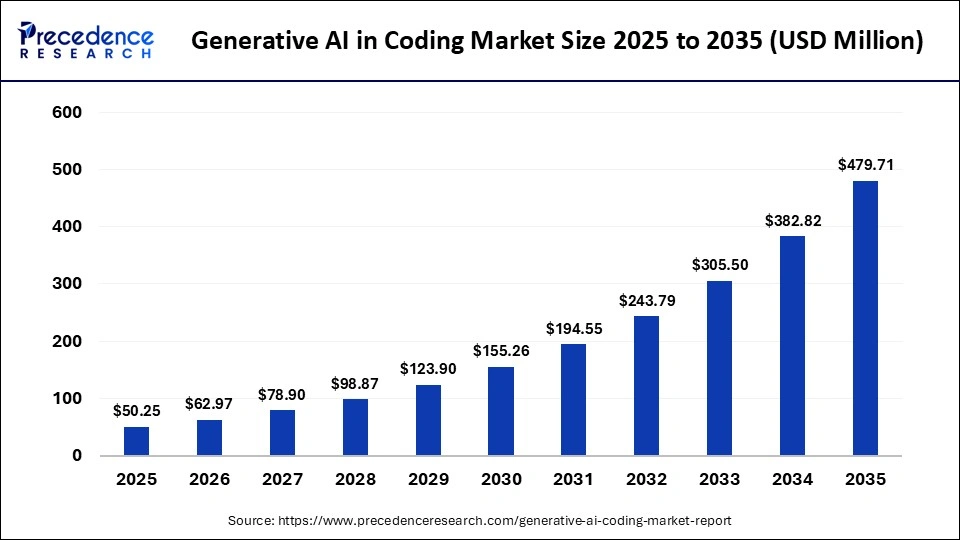
The growing shortage of skilled software developers, increasing pressure for faster application deployment, and rapid adoption of low-code/no-code platforms are major factors driving market growth worldwide.
Read Also: Generative AI in Animation Market
Understanding Generative AI in Coding
Generative AI in coding refers to the use of large language models (LLMs), machine learning algorithms, and AI copilots to automate software development activities such as code generation, debugging, code review, testing, documentation, and refactoring.
These AI systems can interpret natural language prompts and generate executable code snippets across multiple programming languages. Modern generative AI coding platforms are transforming traditional software engineering workflows into highly automated and intelligent development ecosystems.
Generative AI tools are increasingly used for:
- Automated code generation
- Intelligent debugging
- Code enhancement
- Software testing
- Documentation creation
- Language translation
- Workflow automation
- API integration
- Refactoring legacy systems
The increasing integration of AI coding assistants into integrated development environments (IDEs) is accelerating adoption across enterprises globally.
Key Market Highlights
- The generative AI in coding market was valued at USD 50.25 million in 2025.
- The market is projected to reach USD 479.71 million by 2035.
- The market is expected to grow at a CAGR of 25.31%.
- North America accounted for 33% of total market revenue in 2025.
- Asia-Pacific is expected to witness the fastest growth during the forecast period.
- The code generation segment dominated the market in 2025.
- Web and application development is expected to register the fastest CAGR.
- IT and telecom emerged as the leading industry vertical globally.
AI Coding Assistants Driving Market Growth
One of the strongest growth drivers for the market is the increasing enterprise adoption of AI-powered coding assistants.
Software developers are under continuous pressure to accelerate development cycles while maintaining software quality and reducing operational costs. Generative AI coding tools are helping developers automate repetitive tasks such as boilerplate code generation, bug fixes, testing, and documentation.
AI-powered copilots can significantly improve development efficiency by offering:
- Real-time code suggestions
- Automated syntax correction
- Intelligent debugging support
- Faster prototyping
- Code optimization recommendations
- Natural language-to-code conversion
These capabilities are helping enterprises improve software delivery speed and reduce developer workloads.
Recent industry surveys indicate that AI adoption among developers has surged dramatically, with approximately 90% of developers now using AI tools regularly in coding workflows.
Shift from Copilot to Agentic AI Reshaping Development
The market is evolving rapidly from basic AI copilots toward advanced agentic AI systems capable of handling complex, multi-step software engineering tasks.
Modern generative AI systems can now:
- Analyze entire codebases
- Plan development workflows
- Perform autonomous debugging
- Refactor applications
- Generate test scripts
- Assist in deployment automation
The growing trend of “repo grokking” allows AI systems to understand broader codebase contexts rather than isolated files, improving development accuracy and contextual understanding.
Researchers increasingly describe the transition toward chat-oriented programming and agentic development workflows as a major transformation in software engineering practices.
Increasing Demand for Low-Code and No-Code Platforms
The rising popularity of low-code and no-code development environments is creating significant opportunities for generative AI in coding technologies.
Organizations are increasingly empowering non-technical users and business teams to build applications through AI-assisted development platforms. These tools simplify software creation by converting natural language instructions into executable code.
Benefits of AI-assisted low-code platforms include:
- Faster application development
- Reduced dependency on manual coding
- Improved accessibility for non-developers
- Lower development costs
- Accelerated digital transformation
The democratization of software development is expected to become one of the major long-term growth drivers for the industry.
Hyper-Automation Accelerating Enterprise Adoption
Hyper-automation is emerging as a key opportunity area in the generative AI in coding market.
AI systems are evolving from simple assistants into autonomous agents capable of handling complete software development workflows, including:
- Requirement analysis
- Full codebase generation
- Legacy modernization
- Automated testing
- Deployment optimization
Organizations are increasingly using generative AI tools to modernize legacy programming languages such as COBOL into modern languages like Python, reducing migration costs and improving operational efficiency.
Segmental Analysis
By Operation
Code Generation Segment Dominates the Market
The code generation segment accounted for the largest market share in 2025 due to its ability to automate repetitive programming tasks and improve software development productivity.
Generative AI coding systems can generate executable code directly from natural language prompts, reducing manual effort and accelerating development timelines.
Code Enhancement Segment Expected to Grow Rapidly
The code enhancement segment is expected to witness the fastest growth during the forecast period.
Organizations are increasingly adopting AI systems for:
- Refactoring existing applications
- Optimizing software performance
- Detecting vulnerabilities
- Improving code readability
- Reducing technical debt
AI-driven code enhancement tools are becoming critical for managing large and complex enterprise codebases.
Language Translation and Code Review Expanding
AI systems are increasingly used for translating legacy code into modern programming languages and automating software review processes.
These technologies improve interoperability and streamline modernization initiatives across enterprises.
By Application
Data Science and Analytics Segment Leads the Market
The data science and analytics segment dominated the market in 2025 due to growing use of generative AI tools for automating data processing, model development, and analytics workflows.
AI-powered coding tools help data scientists accelerate model training, automate scripting, and improve workflow efficiency.
Web and Application Development Emerging as Fastest-Growing Segment
Web and application development is projected to register the fastest CAGR during the forecast period due to rising demand for rapid application deployment and AI-assisted front-end and back-end development.
Developers are increasingly leveraging AI tools to generate APIs, automate UI development, and improve deployment speed.
Game Development and IoT Applications Expanding
Gaming studios and IoT developers are adopting generative AI coding systems to automate complex workflows and accelerate software production cycles.
By Industry Vertical
IT and Telecom Segment Holds Largest Share
The IT and telecom sector dominated the market in 2025 due to strong investments in AI-driven software engineering and cloud-native development environments.
Technology companies are rapidly integrating generative AI tools into enterprise software development pipelines.
Media and Entertainment Witnessing Fastest Growth
The media and entertainment sector is expected to witness the highest CAGR during the forecast period due to increasing demand for AI-assisted game development, animation, and digital content platforms.
BFSI and Healthcare Expanding AI Adoption
Financial institutions and healthcare organizations are increasingly adopting AI coding tools for workflow automation, compliance systems, and secure software development initiatives.
Regional Insights
North America
North America dominated the generative AI in coding market in 2025 due to:
- Strong AI research ecosystem
- High cloud adoption
- Presence of leading AI companies
- Advanced software development infrastructure
- Significant venture capital investments
The United States continues to lead global innovation in AI coding assistants and enterprise software automation platforms.
Europe
Europe is witnessing steady market growth supported by increasing investments in enterprise AI adoption, software modernization, and digital transformation programs.
Countries such as Germany, the UK, and France are actively supporting AI innovation across software engineering sectors.
Asia-Pacific
Asia-Pacific is expected to witness the fastest growth during the forecast period due to:
- Expanding startup ecosystem
- Rapid digitalization
- Growing IT outsourcing industry
- Increasing cloud adoption
- Rising AI investments
China, India, Japan, and South Korea are becoming major growth hubs for AI-assisted software development technologies.
Competitive Landscape
The generative AI in coding market is highly competitive and innovation-driven. Companies are aggressively investing in AI-powered development platforms, autonomous coding systems, and cloud-native software engineering tools.
Major industry participants include:
- OpenAI
- Microsoft Corporation
- Google LLC
- IBM Corporation
- NVIDIA Corporation
- Tabnine
- Codium AI
These companies are focusing on:
- Agentic AI development
- AI-powered IDE integration
- Autonomous debugging
- Secure code generation
- Enterprise AI copilots
- Multi-agent coding systems
Challenges Facing the Market
Despite strong growth potential, the market faces several challenges.
Security Risks in AI-Generated Code
Studies indicate that a significant percentage of AI-generated code may contain vulnerabilities or logical flaws if not reviewed properly. Recent research found that nearly 45% of AI-generated code samples contained security issues.
Over-Reliance on AI Tools
Excessive dependence on AI coding systems may reduce developers’ problem-solving capabilities and software architecture expertise.
Trust and Reliability Concerns
Developers continue expressing concerns regarding hallucinations, inaccurate outputs, and lack of contextual understanding in AI-generated code.
Productivity Gains Still Under Evaluation
Some industry analysts argue that while AI coding tools improve specific workflows, broader enterprise productivity gains remain inconsistent without full process transformation.
Emerging Trends Reshaping the Industry
Rise of Agentic AI Systems
AI agents capable of independently managing complex software engineering tasks are becoming increasingly sophisticated.
Integration of Small Language Models
Organizations are increasingly adopting lightweight coding models that can run locally for improved security and faster performance.
AI-Assisted Legacy Modernization
Enterprises are using generative AI to modernize legacy applications and reduce migration timelines.
Democratization of Software Development
Natural language-based coding systems are enabling non-technical users to participate in application development.
Expansion of AI-Native Development Workflows
AI-assisted development is reshaping traditional software engineering practices and collaborative coding environments.
Future Outlook
The future of the generative AI in coding market appears exceptionally promising as enterprises increasingly integrate AI into software engineering workflows.
Advancements in large language models, autonomous AI agents, multimodal AI systems, and secure code-generation technologies are expected to redefine how software is designed, tested, and deployed.
As organizations continue prioritizing automation, cloud-native development, and accelerated digital transformation, demand for generative AI coding tools is expected to grow substantially throughout the forecast period.
Conclusion
The generative AI in coding market is transforming the global software development landscape through intelligent automation, AI-assisted programming, and autonomous development systems.
From code generation and debugging to legacy modernization and workflow automation, generative AI technologies are enabling organizations to improve productivity, reduce costs, and accelerate innovation.
With the market projected to surpass USD 479.71 million by 2035, the industry presents substantial opportunities for AI platform providers, software development companies, cloud vendors, and enterprise technology firms seeking to capitalize on the future of intelligent software engineering.
Get a Sample Copy: https://www.precedenceresearch.com/sample/8226
For inquiries regarding discounts, bulk purchases, or customization requests, please contact us at sales@precedenceresearch.com