
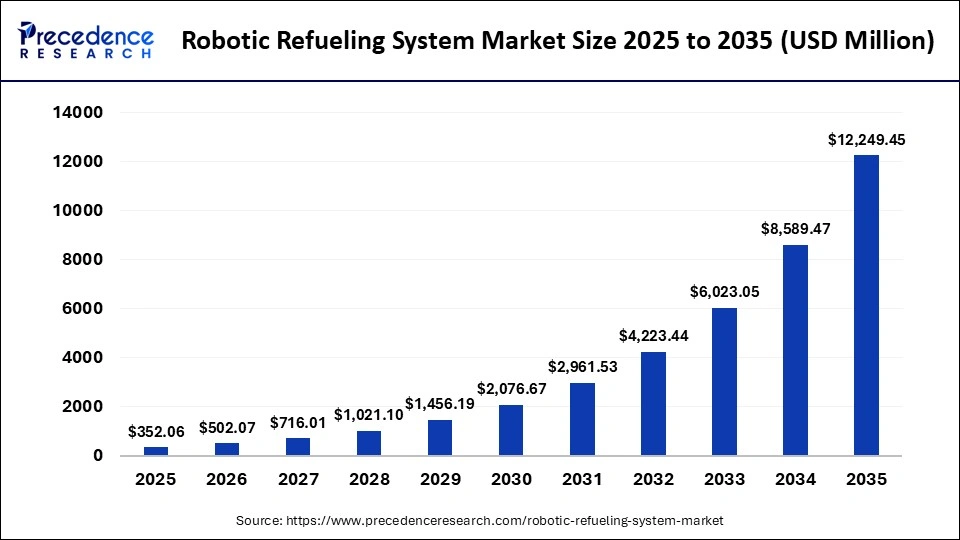
The global robotic refueling system market is projected to grow from USD 502.07 million in 2026 to USD 12,249.45 million by 2035 at a CAGR of 42.61%. Explore market trends, AI-driven innovations, regional insights, segment analysis, and key companies shaping the industry.
Read Also: Machine Automation Controller Market
Robotic Refueling System Market Size, Share, Trends and Forecast 2026 to 2035
The global robotic refueling system market is witnessing explosive growth due to increasing automation across transportation, aerospace, military, and industrial sectors. Rising demand for safer, faster, and more efficient fueling operations is encouraging organizations to adopt robotic refueling technologies that minimize human intervention while improving operational accuracy and workplace safety.
According to recent industry analysis, the global robotic refueling system market size was valued at USD 352.06 million in 2025 and is expected to increase from USD 502.07 million in 2026 to approximately USD 12,249.45 million by 2035, expanding at a remarkable CAGR of 42.61% during the forecast period.
The rapid expansion of autonomous fleets, electric vehicles (EVs), hydrogen-powered transportation, industrial robotics, and AI-driven fueling infrastructure is significantly accelerating market growth worldwide.
Market Overview
Robotic refueling systems are automated technologies that use robotic arms, computer vision, AI algorithms, and sensor-based systems to perform fueling or charging operations with minimal or no human involvement.
These systems are increasingly used in:
- Airports
- Military bases
- Commercial fuel stations
- EV charging hubs
- Marine ports
- Logistics depots
- Industrial facilities
The primary advantages of robotic refueling systems include:
- Improved worker safety
- Faster fueling operations
- Reduced labor dependency
- Precision fuel delivery
- Reduced operational errors
- Enhanced automation efficiency
North America dominated the global robotic refueling system market with 43% market share in 2025, while Asia-Pacific is projected to witness the fastest growth during the forecast period.
How AI is Transforming the Robotic Refueling System Market
Artificial intelligence (AI) is becoming a critical technology within robotic refueling systems. AI-powered solutions improve nozzle alignment, fuel detection accuracy, operational monitoring, and predictive maintenance.
AI algorithms are increasingly used for:
- Autonomous nozzle positioning
- Leak detection
- Fire risk monitoring
- Real-time fuel optimization
- Fleet energy management
- Predictive maintenance
- Smart charging automation
AI-driven systems help robotic fueling stations perform highly accurate and contactless refueling operations while minimizing operational downtime.
In March 2026, NextNRG launched an AI-driven platform designed to enhance automated EV refueling and charging operations.
The integration of AI with robotics and IoT technologies is expected to redefine fueling infrastructure over the next decade.
Key Market Drivers
Rising Adoption of Electric Vehicles (EVs)
The growing adoption of battery electric vehicles is significantly driving demand for robotic charging and refueling systems.
Automated charging systems offer several advantages for EV operators, including:
- Faster charging operations
- Reduced manual intervention
- Improved charging efficiency
- Better fleet management
- Enhanced safety standards
According to Statbase Organization, approximately 1.2 million EVs were sold in the United States during 2024.
The expansion of autonomous EV fleets is expected to further accelerate demand for robotic charging infrastructure.
Increasing Demand for Automation in Fueling Operations
Industries are increasingly deploying automated fueling systems to improve efficiency and reduce labor costs.
Robotic refueling systems are particularly valuable in hazardous environments where human exposure to flammable materials can create operational risks.
The aerospace and military sectors are rapidly adopting automated fueling technologies for improved precision and operational speed.
Expansion of Hydrogen Fuel Infrastructure
Hydrogen-powered transportation is emerging as a major growth segment for robotic refueling systems.
Hydrogen fueling requires extremely precise handling due to safety concerns associated with highly flammable gases.
Robotic systems provide:
- Precise nozzle positioning
- Leak prevention
- Consistent fueling accuracy
- Automated pressure monitoring
The hydrogen segment dominated the market in 2025 due to rising hydrogen vehicle adoption and increasing government investments in clean energy infrastructure.
Emerging Market Trends
Growth of Autonomous Refueling Stations
Petroleum and energy companies are increasingly investing in autonomous fueling stations capable of operating without direct human supervision.
Countries such as China and Japan are actively expanding automated fueling infrastructure to support smart mobility ecosystems.
Increasing Adoption in Aerospace and Defense
The aerospace segment accounted for the largest market share in 2025 due to rising deployment of robotic fueling systems in airports, military airbases, and aviation maintenance facilities.
Automated refueling systems are increasingly being used for:
- Military aircraft refueling
- Drone fueling
- Autonomous aviation systems
- Rapid turnaround operations
Defense agencies are prioritizing robotic fueling technologies to improve operational efficiency and reduce human risk in combat environments.
Expansion of Marine Automation
The marine segment is expected to witness the fastest growth during the forecast period due to increasing adoption of automated fueling technologies for ships and maritime logistics operations.
Robotic marine fueling systems help improve:
- Fuel transfer accuracy
- Operational safety
- Maritime efficiency
- Automated vessel servicing
Market Restraints
High Deployment and Maintenance Costs
One of the major barriers to widespread adoption is the high initial investment associated with robotic fueling infrastructure.
Costs include:
- Robotic hardware installation
- AI software integration
- Sensor deployment
- Maintenance services
- Skilled technical personnel
Small and medium-sized fueling operators may face financial limitations when adopting these advanced systems.
Technical Complexity
Robotic refueling systems require advanced integration with fueling infrastructure, automation software, and safety systems.
Operational challenges include:
- Complex calibration
- Software compatibility
- Sensor synchronization
- Real-time monitoring integration
Cybersecurity Concerns
As fueling systems become increasingly connected through IoT and cloud technologies, cybersecurity risks are emerging as a significant concern.
Potential threats include:
- Data breaches
- Operational disruption
- Remote system manipulation
- Infrastructure vulnerabilities
Segment Analysis
Fuel Type Insights
Hydrogen Segment Dominated the Market
The hydrogen segment accounted for the largest market share in 2025 due to growing hydrogen fuel infrastructure development and increasing fuel cell vehicle adoption.
Robotic systems are particularly important in hydrogen fueling due to the need for highly accurate and secure fuel transfer.
Electricity Segment to Grow Fastest
The electricity segment is projected to witness the fastest CAGR during the forecast period due to increasing deployment of robotic EV charging systems.
Automated EV charging technologies are gaining popularity across:
- Commercial charging stations
- Autonomous vehicle depots
- Smart city infrastructure
- Fleet management centers
System Type Insights
Fully Automated Systems Led the Market
The fully automated systems segment dominated the market in 2025 due to rising demand for contactless fueling operations and advanced robotic precision.
These systems provide:
- Autonomous nozzle alignment
- AI-powered fuel detection
- Remote operation capabilities
- Enhanced safety monitoring
Semi-Automated Systems to Grow Rapidly
The semi-automated systems segment is expected to witness the fastest growth due to cost-efficiency and easier implementation compared to fully autonomous systems.
Application Insights
Aerospace Segment Dominated the Market
The aerospace segment accounted for the highest market share in 2025 due to increasing automation in aviation fueling operations.
Airports and military airbases increasingly rely on robotic fueling systems to:
- Reduce turnaround time
- Improve safety
- Enhance operational efficiency
Marine Segment to Witness Strong Growth
The marine segment is projected to grow rapidly due to increasing automation in maritime fuel transfer operations.
End-Use Insights
Commercial Segment Held the Largest Share
The commercial segment dominated the market in 2025 due to increasing deployment of robotic fueling systems in logistics fleets, ride-sharing networks, and commercial fueling stations.
Military Segment Growing Rapidly
The military segment is expected to witness the fastest growth due to rising demand for autonomous fueling operations in defense applications.
Automated military fueling systems help improve:
- Battlefield safety
- Rapid deployment efficiency
- Fueling precision
- Operational automation
Regional Analysis
North America Dominated the Global Market
North America accounted for the largest market share of 43% in 2025 due to strong investment in autonomous technologies, EV infrastructure, and military modernization.
The North America robotic refueling system market was valued at USD 151.39 million in 2025 and is expected to reach approximately USD 5,328.51 million by 2035.
United States Market Trends
The U.S. remains a major contributor due to rapid adoption of:
- Autonomous fueling systems
- AI-powered robotics
- Hydrogen fueling infrastructure
- EV charging automation
The country is home to several major market players, including Textron, General Atomics, and Raytheon Technologies.
Asia-Pacific to Witness Fastest Growth
Asia-Pacific is expected to grow at the fastest CAGR during the forecast period due to increasing automation investments, EV adoption, and smart transportation development.
Key growth countries include:
- China
- Japan
- India
- Singapore
- Malaysia
China Market Trends
China is rapidly expanding its robotic fueling infrastructure due to strong growth in:
- Electric vehicle adoption
- Smart manufacturing
- Autonomous transportation
- Marine logistics
- Defense modernization
Government support for industrial automation is further accelerating regional market expansion.
Competitive Landscape
The robotic refueling system market is highly competitive, with major companies focusing on AI integration, autonomous fueling innovation, and smart energy infrastructure development.
Key Companies Operating in the Market
- Textron
- General Atomics
- Raytheon Technologies
- NextNRG
- ABB Ltd.
- Siemens AG
- Bosch Rexroth
- KUKA AG
These companies are heavily investing in:
- AI-powered robotics
- Autonomous fueling systems
- Smart charging infrastructure
- Industrial automation
- Hydrogen fueling technologies
Recent Developments
- In March 2026, NextNRG launched an AI-driven automated EV refueling platform to improve charging efficiency and operational safety.
- Major energy and automation companies are increasingly developing robotic hydrogen fueling systems to support the expansion of clean energy transportation infrastructure.
- Aerospace operators are expanding deployment of automated fueling systems to reduce aircraft turnaround times and improve operational efficiency.
Future Outlook
The future of the robotic refueling system market appears extremely promising due to increasing automation adoption, rising EV penetration, and growing demand for smart fueling infrastructure.
Emerging technologies expected to reshape the market include:
- AI-powered autonomous fueling
- Robotic EV charging
- Smart hydrogen fueling systems
- Industrial IoT integration
- Edge computing
- Autonomous fleet management
The continued rise of autonomous transportation and smart mobility ecosystems will likely drive substantial long-term demand for robotic fueling solutions.
Conclusion
The global robotic refueling system market is experiencing extraordinary growth fueled by industrial automation, autonomous transportation, AI integration, and expanding clean energy infrastructure.
Hydrogen fueling, robotic EV charging, aerospace automation, and military applications are emerging as major growth segments, while North America continues to dominate the global market.
With rapid technological innovation and increasing investments in autonomous fueling infrastructure, the robotic refueling system industry is expected to witness sustained expansion through 2035.
Get a Sample Copy: https://www.precedenceresearch.com/sample/8230
For inquiries regarding discounts, bulk purchases, or customization requests, please contact us at [email protected]
