
In today’s fast-paced business landscape, agility, collaboration, and strategic decision-making define the success of enterprises worldwide. Organizations increasingly recognize that conventional project management practices are no longer sufficient to manage the complexities of modern business. Enter Project and Portfolio Management (PPM) software, a transformative solution designed to streamline operations, enhance visibility, and drive sustainable growth.
Strategic Alignment and Decision-Making at the Core
Modern enterprises manage multiple projects simultaneously, often across geographies, business units, and diverse teams. Ensuring that every project contributes to broader business objectives is a complex challenge. PPM software addresses this by providing leaders with real-time insights into project performance, resource utilization, and financial impacts, enabling informed, strategic decision-making.
The predictive capabilities of advanced PPM platforms allow organizations to simulate project scenarios, forecast outcomes, and assess risks before committing resources. This not only minimizes errors and costly delays but also empowers decision-makers to prioritize initiatives with the highest potential for business impact. In a market defined by speed and adaptability, the ability to anticipate challenges is a competitive advantage.
Enabling Seamless Collaboration in the Hybrid Work Era
The rise of hybrid and remote work models has reshaped how teams collaborate and communicate. PPM software provides a centralized platform where team members can access project plans, timelines, updates, and shared resources in real time, regardless of their location.
Integrated communication features—such as dashboards, task comments, and automated notifications—enhance transparency and ensure that all stakeholders remain aligned. By fostering a collaborative environment, PPM solutions reduce miscommunication, enhance accountability, and enable teams to respond dynamically to project changes. The result is a culture of responsiveness, efficiency, and high-performance collaboration.
Optimizing Resources for Maximum Productivity
Effective resource management is a cornerstone of successful project execution. PPM platforms provide organizations with a comprehensive view of workforce capacity, budget allocation, and equipment utilization, allowing managers to make data-driven adjustments to maximize efficiency.
By identifying bottlenecks, preventing overutilization, and ensuring that critical tasks receive adequate attention, PPM software enables teams to meet deadlines without compromising quality. Furthermore, advanced analytics help forecast future resource requirements, identify skill gaps, and inform workforce training programs, strengthening both operational capability and organizational resilience.
Harnessing Data for Strategic Insights
The ability to leverage data effectively distinguishes leading organizations from the rest. PPM software centralizes project information and translates it into actionable insights through advanced reporting, performance dashboards, and predictive analytics.
Artificial intelligence-driven modules enhance the value of data by identifying trends, anticipating risks, and recommending optimized approaches to project execution. Leaders gain data-backed visibility into key performance indicators, enabling proactive management, faster problem-solving, and continuous improvement. This analytic edge ensures that organizations can respond to challenges efficiently and capitalize on opportunities as they arise.
Governance, Compliance, and Accountability
For organizations operating in regulated industries, maintaining governance and compliance is non-negotiable. PPM platforms simplify this by providing standardized workflows, automated compliance checks, and centralized documentation, ensuring accountability across all projects.
Audit-ready records and transparent processes reduce administrative burdens and mitigate risks associated with non-compliance. With these governance features, organizations not only satisfy regulatory requirements but also instill trust among stakeholders, clients, and partners, reinforcing their credibility and operational integrity.
Tailored Solutions for Diverse Industries
The adoption of PPM software is not one-size-fits-all. Vendors are increasingly offering industry-specific solutions to address unique operational needs across sectors such as IT, construction, healthcare, and finance.
IT firms may prioritize agile project management features, while construction companies benefit from robust scheduling and resource-tracking modules. Healthcare organizations often focus on compliance, risk mitigation, and patient-centric project outcomes. By delivering specialized functionality, PPM solutions provide measurable value across industries, ensuring that organizations can meet both operational and strategic objectives effectively.
Enhancing User Experience and Driving Adoption
User experience plays a critical role in successful software adoption. PPM platforms now emphasize intuitive interfaces, interactive dashboards, and customizable reporting, making complex project information accessible and actionable for users at all levels.
By simplifying navigation and reducing the learning curve, these platforms encourage engagement, increase adoption rates, and allow teams to focus on execution rather than administrative challenges. Employees are empowered to make data-informed decisions, fostering a culture of efficiency, innovation, and accountability.
Catalyzing Digital Transformation
Beyond project management, PPM software is a catalyst for digital transformation. When integrated with ERP, CRM, and collaboration tools, PPM platforms provide a unified operational ecosystem that breaks down silos and facilitates end-to-end visibility.
This integration allows organizations to align project execution with evolving business priorities, respond swiftly to market shifts, and promote data-driven decision-making. As enterprises increasingly embrace digital strategies, PPM software becomes central to achieving operational agility, strategic coherence, and sustainable growth.
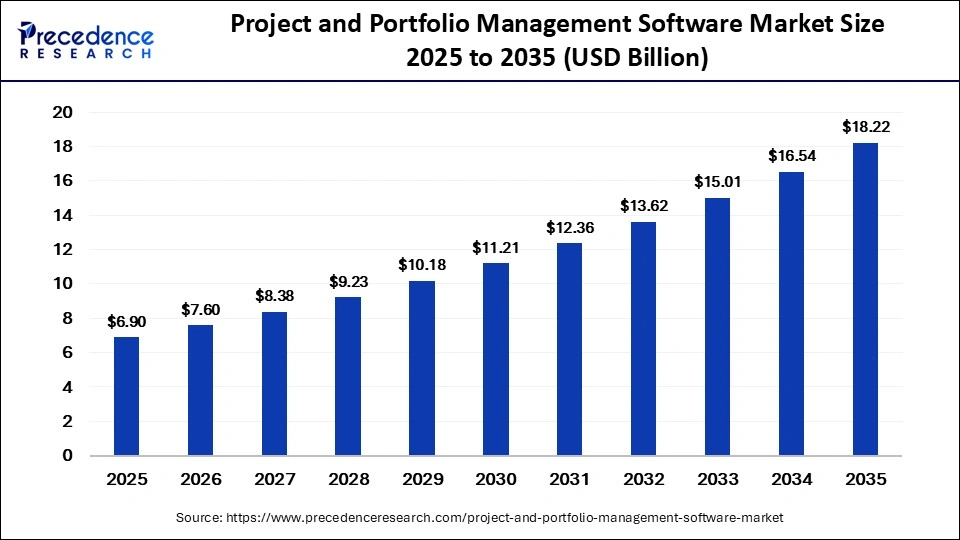
According to recent industry projections, the global project and portfolio management software market size accounted for USD 6.90 billion in 2025 and is expected to grow significantly, reaching approximately USD 18.22 billion by 2035, expanding at a CAGR of 10.20% from 2026 to 2035. This remarkable growth is largely fueled by the increasing adoption of AI-integrated, cloud-based collaboration tools, which are enabling organizations to optimize project execution, enhance team efficiency, and achieve measurable business outcomes.
Future Trends and Innovation
The future of PPM software is being shaped by cutting-edge technologies. Artificial intelligence, machine learning, and natural language processing are increasingly embedded into PPM solutions to enhance predictive capabilities, automate routine workflows, and generate actionable insights.
Cloud-based deployment continues to grow, offering scalability, remote accessibility, and real-time collaboration across global teams. Organizations can expect PPM platforms to become even smarter, more adaptive, and more user-centric, enabling them to tackle complex projects with unprecedented precision and efficiency.
Conclusion
Project and Portfolio Management software is no longer just a tool—it is a strategic enabler. By optimizing resources, enhancing collaboration, fostering data-driven decision-making, and ensuring governance, PPM solutions empower organizations to transform the way they plan, execute, and deliver projects.
With a global market poised to grow from USD 6.90 billion in 2025 to USD 18.22 billion by 2035, at a CAGR of 10.20%, the adoption of AI-integrated, cloud-based PPM solutions represents a strategic imperative for forward-thinking enterprises. Investing in the right PPM software is not merely a choice; it is a decisive step toward resilience, innovation, and sustained competitive advantage in an increasingly complex global business environment.

- ESG Software Market 2025: Comprehensive Company Ecosystem and Revenue Overview - May 20, 2026
- ESG Software Market Surges Toward USD 31.96 Billion by 2035 as AI-Powered Compliance and Sustainability Reporting Transform Global Enterprises - May 20, 2026
- Hematopoietic Stem Cell Transplantation Market Surges Toward USD 24.32 Billion by 2035 as Precision Medicine and AI Reshape Blood Cancer Treatment - May 20, 2026