
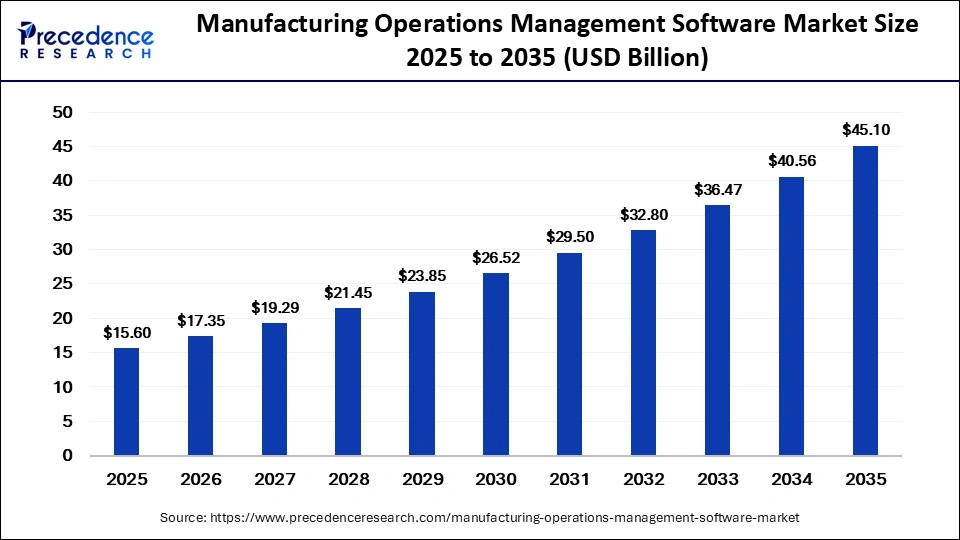
The global manufacturing operations management software market is projected to reach USD 45.10 billion by 2035, driven by Industry 4.0 adoption, AI-powered manufacturing, cloud-based MES solutions, predictive maintenance, and smart factory transformation across industries worldwide.
Manufacturing Operations Management Software Market Overview
The global manufacturing operations management software market is witnessing substantial growth as manufacturers worldwide accelerate digital transformation initiatives to improve operational efficiency, reduce downtime, and optimize production workflows. According to industry estimates, the market size was valued at USD 15.60 billion in 2025 and is expected to grow from USD 17.35 billion in 2026 to approximately USD 45.10 billion by 2035, expanding at a CAGR of 11.20% during the forecast period.
Manufacturing operations management (MOM) software has become a critical component of modern industrial ecosystems, enabling companies to monitor, manage, and synchronize shop-floor activities in real time. The increasing adoption of Industry 4.0 technologies such as artificial intelligence (AI), the Internet of Things (IoT), digital twins, machine learning, and advanced analytics is significantly reshaping manufacturing environments and driving the demand for advanced MOM solutions.
As manufacturers continue to focus on automation, smart factories, sustainability, and predictive maintenance, manufacturing operations management software is emerging as a key technology for ensuring production efficiency, quality control, compliance, and operational transparency.
Read Also: SaaS-Based Business Analytics Market
What is Manufacturing Operations Management Software?
Manufacturing operations management software refers to a comprehensive suite of digital solutions designed to oversee production processes, quality management, maintenance, scheduling, inventory control, and performance analytics within manufacturing facilities.
These platforms act as a bridge between enterprise resource planning (ERP) systems and production-floor machinery, helping manufacturers gain real-time visibility into operations while streamlining workflows and improving productivity.
Modern MOM software integrates multiple functions, including:
- Manufacturing Execution Systems (MES)
- Quality Management Systems (QMS)
- Advanced Planning and Scheduling (APS)
- Inventory and Warehouse Management
- Production Intelligence and Analytics
- Compliance and Traceability Solutions
The growing need for centralized manufacturing data and intelligent production management is fueling widespread adoption across industries such as automotive, pharmaceuticals, aerospace, electronics, food & beverage, and heavy machinery.
Key Market Growth Drivers
Rapid Adoption of Industry 4.0 Technologies
One of the primary drivers accelerating the manufacturing operations management software market is the increasing implementation of Industry 4.0 technologies across industrial sectors.
Manufacturers are integrating IoT-enabled devices, robotics, cloud computing, AI-powered analytics, and digital twin technologies to create intelligent manufacturing ecosystems. MOM software plays a vital role in managing and analyzing massive volumes of production data generated by these technologies.
Real-time monitoring and predictive analytics allow manufacturers to:
- Reduce machine downtime
- Improve production scheduling
- Enhance product quality
- Minimize operational waste
- Optimize resource allocation
As smart manufacturing becomes mainstream, demand for scalable and intelligent operations management platforms continues to rise.
Rising Need for Predictive Maintenance
Manufacturers are increasingly shifting from reactive maintenance to predictive maintenance strategies to improve equipment reliability and reduce unexpected breakdowns.
AI-powered MOM software can analyze machine performance data and identify early warning signs of equipment failure. This helps manufacturers schedule maintenance proactively, reduce repair costs, and improve overall equipment effectiveness (OEE).
Predictive maintenance capabilities are becoming particularly important in industries with high-value production assets, including automotive, aerospace, and semiconductor manufacturing.
Growing Focus on Operational Efficiency
In highly competitive industrial environments, companies are prioritizing operational efficiency and cost optimization. Manufacturing operations management software provides manufacturers with actionable insights into production bottlenecks, labor utilization, inventory levels, and workflow inefficiencies.
Advanced analytics dashboards enable decision-makers to optimize production cycles, improve throughput, and ensure better quality control while reducing waste and downtime.
How AI is Transforming Manufacturing Operations Management Software
Artificial intelligence is revolutionizing manufacturing operations management software by transforming traditional systems into intelligent and autonomous operational platforms.
AI-powered MOM solutions can:
- Detect defects using computer vision
- Predict maintenance requirements
- Automate quality inspections
- Improve demand forecasting
- Optimize energy consumption
- Enhance production scheduling
Machine learning algorithms continuously analyze production data to improve manufacturing performance and identify hidden inefficiencies.
Additionally, AI-driven analytics help manufacturers make faster and more informed decisions, enabling greater agility and resilience in rapidly changing market conditions.
The integration of AI with MOM software is expected to remain one of the most influential trends shaping the future of smart manufacturing.
Emerging Market Trends
Cloud-Based MOM Solutions Gaining Momentum
Cloud-based deployment models are rapidly gaining popularity due to their scalability, flexibility, and lower infrastructure costs.
Cloud-native manufacturing operations management platforms offer:
- Remote accessibility
- Real-time collaboration
- Faster software updates
- Lower maintenance expenses
- Easier integration with IoT systems
The cloud-based segment is projected to grow at a CAGR of 15.5% between 2026 and 2035, making it the fastest-growing deployment model in the market.
Adoption of Digital Twin Technology
Digital twin technology is becoming increasingly important in modern manufacturing environments.
Manufacturers are using virtual replicas of production systems to simulate operations, test production scenarios, and optimize workflows before implementing physical changes on the factory floor.
Digital twins help improve:
- Production efficiency
- Predictive maintenance accuracy
- Equipment performance
- Supply chain visibility
- Resource utilization
This technology is creating significant opportunities for advanced manufacturing operations management software providers.
Sustainability and Energy Optimization
Sustainability initiatives are becoming a major focus for industrial organizations worldwide.
Manufacturing operations management software is helping manufacturers monitor energy consumption, reduce emissions, and improve environmental compliance. Companies are increasingly leveraging analytics tools to optimize energy usage and support net-zero manufacturing goals.
Segment Analysis
By Deployment Model
On-Premise Solutions Dominated in 2025
The on-premise segment accounted for 55% of market revenue in 2025 due to concerns regarding data security, regulatory compliance, and control over sensitive manufacturing data.
Industries such as aerospace, defense, and pharmaceuticals continue to prefer on-premise deployments because they provide enhanced cybersecurity and system customization capabilities.
Cloud-Based Solutions Expected to Grow Rapidly
Cloud-based MOM software is expected to witness the fastest growth during the forecast period. Increasing adoption of remote operations, industrial IoT, and AI-enabled manufacturing systems is fueling demand for cloud-native manufacturing platforms.
By Solution
MES Segment Led the Market
Manufacturing Execution Systems (MES) held the largest market share of 30% in 2025.
MES solutions provide:
- Real-time production monitoring
- Workflow automation
- Equipment tracking
- Quality management
- Production scheduling
The growing demand for agile manufacturing and real-time visibility is driving adoption of MES platforms globally.
APS Segment to Witness Strong Growth
Advanced Planning & Scheduling (APS) solutions are projected to grow at a CAGR of 12% due to increasing demand for optimized production scheduling and resource planning.
APS tools help manufacturers minimize idle time, manage bottlenecks, and improve production agility.
By Industry Vertical
Automotive Industry Dominated the Market
The automotive segment accounted for 22% of market share in 2025.
The growing shift toward electric vehicles (EVs), autonomous vehicles, and connected manufacturing is driving significant investments in smart factory solutions across the automotive sector.
Electronics & Semiconductor Segment to Grow Fastest
The electronics and semiconductor segment is projected to grow at the fastest CAGR of 13.5% due to rising demand for precision manufacturing, traceability, and advanced quality management systems.
Regional Analysis
Asia Pacific Dominated the Global Market
Asia Pacific held the largest market share of 36% in 2025.
The region’s dominance is attributed to:
- Strong manufacturing ecosystems
- Rapid industrialization
- Expanding electronics and semiconductor industries
- Increasing adoption of smart manufacturing technologies
Countries such as China, Japan, South Korea, and India are heavily investing in Industry 4.0 transformation initiatives.
China Market Insights
China is witnessing rapid adoption of cloud-based manufacturing operations management software as manufacturers focus on automation, operational efficiency, and IoT-enabled production systems.
The country’s smart manufacturing initiatives and digital transformation programs continue to support strong market growth.
North America Remains a Key Growth Hub
North America held the second-largest market share of 28% in 2025.
The region is benefiting from:
- Strong adoption of industrial automation
- Rising investments in digital supply chains
- Advanced manufacturing infrastructure
- Growing implementation of AI-powered production systems
The United States continues to lead regional adoption due to increasing demand for operational intelligence and compliance management solutions.
Europe Showing Strong Growth Potential
Europe accounted for 26% of the global market in 2025.
Countries including Germany, France, and the UK are accelerating adoption of smart manufacturing technologies through government-backed digital transformation initiatives and sustainability programs.
The region’s strong automotive and industrial base continues to create significant opportunities for MOM software providers.
Leading Companies in the Market
Several technology providers are actively investing in AI-powered industrial software, cloud integration, and smart manufacturing innovations.
Key market players include:
- Siemens
- Rockwell Automation
- Schneider Electric
- Oracle
- SAP
- GE Digital
- Dassault Systèmes
- Honeywell
Future Outlook
The future of the manufacturing operations management software market looks highly promising as industries continue embracing smart manufacturing technologies and AI-driven industrial automation.
Growing adoption of:
- Industry 4.0
- Industrial IoT
- AI-powered analytics
- Digital twins
- Predictive maintenance
- Cloud-based manufacturing platforms
will continue transforming manufacturing environments over the next decade.
As manufacturers seek greater agility, operational efficiency, and sustainability, manufacturing operations management software will remain a critical technology for enabling intelligent, data-driven, and autonomous industrial operations worldwide.
Get Sample Copy: https://www.precedenceresearch.com/sample/8399
For inquiries regarding discounts, bulk purchases, or customization requests, please contact us at sales@precedenceresearch.com
