
The global observability tools and platforms market is witnessing rapid growth as enterprises increasingly prioritize real-time monitoring, AI-driven analytics, and unified visibility across complex digital environments. The market is expanding significantly due to the growing adoption of cloud-native applications, Kubernetes ecosystems, microservices architectures, and DevOps practices across industries. According to industry estimates, the market is projected to grow strongly over the coming years as organizations modernize IT infrastructure and seek advanced observability solutions capable of handling massive telemetry data volumes.
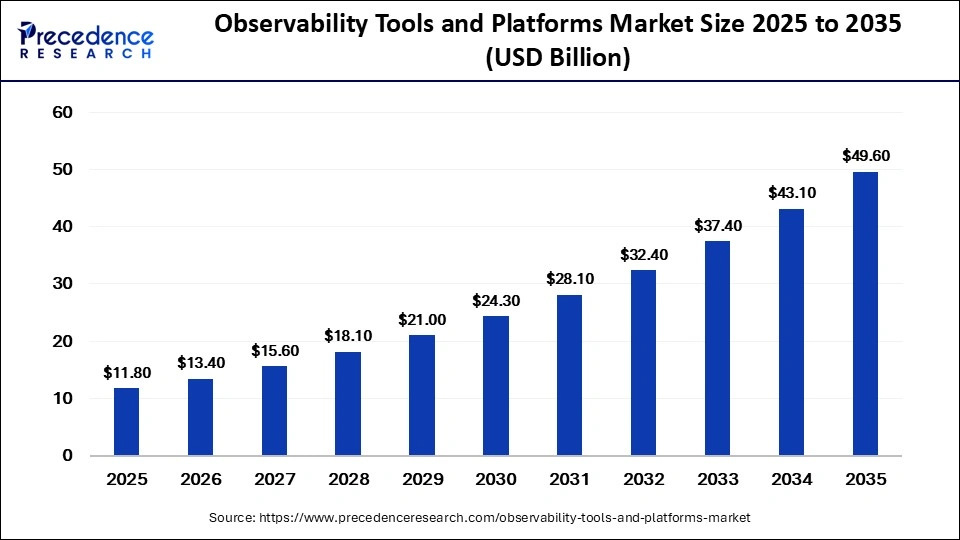
Modern observability platforms are becoming mission-critical for enterprises as they help organizations monitor logs, metrics, traces, infrastructure, applications, and user experiences from a centralized environment. These solutions enable faster root-cause analysis, proactive incident detection, operational resilience, and improved digital experiences.
The rise of AI-powered observability, automation-first IT operations, and OpenTelemetry-based ecosystems is fundamentally reshaping how enterprises monitor distributed systems and optimize application performance globally.
Read Also: Shipping Software Market
Quick Insights: What Is Driving the Observability Tools and Platforms Market?
North America currently dominates the observability tools and platforms market due to strong cloud adoption, advanced digital infrastructure, and widespread enterprise modernization initiatives.
Asia Pacific is emerging as the fastest-growing regional market owing to rapid cloud-native transformation, rising DevOps adoption, and increasing digitalization investments.
Cloud deployment models are leading the market because enterprises increasingly prefer scalable SaaS-based observability platforms capable of supporting hybrid and multi-cloud environments.
Large enterprises remain the primary adopters of observability solutions due to the growing complexity of distributed applications and digital operations.
AI-powered anomaly detection, automated remediation, predictive analytics, and observability automation are becoming key competitive differentiators among vendors.
OpenTelemetry is rapidly becoming the industry standard for telemetry collection and observability interoperability.
Leading technology providers are aggressively investing in unified observability ecosystems integrating infrastructure monitoring, application performance management (APM), logging, tracing, and security analytics.
What Are Observability Tools and Platforms?
Observability tools and platforms are software solutions designed to provide deep visibility into modern IT systems, cloud infrastructure, applications, and digital services. These platforms collect and analyze telemetry data including:
- Metrics
- Logs
- Distributed traces
- Events
- Infrastructure signals
- User interactions
The goal of observability is not only to detect problems but also to understand why issues occur and how they impact business operations.
Modern observability platforms help organizations:
- Monitor distributed systems
- Detect anomalies in real time
- Troubleshoot application failures
- Improve system reliability
- Enhance customer experiences
- Optimize cloud infrastructure
- Reduce downtime
- Automate incident response
As enterprises increasingly operate across hybrid, multi-cloud, and Kubernetes-based environments, observability platforms have become essential for operational resilience and digital transformation.
How Is Artificial Intelligence Transforming the Observability Market?
Artificial intelligence is fundamentally changing the observability tools and platforms market by enabling predictive analytics, intelligent automation, and proactive incident management.
AI-powered observability platforms can:
- Detect anomalies automatically
- Correlate logs, metrics, and traces
- Identify root causes faster
- Predict infrastructure failures
- Reduce alert fatigue
- Automate remediation workflows
Leading vendors are integrating advanced AI engines capable of analyzing massive telemetry datasets in real time to provide actionable operational insights.
AI-driven observability solutions are increasingly helping enterprises:
- Improve operational efficiency
- Minimize downtime
- Reduce mean time to resolution (MTTR)
- Optimize cloud spending
- Enhance application performance
- Strengthen cybersecurity visibility
The growing convergence of observability and AIOps is expected to remain one of the strongest growth drivers in the industry over the next decade.
Why Is the Observability Tools and Platforms Market Growing Rapidly?
Rising Complexity of Modern IT Infrastructure
The increasing adoption of:
- Microservices
- Containers
- Kubernetes
- Hybrid cloud
- Multi-cloud architectures
- Edge computing
has significantly increased operational complexity, creating strong demand for advanced observability platforms capable of providing unified visibility across distributed environments.
Expansion of DevOps and Site Reliability Engineering (SRE)
Organizations increasingly rely on DevOps and SRE practices to accelerate software delivery and improve operational resilience, driving adoption of observability solutions for continuous monitoring and incident response.
Growing Cloud-Native Transformation
Cloud-native applications generate massive telemetry data streams requiring scalable observability platforms capable of handling dynamic infrastructure environments.
Rising Demand for Digital Experience Monitoring
Enterprises are prioritizing customer experience optimization, increasing demand for real-time application monitoring and user experience analytics.
Increasing Need for Real-Time Operational Visibility
Organizations require instant visibility into infrastructure performance and service dependencies to maintain uptime and business continuity.
Why Is OpenTelemetry Becoming a Game-Changer for the Industry?
OpenTelemetry has emerged as a transformative open-source standard for telemetry collection and observability interoperability. It enables organizations to collect logs, traces, and metrics using standardized instrumentation across different platforms and vendors.
The rise of OpenTelemetry is helping organizations:
- Avoid vendor lock-in
- Standardize telemetry collection
- Improve interoperability
- Simplify instrumentation
- Reduce operational complexity
Many modern observability vendors are now positioning OpenTelemetry compatibility as a core platform capability.
The growing adoption of OpenTelemetry is also accelerating the shift toward open-source and hybrid observability ecosystems globally.
Could Unified Observability Platforms Replace Traditional Monitoring Systems?
Traditional monitoring tools focused primarily on infrastructure uptime and static threshold alerts. However, modern distributed systems require deeper operational intelligence capable of correlating application, infrastructure, and user-level data in real time.
Unified observability platforms provide:
- End-to-end visibility
- Cross-domain correlation
- Full-stack monitoring
- Distributed tracing
- AI-powered analytics
- Centralized dashboards
These platforms are increasingly replacing siloed monitoring solutions and enabling enterprises to manage digital operations from a single pane of glass.
Organizations are rapidly shifting toward unified observability ecosystems capable of supporting:
- Hybrid infrastructure
- Cloud-native workloads
- Containerized applications
- Serverless computing
- Edge environments
What Challenges Are Restricting Market Growth?
Rising Telemetry Data Costs
As telemetry volumes increase exponentially, enterprises face rising storage, ingestion, and processing costs associated with observability platforms.
Alert Fatigue and Operational Noise
Many organizations struggle with excessive alerts and fragmented monitoring systems that reduce operational efficiency.
Integration Complexity
Enterprises frequently encounter challenges integrating observability platforms with legacy infrastructure and heterogeneous IT ecosystems.
Skills Shortage
The growing complexity of cloud-native observability environments is increasing demand for skilled DevOps engineers, SRE professionals, and observability specialists.
Vendor Lock-In Concerns
Organizations increasingly seek open and interoperable solutions to avoid dependence on proprietary observability ecosystems.
Segment Analysis: Which Areas Are Driving Revenue Growth?
Cloud-Based Observability Platforms Lead Adoption
Cloud deployment models dominate the market because they offer:
- Scalability
- Remote accessibility
- Faster deployment
- Lower infrastructure costs
- Flexible subscription pricing
Large Enterprises Continue Dominating Demand
Large organizations generate massive telemetry datasets and require advanced observability solutions to manage complex digital environments.
AI-Powered Observability Emerges as Fastest-Growing Segment
AI-driven anomaly detection, predictive analytics, and automated remediation capabilities are becoming major investment areas.
Hybrid and Multi-Cloud Monitoring Witness Strong Growth
Organizations increasingly require observability platforms capable of monitoring workloads across multiple cloud providers and on-premises systems.
Regional Analysis: Which Regions Are Leading the Market?
Why Does North America Dominate the Observability Market?
North America remains the leading regional market due to:
- Advanced cloud infrastructure
- High enterprise technology spending
- Strong DevOps adoption
- Presence of major observability vendors
- Rapid AI integration initiatives
The region has been an early adopter of cloud-native architectures and real-time observability solutions.
The United States continues leading market growth due to large-scale enterprise digital transformation and cloud modernization initiatives.
Why Is Asia Pacific Emerging as the Fastest-Growing Region?
Asia Pacific is witnessing strong growth because of:
- Rapid enterprise digitization
- Expansion of cloud infrastructure
- Growing startup ecosystems
- Increasing DevOps adoption
- Rising investments in AI and automation
Countries such as India, China, Japan, and Singapore are increasingly investing in cloud-native and observability technologies.
Europe Maintains Strong Market Position
Europe continues experiencing steady demand due to:
- Expansion of digital transformation programs
- Strong regulatory compliance requirements
- Increasing hybrid cloud adoption
- Rising enterprise cybersecurity investments
The region is increasingly adopting AI-driven observability platforms for operational resilience and compliance monitoring.
Competitive Landscape: Which Companies Are Leading the Market?
The observability tools and platforms market is highly competitive as both enterprise software giants and specialized observability vendors compete aggressively.
Major Companies Operating in the Market
- Dynatrace
- Datadog
- Splunk
- New Relic
- Grafana Labs
- Cisco AppDynamics
- Elastic
- IBM
- Microsoft
- LogicMonitor
- ScienceLogic
- Sumo Logic
- SolarWinds
- Riverbed Technology
- Chronosphere
These companies are focusing heavily on:
- AI-powered observability
- OpenTelemetry integration
- Full-stack monitoring
- Cloud-native visibility
- Unified analytics
- Automation-first operations
- Security observability
Strategic acquisitions and AI-driven innovation continue reshaping competition across the industry.
What Recent Innovations Are Transforming the Industry?
Dynatrace Expands AI-Powered Data Observability
Dynatrace introduced new AI-powered data observability capabilities to improve analytics and automation workflows through its Davis AI engine.
Riverbed Launches AI-Driven Observability Platform
Riverbed introduced an AI-powered observability and acceleration platform aimed at improving cross-domain visibility and reducing operational alert overload.
OpenTelemetry Adoption Accelerates Industry Standardization
The increasing adoption of OpenTelemetry standards is transforming telemetry collection and reducing interoperability challenges across observability ecosystems.
Case Study: AI-Driven Observability Improves Enterprise Incident Response
A global financial services organization implemented an AI-powered observability platform integrated with cloud infrastructure, Kubernetes environments, and OpenTelemetry pipelines.
The deployment enabled the company to:
- Reduce incident resolution time by 45%
- Improve cross-team collaboration
- Minimize alert fatigue
- Enhance cloud cost optimization
- Improve service reliability
- Gain unified visibility across hybrid infrastructure
The organization also reported improved customer experience metrics and reduced operational downtime.
What Are Industry Experts Saying About Modern Observability?
Technology communities increasingly emphasize that observability is evolving beyond traditional monitoring into a strategic operational discipline focused on telemetry correlation, predictive analytics, and proactive automation.
Industry discussions increasingly highlight:
- OpenTelemetry adoption
- Unified observability ecosystems
- AI-assisted root-cause analysis
- Dynamic anomaly detection
- Hybrid cloud visibility
- Cost optimization challenges
Many enterprises are also exploring open-source observability stacks for flexibility and reduced vendor lock-in.
Conclusion: AI, OpenTelemetry, and Cloud-Native Operations Are Reshaping Observability
The observability tools and platforms market is entering a new era of growth driven by cloud-native transformation, AI-powered automation, and increasing enterprise demand for unified operational visibility.
Future market growth will increasingly focus on:
- AI-driven observability
- OpenTelemetry standardization
- Predictive analytics
- Unified telemetry ecosystems
- Automated remediation
- Hybrid cloud monitoring
- Security observability
- Cost-efficient telemetry management
As digital infrastructure becomes increasingly distributed and complex, observability platforms will remain critical for ensuring operational resilience, performance optimization, and seamless customer experiences worldwide.
Get a Sample Copy: https://www.precedenceresearch.com/sample/8395
For inquiries regarding discounts, bulk purchases, or customization requests, please contact us at sales@precedenceresearch.com
