
The global direct attached AI storage system market is witnessing explosive growth as organizations increasingly adopt artificial intelligence (AI), machine learning (ML), and big data analytics. These advanced technologies demand ultra-fast, low-latency, and high-throughput storage solutions—making direct attached storage (DAS) systems a critical component of modern AI infrastructure.
Unlike traditional network-based storage, DAS systems are directly connected to computing devices, enabling faster data access and reduced latency. This makes them ideal for AI workloads that require real-time processing and rapid data retrieval.
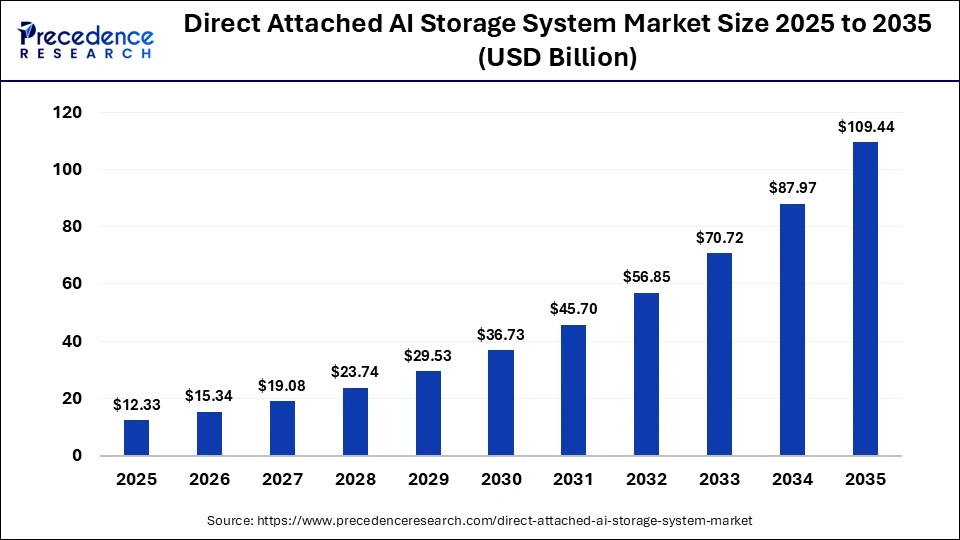
According to market estimates, the market is projected to grow from USD 15.34 billion in 2026 to approximately USD 109.44 billion by 2035, expanding at a remarkable CAGR of 24.40% during the forecast period.
What is a Direct Attached AI Storage System?
A Direct Attached AI Storage System refers to a storage architecture where storage devices are directly connected to a server or computing system without a network layer. This setup ensures:
- Ultra-low latency
- High-speed data transfer
- Improved performance for AI workloads
- Reduced network bottlenecks
Key Components:
- NVMe SSDs and high-performance HDDs
- GPU-integrated servers
- High-bandwidth interfaces (PCIe, SAS, SATA)
These systems are widely used in AI model training, inference, and data-intensive applications.
Market Highlights
- Market Size 2026: USD 15.34 Billion
- Projected Size 2035: USD 109.44 Billion
- CAGR (2026–2035): 24.40%
- Growth Driver: Rising AI and big data adoption
- Key Trend: Shift toward edge computing and real-time analytics
Market Dynamics
Key Growth Drivers
1. Rapid Adoption of AI and Machine Learning
AI applications generate massive datasets that require high-performance storage systems. DAS solutions enable faster data access, reducing training time and improving efficiency.
2. Increasing Demand for Real-Time Data Processing
Industries such as finance, healthcare, and retail require real-time analytics, driving demand for low-latency storage systems.
3. Expansion of Data Centers
The rapid growth of hyperscale and enterprise data centers is fueling the adoption of high-capacity storage systems.
4. Growth of Edge Computing
Edge AI applications require localized data processing, making DAS systems ideal due to their speed and efficiency.
Market Challenges
- High initial infrastructure costs
- Limited scalability compared to cloud storage
- Data management complexity in large-scale deployments
Market Restraints
- Scalability Limitations: Compared to cloud storage
- High Capital Investment: Especially for NVMe-based systems
- Complex Deployment: Requires specialized infrastructure
Advanced Segmentation Analysis
By Capacity: Performance vs Scale
- 5TB–20TB (30.5%)
Ideal for mid-scale AI workloads and enterprise applications - 20TB–50TB
Preferred for large-scale training models and data centers - Below 5TB
Rapidly growing in edge AI and IoT environments - Above 50TB
Critical for hyperscale data centers and deep learning
By Storage Technology: Speed vs Cost
- HDD (40%) → Best for bulk storage
- SSD (30%) → Fastest-growing for high-speed processing
- Hybrid Storage → Balanced performance and cost
- NAS Integration → Enables collaboration
By Application: AI Workload Spectrum
- Data Analytics (28%) → Real-time insights
- Machine Learning (22%) → Predictive modeling
- AI Applications (18.5%) → Automation systems
- Deep Learning (16%) → Advanced neural networks
- Big Data (Fastest Growing) → Massive datasets
By End User: Adoption Landscape
- Large Enterprises (50%)
- SMEs (40%)
- Government (10%)
Regional Outlook: Global Power Shift
North America
- Dominates due to strong tech ecosystem
- Home to major cloud and AI companies
- Heavy investment in R&D
Asia-Pacific
- Fastest-growing region
- Rapid digital transformation
- Government-led AI initiatives
- Expansion of hyperscale data centers
AI + Storage = Intelligent Infrastructure
AI is not just driving demand—it is also transforming storage systems themselves.
Smart Storage Capabilities:
- AI-based data tiering
- Predictive maintenance
- Automated workload optimization
- Intelligent caching
This convergence is creating self-optimizing storage ecosystems.
Competitive Landscape
Leading Companies:
- Dell Technologies
- Hewlett Packard Enterprise (HPE)
- IBM Corporation
- NetApp Inc.
- Lenovo Group Limited
- NVIDIA Corporation
Strategic Focus:
- NVMe and GPU integration
- Edge AI storage solutions
- AI-powered storage management
- Strategic partnerships
Innovation & Recent Developments
- Launch of AI-optimized NVMe storage arrays
- Development of GPU-direct storage architectures
- Integration of AI-driven storage analytics tools
- Expansion of edge AI storage platforms
Future Trends Reshaping the Market
- Rise of AI-native data centers
- Growth of edge AI ecosystems
- Adoption of quantum computing storage
- Expansion of autonomous AI systems
- Evolution toward self-learning storage infrastructure
Investment & Business Opportunities
- AI infrastructure startups
- Edge computing solutions
- High-performance storage hardware
- AI-driven data management platforms
The market is attracting strong investor interest due to its high growth potential and strategic importance.
Conclusion
The Direct Attached AI Storage System Market is not just growing—it is redefining the future of data infrastructure. As AI adoption accelerates globally, the demand for high-speed, low-latency storage solutions will continue to surge.
Organizations that invest in AI-optimized storage today will gain a significant competitive advantage in the data-driven economy of tomorrow.
Get Sample: https://www.precedenceresearch.com/sample/8270
For inquiries regarding discounts, bulk purchases, or customization requests, please contact us at [email protected]
