What is the Electronic Control Access Systems Market Size in 2026?
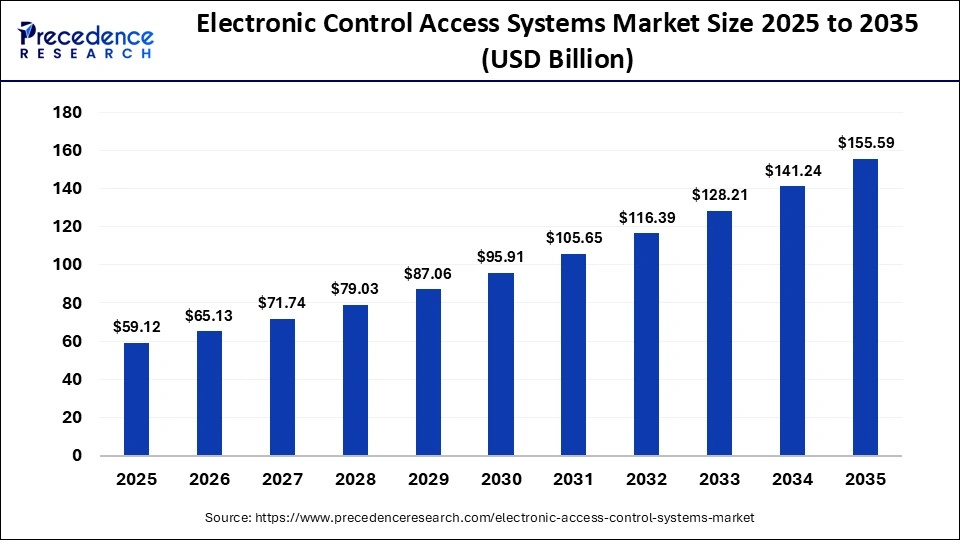
The global electronic control access systems market size accounted for USD 59.12 billion in 2025 and is predicted to increase from USD 65.13 billion in 2026 to approximately USD 155.59 billion by 2035, expanding at a CAGR of 10.16% from 2026 to 2035. The market is driven by growing demand for smart, secure access solutions across numerous industries.
Key Takeaways
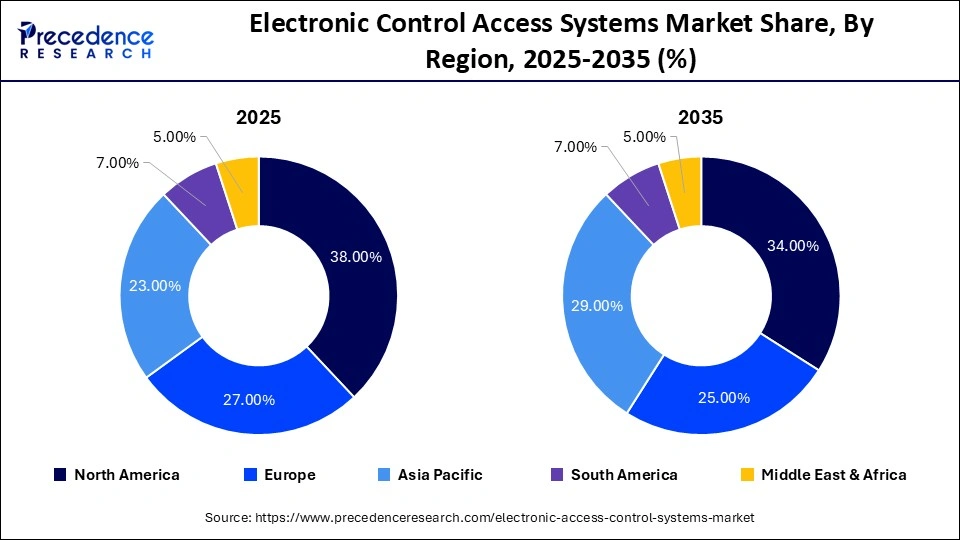
- North America led the market with the highest market share of 38% in 2025.
- The Asia Pacific is projected to grow at the fastest rate in the market during the forecast period.
- By type, the card-based access control segment held the largest market share of 48% in 2025.
- By type, the biometric access control segment is anticipated to expand at the fastest rate over the forecast period.
- By component, the hardware segment maintained a leading position in the market with a 55% share in 2025.
- By component, the software segment is expected to grow at the fastest rate during the forecast period.
- By end user, the commercial segment dominated the global market with a 42% share in 2025.
- By end user, the residential segment is projected to grow at the fastest rate in the coming years.
- By technology, the wired systems segment accounted for a major revenue share of 60% in 2025.
- By technology, the wireless systems segment is expected to grow at the fastest rate during the forecast period.
Market Overview
The electronic access control systems market focuses on technologies that help manage and monitor access to both physical spaces and digital systems across commercial, residential, and government sectors. These solutions combine advanced technologies such as biometrics, cloud computing, IoT, and artificial intelligence to provide secure and efficient access management.
Modern access control systems now include features like mobile-based entry, multi-factor authentication, and cloud platforms that allow users to manage and monitor access remotely. These advancements not only improve security but also offer greater flexibility and convenience. The market is growing rapidly as organizations prioritize safety, streamline operations, and adopt digital solutions to build smarter and more secure environments.
How is AI Impacting the Electronic Access Control Systems Market?
Artificial intelligence is significantly transforming electronic access control systems. When combined with IoT, AI enables smarter and more proactive security solutions. Technologies like facial recognition, predictive security, and behavioral analysis are changing how access systems operate.
AI-powered systems can continuously monitor user activity and quickly detect unusual or suspicious behavior. This allows organizations to respond faster and more accurately to potential threats. By reducing reliance on manual monitoring and minimizing human error, AI enhances overall security and improves threat detection.
As a result, businesses can strengthen their protection against unauthorized access while ensuring a safer and more reliable security environment.
Electronic Control Access Systems Market Trends
- There is a growing adoption of cloud platforms across industries, driven by organizations’ need to enable remote access, ensure real-time security operations, and reduce infrastructure costs.
- The integration of AI into electronic control access systems is rising. The integration of fingerprint and facial recognition systems with AI-powered behavioral analytics enhances fraud prevention and enables seamless, touchless authentication across commercial, residential, and government facilities.
- Expansion of smart infrastructure boosts the market. Smart infrastructure systems improve operational efficiency, strengthen security, and enhance user experience by integrating access control with IoT-enabled devices such as lighting, HVAC, and surveillance systems.
Market Scope
| Report Coverage | Details |
| Market Size in 2025 | USD 59.12 Billion |
| Market Size in 2026 | USD 65.13 Billion |
| Market Size by 2035 | USD 155.59 Billion |
| Market Growth Rate from 2026 to 2035 | CAGR of 10.16% |
| Dominating Region | North America |
| Fastest Growing Region | Asia-Pacific |
| Base Year | 2025 |
| Forecast Period | 2026 to 2035 |
| Segments Covered | Type, Component, End User, Technology, and Region |
| Regions Covered | North America, Europe, Asia-Pacific, Latin America, and Middle East & Africa |

- Farm Management Software Market: Digital Agriculture Driving Smarter and More Sustainable Farming - July 9, 2026
- AI in CGT Manufacturing Market: Artificial Intelligence Accelerating the Future of Cell and Gene Therapy Production - July 9, 2026
- 3T MRI System Market: Advanced Imaging Technology Transforming Modern Diagnostics - July 9, 2026