
What is the Generative AI in Fulfillment and Logistics Market Size in 2026?
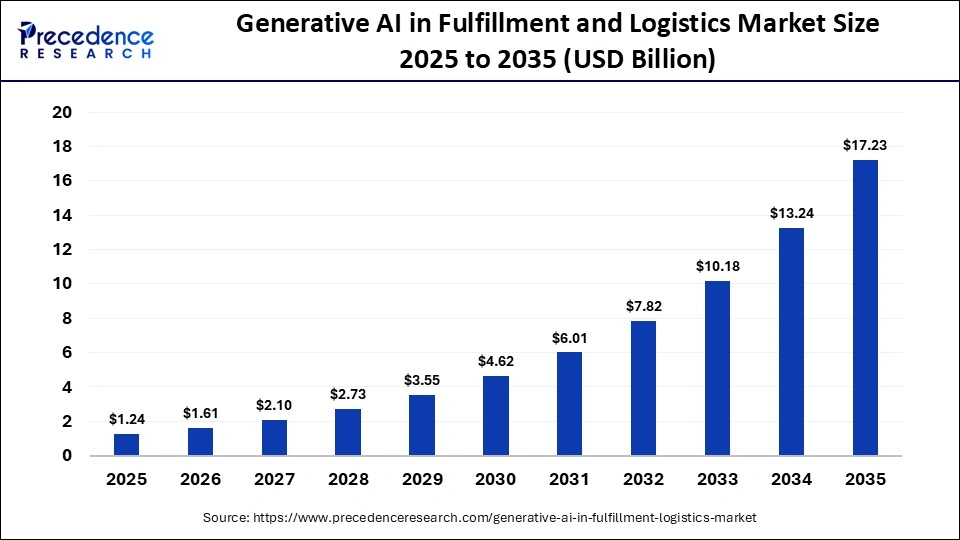
The global generative AI in fulfillment and logistics market size was accounted for USD 1.24 billion in 2025 and is predicted to increase from USD 1.61 billion in 2026 to approximately USD 17.23 billion by 2035, expanding at a CAGR of 30.10% from 2026 to 2035.The generative AI in fulfillment and logistics market is growing rapidly due to the propelling demand by the industry for ease in management of complex supply chains, cost reduction, and easy warehouse management. Cloud services also help the industry automate workflows of the shippers, retailers, and product manufacturers.
Key Takeaways
- North America led the global generative AI in fulfillment and logistics market with a share of 37.6% in 2025.
- Asia-Pacific is expected to be the fastest-growing region in the foreseeable period.
- By component, the software segment held a major dominance over the global market in 2025 with 72.5% share.
- By component, the services segment is expected to be the fastest-growing segment with the highest CAGR of 31.7% in the forecast period.
- By deployment mode, the cloud segment held a dominant position in the market with a share of 61.7% in 2025.
- By deployment mode, the hybrid segment is expected to grow at the fastest CAGR of 34.6% in the market between 2026 and 2035.
- By function, the transportation management segment accounted for a considerable revenue share of 22.4% in the market in 2025.
- By function, the fulfillment orchestration segment is expected to grow with the highest CAGR of 34.2% in the market during the studied years.
- By application, the route and load optimization segment led the global market with 20.3% share in 2025.
- By application, the control tower and scenario simulation segment is expected to expand rapidly with the highest CAGR of 34.8% in the coming years.
- By end use industry, the e commerce and retail segment dominated the global market with a share of 24.8% in 2025.
- By end use industry, the healthcare and pharmaceuticals segment is expected to show the fastest growth with a CAGR of 35.1% over the forecast period.
What is the Generative AI in Fulfillment and Logistics Market?
The generative AI in fulfillment and logistics market comprises a wide range of software platforms, AI models, and associated services designed to enhance various aspects of supply chain and logistics operations. These solutions leverage generative AI to optimize warehouse management, transportation planning, inventory control, order orchestration, customer communication, and document processing.
The market includes both cloud-based and on-premises deployments, catering to a diverse set of end users such as shippers, retailers, manufacturers, and third-party logistics providers. By automating workflows, generating actionable insights, and simulating operational scenarios, generative AI solutions help organizations improve productivity, service quality, cost efficiency, and decision-making across the entire logistics value chain.
As supply chains become more complex and dynamic, the adoption of generative AI is expected to accelerate, positioning it as a key driver of innovation and competitive advantage in the fulfillment and logistics industry.
Role of AI in Generative AI in Fulfillment and Logistics
Generative Artificial Intelligence (GenAI) is playing a transformative role in the fulfillment and logistics sector by enhancing operational efficiency, decision-making, and customer experience. One of its key applications lies in simulation and risk mitigation, where advanced AI models generate synthetic datasets to simulate complex supply chain scenarios. This enables organizations to anticipate disruptions, optimize logistics networks, and build more resilient and adaptive supply chain strategies.
In addition, GenAI is revolutionizing customer service through AI-powered, context-aware chatbots capable of handling complex queries, providing real-time shipment tracking, and delivering personalized responses. These systems improve customer satisfaction while reducing the burden on human support teams.
Another critical area is intelligent documentation, where GenAI automates the processing of complex logistics paperwork such as customs documentation, invoices, and shipping contracts. By minimizing manual intervention, these systems significantly reduce errors, improve compliance, and accelerate administrative workflows. Overall, GenAI is enabling smarter, faster, and more efficient logistics operations.
Market Scope
| Report Coverage | Details |
| Market Size in 2025 | USD 1.24 Billion |
| Market Size in 2026 | USD 1.61 Billion |
| Market Size by 2035 | USD 17.23 Billion |
| Market Growth Rate from 2026 to 2035 | CAGR of 30.10% |
| Dominating Region | North America |
| Fastest Growing Region | Asia-Pacific |
| Base Year | 2025 |
| Forecast Period | 2026 to 2035 |
| Segments Covered | Component, Deployment Mode, Function, Application, End Use Industry, and Region |
| Regions Covered | North America, Europe, Asia-Pacific, Latin America, and Middle East & Africa |
Regional Insights
North America holds the largest share of the generative AI in fulfillment and logistics market, driven by its advanced digital infrastructure, strong presence of leading technology companies, and early adoption of AI-driven supply chain solutions. The United States leads the region, with widespread implementation of generative AI across warehouse automation, transportation optimization, and customer service operations. High investments in cloud computing, data analytics, and AI innovation are further accelerating market growth, enabling organizations to enhance efficiency and responsiveness across complex logistics networks.
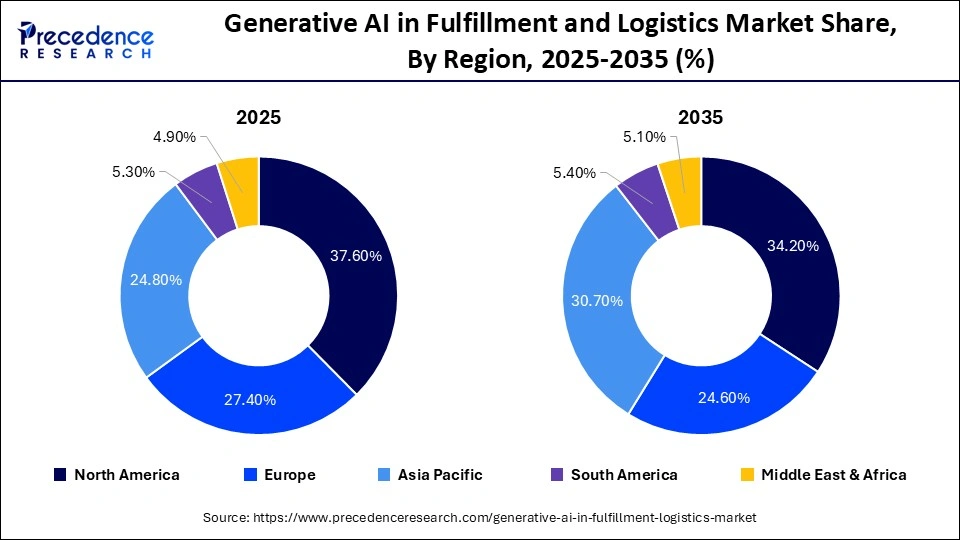
Europe represents a significant portion of the global market, supported by increasing adoption of digital supply chain technologies and a strong focus on operational efficiency and sustainability. Countries such as Germany, the United Kingdom, and France are leading contributors, leveraging generative AI for smart warehousing, predictive logistics, and intelligent transportation systems. Additionally, stringent regulations related to data privacy and environmental sustainability are encouraging the development of transparent, compliant, and energy-efficient AI solutions across the region.
Asia-Pacific is expected to witness the fastest growth in the generative AI in fulfillment and logistics market, fueled by rapid expansion of e-commerce, manufacturing, and digital infrastructure. Countries such as China, India, and Japan are at the forefront, adopting generative AI to optimize supply chain operations, improve inventory management, and enhance last-mile delivery efficiency. The region’s large consumer base, growing demand for fast and reliable delivery services, and increasing investments in AI and automation technologies are key factors driving market expansion.
Latin America is emerging as a growing market, with increasing adoption of digital logistics solutions across sectors such as retail, e-commerce, and transportation. Countries like Brazil and Mexico are investing in AI-driven supply chain optimization to improve efficiency and competitiveness. However, challenges such as infrastructure limitations and budget constraints may impact the pace of adoption compared to more developed regions.
The Middle East & Africa region is witnessing steady growth, driven by rising investments in logistics infrastructure, digital transformation initiatives, and the development of smart cities. Gulf countries, in particular, are adopting advanced AI technologies to modernize supply chains and improve logistics efficiency. While adoption is increasing, factors such as limited technological infrastructure and skill gaps in certain areas may pose challenges to widespread implementation.
Generative AI in Fulfillment and Logistics Market Key Players
- Microsoft Corporation
- Amazon Web Services, Inc .
- Google Cloud
- SAP SE
- Oracle Corporation
- International Business Machines Corporation
- NVIDIA Corporation
- Manhattan Associates, Inc.
- Blue Yonder Group, Inc.
- Kinaxis Inc.
- o9 Solutions, Inc.
- project44
- FourKites, Inc.
- The Descartes Systems Group Inc.
- Infor, Inc.
Recent Developments
- In March 2026, Yusen Logistics entered into an exclusive, multiyear partnership with Rabot Inc. to deploy Vision AI technology aimed at improving packing accuracy, productivity, and compliance across its U.S. contract logistics operations. The agreement combines Yusen’s fulfillment capabilities with Rabot’s real-time imaging and analytics tools as distribution centers seek greater consistency in order processing.
- In June 2025, Amazon deployed its 1 millionth robot as the world’s largest manufacturer and operator of mobile robotics. This milestone robot was delivered to a fulfillment center in Japan, joining its global network spanning more than 300 facilities worldwide. The new GenAI model can make its entire fleet of robots smarter and more efficient.
Segments Covered in the Report
By Component
- Software
- Services
By Deployment Mode
- Cloud
- On Premises
- Hybrid
By Function
- Warehousing
- Transportation Management
- Inventory Management
- Order Management
- Fulfillment Orchestration
- Customer Service and Exception Management
- Procurement and Supplier Collaboration
By Application
- Demand Forecasting and Replenishment
- Route and Load Optimization
- Warehouse Slotting, Picking, and Labor Optimization
- Document Automation and Customs Workflow
- Returns and Reverse Logistics
- Control Tower and Scenario Simulation
- Customer Communication and Order Status Automation
By End Use Industry
- Ecommerce and Retail
- Third Party Logistics and Fourth Party Logistics
- Manufacturing
- Food and Beverages
- Healthcare and Pharmaceuticals
- Automotive
- Consumer Electronics
- Others
By Region
- North America
- Latin America
- Europe
- Asia-pacific
- Middle and East Africa
Get Sample Link: https://www.precedenceresearch.com/sample/8236

- Cholestatic Pruritus Market: Advancements in Targeted Therapies Are Transforming Patient Care - June 30, 2026
- Inflammatory Disease Market: Biologic Therapies and Precision Medicine Are Reshaping Patient Care - June 30, 2026
- Retail Cloud Market: Driving the Future of Smart, Connected Retail Operations - June 30, 2026