What is the Microprinting Market Size in 2026?
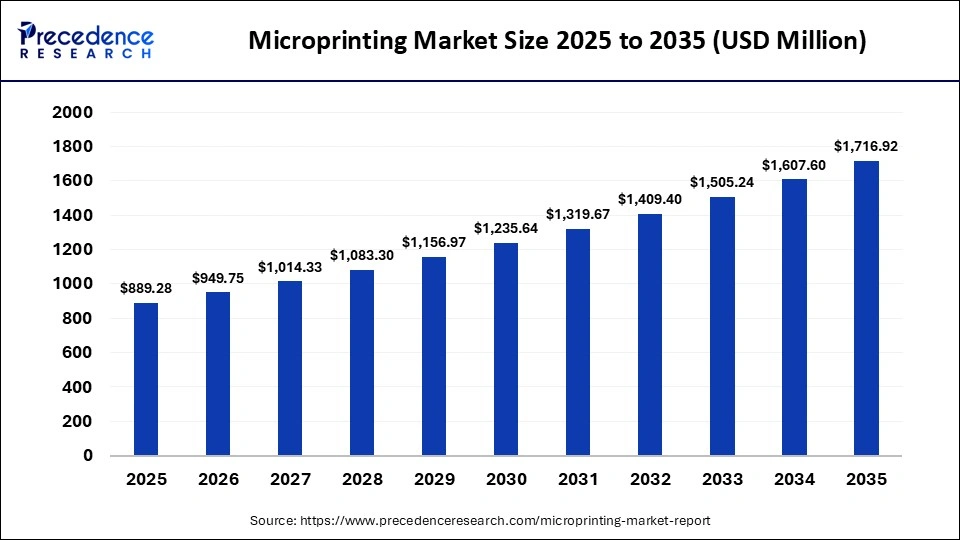
The global microprinting market size was accounted for USD 889.28 million in 2025 and is predicted to increase from USD 949.75 million in 2026 to approximately USD 1,716.92 million by 2035, expanding at a CAGR of 6.80% from 2026 to 2035. The market is driven by rising demand for advanced anti-counterfeiting and security solutions across banking, government, and packaging sectors.
Key Takeaways
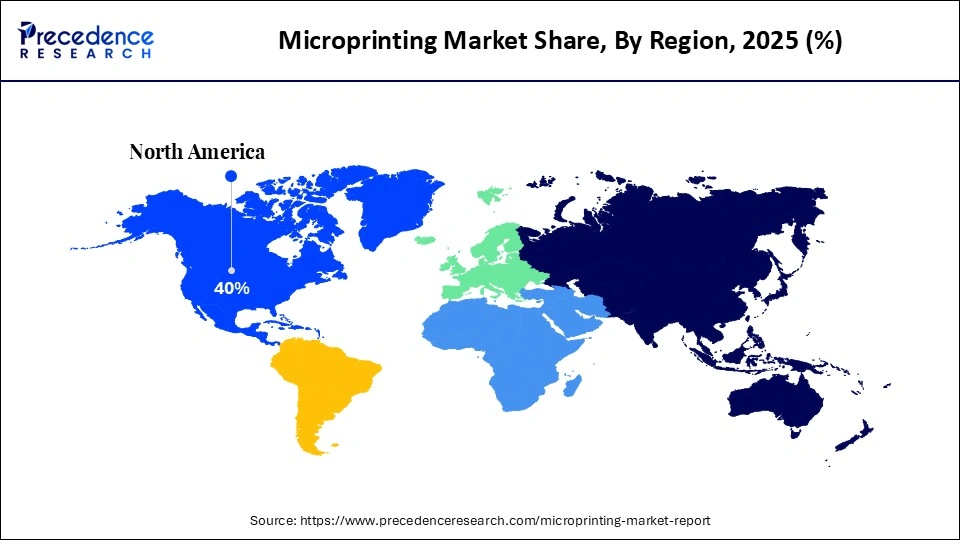
- North America dominated the global market with the largest share of 40% in 2025.
- Asia Pacific is expected to experience the fastest growth over the forecast period.
- By type, the monochrome segment held the major market share of 65% in 2025.
- By type, the color segment is anticipated to grow at a significant rate in the market over the forecast period.
- By ink type, the magnetic inks segment held a major share of the market in 2025.
- By ink type, the UV invisible inks segment is anticipated to grow at the fastest rate in the market over the forecast period.
- By application, the labels segment held the largest market share in 2025.
- By application, the currency segment is anticipated to grow at a rapid pace in the market over the forecast period.
- By end use, the BFSI segment held a major share of the market in 2025.
- By end use, the packaging segment is anticipated to grow at the fastest CAGR in the market over the forecast period.
Market Overview
Microprinting is an advanced printing technique that produces extremely fine text and intricate patterns, often invisible to the naked eye. It is widely used as a security feature on items such as banknotes, passports, certificates, and product packaging to prevent forgery and ensure authenticity.
The microprinting market is experiencing steady growth, driven by rising concerns over counterfeiting, fraud, and brand protection across multiple industries. Governments, financial institutions, and manufacturers are increasingly adopting advanced microprinting technologies to safeguard sensitive documents and high-value goods.
The surge in global e-commerce has further amplified the risk of counterfeit products entering the market, significantly increasing the demand for robust anti-counterfeiting solutions. As a result, microprinting has become a critical component in modern security printing and authentication systems.
How is AI Influencing the Microprinting Market?
Artificial Intelligence (AI) is playing a transformative role in the microprinting market by enhancing precision, security, and operational efficiency. AI-powered systems can analyze and detect even the smallest defects or inconsistencies in microprinted patterns, ensuring superior print quality and reliability.
In addition, machine learning algorithms are enabling the creation of highly complex microtext and intricate designs that are extremely difficult to replicate, thereby strengthening anti-counterfeiting measures. AI-driven innovations are pushing the boundaries of traditional printing by introducing dynamic and adaptive pattern generation techniques.
Furthermore, AI-based image recognition technologies are improving authentication processes by rapidly identifying and verifying microprinted features at scale. This allows for faster and more accurate document verification across industries such as banking, government, and manufacturing.
Overall, the integration of AI is enhancing both the production and verification aspects of microprinting, making it more secure, efficient, and resistant to counterfeiting in an increasingly digital and globalized marketplace.
Market Scope
| Report Coverage | Details |
| Market Size in 2025 | USD 889.28 Million |
| Market Size in 2026 | USD 949.75 Million |
| Market Size by 2035 | USD 1,716.92 Million |
| Market Growth Rate from 2026 to 2035 | CAGR of 6.80% |
| Dominating Region | North America |
| Fastest Growing Region | Asia-Pacific |
| Base Year | 2025 |
| Forecast Period | 2026 to 2035 |
| Segments Covered | Type, Ink Type, Application, End-use, and Region |
| Regions Covered | North America, Europe, Asia-Pacific, Latin America, and Middle East & Africa |
Regional Insights
North America holds the largest share of the microprinting market, accounting for over 40% of global revenue.
The region’s dominance is driven by:
- Strong adoption of advanced security printing technologies
- High demand for anti-counterfeiting solutions in banking, packaging, and government sectors
- Presence of major industry players and advanced printing infrastructure
The United States leads the region, supported by increasing cases of counterfeit currency and fraud, which has accelerated the adoption of microprinting in financial documents, identity cards, and packaging.
Europe represents a significant share of the global microprinting market, supported by stringent regulations focused on document security and anti-counterfeiting measures.
Key growth factors include:
- Widespread use of microprinting in banknotes, passports, and official documents.
- Strong involvement of central banks and government authorities in security printing
- Increasing adoption in luxury goods and brand protection
Countries such as Germany, the UK, and France are leading contributors due to their advanced printing technologies and strict compliance standards.
Asia-Pacific is expected to witness the fastest growth in the microprinting market during the forecast period.
Growth is driven by:
- Rapid expansion of banking and financial services.
- Increasing use of microprinting in currency notes, checkbooks, and ID cards.
- Rising e-commerce activity leading to higher demand for anti-counterfeit packaging.
Countries like China and India are major contributors, with governments and financial institutions heavily investing in secure printing technologies to combat fraud and counterfeit currency.
Microprinting Market Key Players
- Xerox Corporation
- Brady Worldwide, Inc.
- H.P. Development Company L.P.
- Zebra Technologies Corp.
- Videojet Technologies, Inc.
- Canon Inc.
- Ricoh
- Huber Group
- Matica Technologies Group S.A.
Recent Developments
- In July 2025, Xerox Holdings Corporation completed its $1.5 million acquisition of Lexmark International, Inc., including net debt and assumed liabilities, from Ninestar Corporation, PAG Asia Capital, and Shanghai Shouda Investment Centre. The deal strengthens Xerox’s global print and managed services portfolio and advances its strategic transformation in the evolving hybrid workplace. CEO Steve Bandrowczak stated that combining Lexmark’s reputation, client base, and global presence with Xerox’s offerings will enhance solutions for clients and partners, supporting long-term profitable growth.
- In October 2024, Orion S.A. introduced the bio-circular PRINTEX Nature 35 ink, which complied with the French mineral-oil regulations. The product enables the use of environmentally friendly printing solutions in accordance with the regulatory and sustainability demands.
- In September 2024, Domino Printing Sciences released a series of coders (Dx-series) at FACHPACK 2024, with 30 times faster processing speeds. The new coders will maximize efficiency regarding the printing and marking of variable information.
Segments Covered in the Report
By Type
- Monochrome
- Color
By Ink Type
- Micro-Embossing
- Special Inks
- Magnetic Inks
- UV Invisible Inks
- Infrared Ink Markings
By Application
- Currency
- Stamps
- Bank Checks
- Labels
- ID and Payment Cards
- Documents
- Others
By End-use
- BFSI
- Government
- Consumer Electronics
- Healthcare
- Education
- IT and Telecom
- Packaging
- Others
By Region
- North America
- Latin America
- Europe
- Asia-pacific
- Middle and East Africa
Get Sample Link: https://www.precedenceresearch.com/sample/8239
Also Read : https://www.businesswebwire.com/lithium-sulfur-battery-market/

- Cholestatic Pruritus Market: Advancements in Targeted Therapies Are Transforming Patient Care - June 30, 2026
- Inflammatory Disease Market: Biologic Therapies and Precision Medicine Are Reshaping Patient Care - June 30, 2026
- Retail Cloud Market: Driving the Future of Smart, Connected Retail Operations - June 30, 2026