
What is the AI Supercomputer Market Size in 2026?
The global AI supercomputer market size accounted for USD 3.42 billion in 2025 and is predicted to increase from USD 4.30 billion in 2026 to approximately USD 33.95 billion by 2035, expanding at a CAGR of 25.80% from 2026 to 2035. The market is a rapidly growing framework of high-performance computing, created to act as a supporter of AI workloads, like deep learning and generative AI, and high-scale statistics of large data volumes. The systems include powerful processors, high-performance interconnections, and a massively parallel computing ability to allow organizations to handle large amounts of data and train complex AI frameworks.
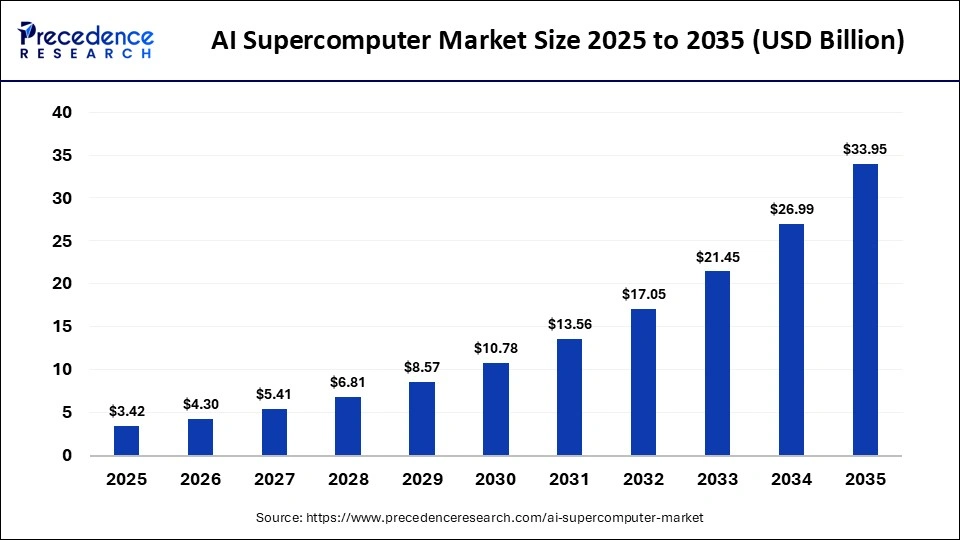
Key Takeaways
- North America dominated the global AI supercomputer market, holding a share of 41.80% in 2025.
- Asia-Pacific is expected to grow at the fastest CAGR in the market during the forecast period.
- By component, the hardware segment held a dominant position in the market with a share of 68.40% in 2025.
- By component, the services segment is expected to grow at the fastest CAGR of 28.60% in the market between 2026 and 2035.
- By deployment model, the cloud based segment led the global market by holding a share of 29.60% in 2025 and is expected to grow with the highest CAGR of 26.90% in the market during the studied years.
- By processor type, the GPU based systems segment registered its dominance over the market with a share of 61.70% in 2025.
- By processor type, the custom AI accelerators segment is expected to account for the fastest growth with a CAGR of 32.70% during the predicted timeframe.
- By computer architecture, the centralized AI supercomputers segment held the largest AI supercomputer market share of 47.60% in 2025.
- By computer architecture, the modular scale out AI clusters segment is expected to expand rapidly in the market with a CAGR of 29.70% in the coming years.
- By cooling technology, the air cooling segment contributed the biggest market share of 49.70% in 2025.
- By cooling technology, the immersion cooling segment is expected to witness the fastest growth in the market with a CAGR of 33.60% over the forecast period.
- By end user, the cloud service providers segment accounted for the highest market share of 34.80% in 2025.
- By end user, the healthcare and life sciences segment is expected to gain the highest market share with a CAGR of 31.40% between 2026 and 2035.
- By application, the AI model training segment registered its dominance over the market with a share of 36.70% in 2025.
- By application, the drug discovery segment is expected to show the fastest growth with a CAGR of 32.10% over the forecast period.
- By system scale, the 100 PFLOPS to 500 PFLOPS segment held a major market share of 34.60% in 2025.
- By system scale, the above 1 EFLOPS segment is expected to grow with the highest CAGR of 31.80% in the market during the studied years.
Key Factors Influencing the AI Supercomputer Market
The AI supercomputer market is experiencing rapid growth, driven by the increasing adoption of high-performance computing (HPC) infrastructure to support complex artificial intelligence workloads. These advanced systems provide the immense computational power required to train large-scale models, run sophisticated simulations, and process massive datasets in real time.
Governments, research institutions, and leading technology companies are making substantial investments in next-generation supercomputing systems to strengthen national innovation capabilities and accelerate scientific discovery. As AI adoption expands across industries, AI supercomputers are becoming essential tools for solving highly complex, data-intensive problems that demand unparalleled processing performance.
Role of AI in the AI Supercomputer Market
Artificial intelligence plays a central role in shaping the evolution of supercomputing technologies. Modern AI frameworks particularly deep learning and generative AI models require vast computational resources that only large-scale supercomputing systems can provide. These platforms enable researchers and organizations to train models with billions or even trillions of parameters, significantly accelerating innovation in areas such as natural language processing, drug discovery, and climate modeling.
In addition, advancements in AI-specific hardware accelerators, high-bandwidth memory systems, and optimized software frameworks are improving the speed and efficiency of model training and inference. These innovations are redefining the capabilities of supercomputing and enabling broader enterprise adoption of AI-driven solutions.
AI Supercomputer Market Trends
- Sovereign AI Initiatives: A major trend in the market is the rise of sovereign AI, where countries are investing in domestic AI infrastructure to enhance national security, technological independence, and global competitiveness. National supercomputing facilities are being developed to support research, innovation, and strategic capabilities.
- Private Sector Leadership and Scaling: Technology companies and cloud service providers are playing a dominant role in advancing AI supercomputing. Large-scale AI clusters are being developed to support the training of next-generation models, enabling unprecedented scalability and computational performance.
- Performance and Energy Challenges: Despite rapid growth, the market faces challenges related to computational efficiency and energy consumption. AI supercomputers require significant power resources, making energy optimization and sustainable computing critical areas of focus.
- Convergence of AI and HPC: The integration of artificial intelligence with traditional high-performance computing is transforming system architectures. HPC systems, originally designed for scientific simulations, are being re-engineered to efficiently handle AI and machine learning workloads.
- Cloud-Based AI Supercomputing: Cloud deployment is emerging as a key trend, allowing organizations to access powerful AI supercomputing resources without investing in physical infrastructure. Scalable, on-demand computing environments are making advanced AI capabilities more accessible to businesses of all sizes.
- Advancements in Hardware Technologies: Continuous innovation in hardware such as GPUs, TPUs, and specialized AI accelerators is significantly enhancing computational speed and efficiency. These advancements enable faster training and deployment of increasingly complex AI models, driving overall market growth.
Market Scope
| Report Coverage | Details |
| Market Size in 2025 | USD 3.42 Billion |
| Market Size in 2026 | USD 4.30 Billion |
| Market Size by 2035 | USD 33.95 Billion |
| Market Growth Rate from 2026 to 2035 | CAGR of 25.80% |
| Dominating Region | North America |
| Fastest Growing Region | Asia Pacific |
| Base Year | 2025 |
| Forecast Period | 2026 to 2035 |
| Segments Covered | Component, Deployment Model, Processor Type, Compute Architecture, Cooling Technology, End User, Application, System Scale, and Region |
| Regions Covered | North America, Europe, Asia-Pacific, Latin America, and Middle East & Africa |
Regional Insights
North America leads the AI supercomputer market, driven by strong investments in advanced computing infrastructure and the presence of major technology companies and research institutions. The United States is at the forefront, with significant funding directed toward AI development, defense applications, and scientific research. The region also benefits from a mature cloud ecosystem, enabling widespread access to AI supercomputing capabilities across enterprises.
Europe represents a key market, supported by government-backed initiatives and collaborative research programs aimed at strengthening digital sovereignty. The region is actively investing in high-performance computing infrastructure to reduce reliance on external technologies and enhance innovation capabilities. Countries such as Germany, France, and the UK are focusing on integrating AI with traditional HPC systems, particularly in sectors like automotive, manufacturing, and climate research.
Asia-Pacific is the fastest-growing region in the AI supercomputer market, fueled by rapid digitalization, strong government support, and increasing investments in AI infrastructure. China, Japan, South Korea, and India are heavily investing in supercomputing capabilities to boost national competitiveness and technological leadership. The region’s expanding industrial base, coupled with rising demand for AI applications in manufacturing, healthcare, and smart cities, is accelerating market growth.
Latin America is gradually emerging in the AI supercomputer landscape, with growing interest in AI-driven research and digital transformation. While adoption remains at an early stage, countries in the region are beginning to invest in HPC infrastructure to support academic research, energy exploration, and public sector applications. However, limited funding and infrastructure challenges may restrain rapid growth.
AI Supercomputer Market Key Players
- NVIDIA
- Hewlett Packard Enterprise
- Dell Technologies
- Lenovo
- Supermicro
- IBM
- Fujitsu
- Oracle
- Microsoft
- Amazon Web Services
- AMD
- Intel
- Eviden
- GIGABYTE
Recent Developments
- In January 2026, NVIDIA introduced the Rubin AI supercomputing platform, a next-generation architecture designed to support large-scale AI workloads. The platform integrates multiple advanced chips that function together to deliver HPC for both AI training and inference. It was engineered to enhance efficiency while reducing operational costs for hyperscale data centers and enterprise environments.
- In October 2025, the U.S. Department of Energy announced the deployment of two new AMD-powered AI supercomputers at Oak Ridge National Laboratory. These systems were designed to support HPC tasks such as scientific simulations, machine learning research, and national security applications. The initiative is part of a broader collaboration between government agencies and technology companies aimed at advancing supercomputing capabilities.
Segments Covered in the Report
By Component
- Hardware
- Software
- Services
By Deployment Model
- On premises
- Cloud based
- Hybrid
By Processor Type
- GPU based systems
- CPU based systems
- TPU based systems
- FPGA based systems
- Custom AI accelerators
By Compute Architecture
- Centralized AI supercomputers
- Distributed AI supercomputers
- Modular scale out AI clusters
By Cooling Technology
- Air cooling
- Direct liquid cooling
- Immersion cooling
By End User
- Cloud service providers
- Government and defense
- Academic and research institutes
- Enterprises
- Healthcare and life sciences
- Financial services
- Others
By Application
- AI model training
- AI inference
- Scientific research
- Drug discovery
- Autonomous systems
- Cybersecurity
- Climate and weather modeling
- Others
By System Scale
- Below 100 PFLOPS
- 100 PFLOPS to 500 PFLOPS
- 500 PFLOPS to 1 EFLOPS
- Above 1 EFLOPS
By Region
- North America
- Latin America
- Europe
- Asia-pacific
- Middle and East Africa
Get Sample Link: https://www.precedenceresearch.com/sample/8191
Also Read : https://www.businesswebwire.com/ai-in-endoscopy-market/

- Cholestatic Pruritus Market: Advancements in Targeted Therapies Are Transforming Patient Care - June 30, 2026
- Inflammatory Disease Market: Biologic Therapies and Precision Medicine Are Reshaping Patient Care - June 30, 2026
- Retail Cloud Market: Driving the Future of Smart, Connected Retail Operations - June 30, 2026