What is the Solid State LiDaR Market Size in 2026?
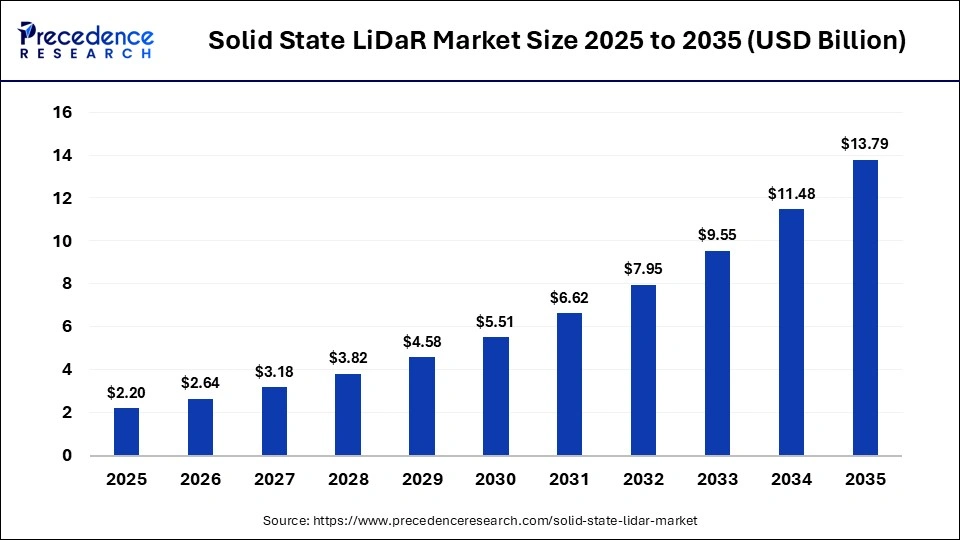
The global solid state LiDaR market size accounted for USD 2.20 billion in 2025 and is predicted to increase from USD 2.64 billion in 2026 to approximately USD 13.79 billion by 2035, expanding at a CAGR of 20.15% from 2026 to 2035. This market is growing due to the soaring need for cost-effective, high-reliability sensors in advanced driver-assistance systems and autonomous vehicles.
Key Takeaways
- North America dominated the global solid state LiDaR market in 2025.
- Asia-Pacific is expected to grow at the fastest CAGR between 2026 and 2035.
- By component, the laser source segment held a dominant position in the market in 2025.
- By component, the processing unit segment is expected to expand at the fastest CAGR between 2026 and 2035.
- By technology, the flash LiDAR segment held the largest market share in 2025.
- By technology, the phased array LiDAR segment is expected to expand at the fastest CAGR between 2026 and 2035.
- By application, the autonomous vehicles segment contributed the biggest market share in 2025.
- By application, the agriculture segment is expected to expand at the fastest CAGR between 2026 and 2035.
- By end use, the automotive segment accounted for the highest market share in 2025.
- By end use, the aerospace segment is expected to expand at the fastest CAGR between 2026 and 2035.
Market Overview
The solid-state LiDAR market is primarily driven by the growing demand for autonomous vehicles and advanced driver assistance systems (ADAS). These technologies require compact, reliable, and cost-efficient sensing solutions to enable accurate navigation and improve road safety. Solid-state LiDAR sensors offer advantages such as enhanced durability, smaller size, and lower maintenance compared to traditional mechanical LiDAR systems.
Technological advancements, including sensor miniaturization, improved resolution, and higher detection range, are further accelerating market growth. In addition, increasing government regulations related to vehicle safety and collision avoidance systems are encouraging automotive manufacturers to adopt advanced sensing technologies. The rising use of LiDAR sensors in robotics, smart city infrastructure, and industrial automation is also contributing significantly to the expansion of the market.
Role of Artificial Intelligence in the Solid-State LiDAR Market
Artificial intelligence (AI) is playing a crucial role in enhancing the capabilities of solid-state LiDAR technology. AI algorithms convert large volumes of raw LiDAR point-cloud data into actionable real-time 3D insights, enabling autonomous systems to better understand their surroundings.
Machine learning models improve object detection, classification, and tracking while minimizing sensor noise, allowing vehicles and robots to operate safely in complex environments. AI also enables predictive analysis, helping autonomous systems anticipate the movement of nearby vehicles, pedestrians, and obstacles. Furthermore, AI-driven data annotation and interpretation are replacing traditional manual labeling methods, making the processing of complex 3D datasets faster and more efficient.
Future Market Outlook
- Growth in Emerging Economies: Emerging markets are expected to play a key role in the growth of the solid-state LiDAR industry. Government investments in smart city initiatives, autonomous mobility projects, and industrial automation in countries like China and India are accelerating the adoption of LiDAR technologies. Additionally, the expanding electric vehicle industry in Japan is encouraging automakers to integrate solid-state LiDAR systems to support Level 2 to Level 4 autonomous driving capabilities.
- Increasing Use in Smart Infrastructure Development: Solid-state LiDAR is increasingly being deployed in urban infrastructure to improve traffic management and city planning. Sensors installed at traffic intersections enable real-time 3D tracking of vehicles, pedestrians, and cyclists, helping optimize traffic flow and enhance road safety. Unlike conventional cameras, LiDAR sensors function effectively in all lighting conditions while providing privacy-friendly data collection. City planners are also using LiDAR technology to create accurate 3D digital models of urban environments. These digital twins support applications such as infrastructure planning, flood risk analysis, and disaster management. Additionally, the high resolution of solid-state LiDAR systems enables highly detailed mapping of complex urban landscapes.
Market Scope
| Report Coverage | Details |
| Market Size in 2025 | USD 2.20 Billion |
| Market Size in 2026 | USD 2.64 Billion |
| Market Size by 2035 | USD 13.79 Billion |
| Market Growth Rate from 2026 to 2035 | CAGR of 20.15% |
| Dominating Region | North America |
| Fastest Growing Region | Asia Pacific |
| Base Year | 2025 |
| Forecast Period | 2026 to 2035 |
| Segments Covered | Component, Technology, Application, End Use, and Region |
| Regions Covered | North America, Europe, Asia-Pacific, Latin America, and Middle East & Africa |
Regional Insights
North America holds a significant share of the solid-state LiDAR market, supported by strong investments in autonomous vehicle technologies, robotics, and smart infrastructure. The region benefits from the presence of leading LiDAR technology developers and automotive manufacturers actively testing autonomous driving systems. The United States leads the regional market due to extensive research and development activities, government support for advanced mobility technologies, and early adoption of advanced driver assistance systems (ADAS). Additionally, increasing use of LiDAR in logistics automation, defense surveillance, and smart city projects is further driving regional demand. North America accounts for roughly 35–38% of the global market share, making it one of the dominant regions in the industry.
Europe represents a strong market for solid-state LiDAR technology due to strict vehicle safety regulations and rapid adoption of Industry 4.0 technologies. Countries such as Germany, France, and United Kingdom are leading the deployment of LiDAR sensors in automotive manufacturing, smart transportation systems, and industrial automation. European safety standards and autonomous driving trials are accelerating the integration of LiDAR into next-generation vehicles and mobility solutions. The region accounts for around 23–28% of the global market, supported by investments in smart mobility infrastructure and advanced robotics.
Asia-Pacific is the largest and fastest-growing region in the solid-state LiDAR market due to rapid industrialization, strong electronics manufacturing ecosystems, and increasing investments in autonomous mobility technologies. Countries such as China, Japan, South Korea, and India are driving regional growth through large-scale production of LiDAR sensors and growing adoption in electric vehicles, robotics, and smart city initiatives. The region accounts for more than 40% of the global market, supported by strong supply chains, lower production costs, and large-scale deployment of smart infrastructure projects.
The solid-state LiDAR market in Latin America is experiencing steady growth as countries invest in infrastructure modernization and industrial automation. Nations such as Brazil and Mexico are adopting LiDAR technologies in applications such as urban mapping, mining operations, and transportation monitoring. Increasing government initiatives aimed at smart city development and transportation efficiency are expected to support further adoption of LiDAR systems in the region.
The Middle East and Africa region is gradually emerging as a promising market for solid-state LiDAR solutions. Countries such as Saudi Arabia and the United Arab Emirates are investing heavily in smart city infrastructure, intelligent transportation systems, and security monitoring technologies. These initiatives are increasing the deployment of LiDAR sensors for traffic management, surveillance, and urban planning applications.
Solid State LiDAR Market Companies
- Velodyne Lidar
- Luminar Technologies
- Ouster
- Waymo
- LeddarTech
- Aeva
- Innoviz Technologies
- Robosense
- Xenomatix
Recent Developments
- In July 2025, Innoviz Technologies Ltd. declared that it had transferred the first InnovizTwo LiDAR section from Fabrinet’s high-volume production line. This marks a huge milestone in Innoviz’s journey to mass-manufacture its InnovizTwo LiDAR technology, thus, for the autonomous vehicle industry.
- In November 2024, Peachtree Corners announced a collaboration with Opsys to launch and deploy its Advanced LiDAR Technology Opsys Sensors (ALTOS) Gen 2 LiDAR at Curiosity Lab. The solid-state LiDAR enables the best-in-class performance with high resolution and extreme reliability.
Get Sample Link: https://www.precedenceresearch.com/sample/8006
Segments Covered in the Report
By Component
- Laser Source
- Receiver
- Optics
- Processing Unit
By Technology
- Flash LiDAR
- Phased Array LiDAR
- Scanning LiDAR
By Application
- Autonomous Vehicles
- Mapping and Surveying
- Infrastructure Monitoring
- Agriculture
- Robotics
By End Use
- Automotive
- Aerospace
- Defense
- Construction
- Environmental Monitoring
By Region
- North America
- Europe
- Asia-Pacific
- Latin America
- Middle East & Africa

- Farm Management Software Market: Digital Agriculture Driving Smarter and More Sustainable Farming - July 9, 2026
- AI in CGT Manufacturing Market: Artificial Intelligence Accelerating the Future of Cell and Gene Therapy Production - July 9, 2026
- 3T MRI System Market: Advanced Imaging Technology Transforming Modern Diagnostics - July 9, 2026