
The global Pantograph Charger Market is poised for exponential growth as electrified public transport and automated charging infrastructure become mission-critical to sustainable mobility. Recent analysis from Precedence Research reveals that the market — valued at USD 4.75 billion in 2025 — is forecast to surge to USD 49.29 billion by 2035, expanding at a robust CAGR of 26.36% through the forecast period.
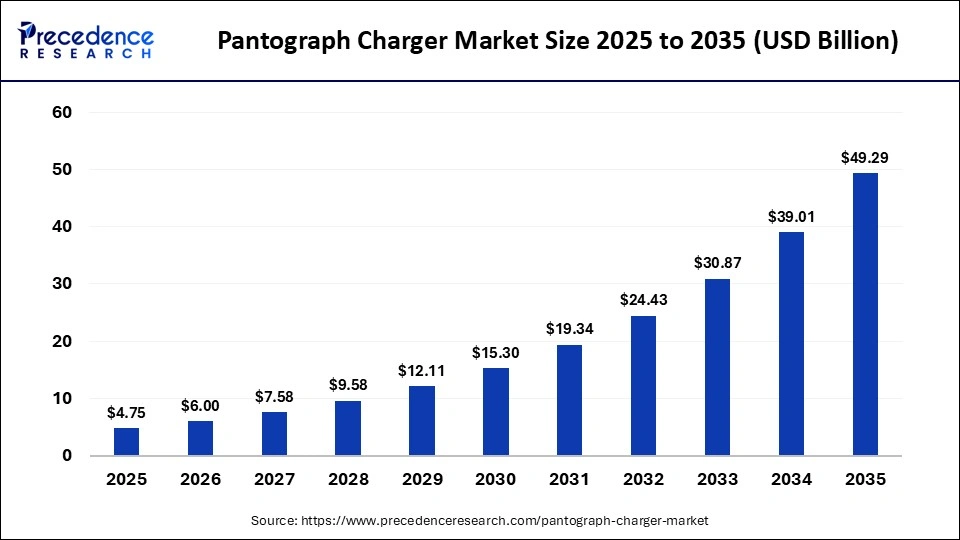
Pantograph chargers are innovative high-power overhead charging systems used predominantly in electric buses, tram systems, and urban rail, enabling rapid energy transfer with minimal downtime. With governments and transit agencies worldwide prioritizing decarbonization, the demand for automated and high-throughput charging infrastructure is increasing rapidly. Strong sustainability policies, rising EV fleets, and smart city investments are the primary growth drivers behind this remarkable market expansion.
Pantograph Charger Market Key Points
-
The global market size is expected to grow from USD 4.75 billion (2025) to USD 49.29 billion by 2035 at a CAGR of 26.36%.
-
North America dominated with the largest share (~35%) in 2025.
-
Asia-Pacific is set to record the fastest growth through 2035.
-
DC Fast Charging (DCFC) holds the leading share by charging type.
-
Hardware components accounted for the majority of market value in 2025.
-
Off-board top-down pantographs led infrastructure deployment in the base year.
Pantograph Charger Market Revenue Table (2025–2035)
| Metric | Value |
|---|---|
| Market Size 2025 | USD 4.75 Billion |
| Market Size 2026 | USD 6.00 Billion |
| Market Forecast by 2035 | USD 49.29 Billion |
| CAGR (2026–2035) | 26.36% |
| Dominant Region | North America |
| Fastest Growing Region | Asia-Pacific |
| Source: Precedence Research |
How is AI Transforming the Pantograph Charger Market?
Artificial Intelligence (AI) is catalyzing a paradigm shift in pantograph charging infrastructure. Smart diagnostics and predictive maintenance algorithms now monitor system health in real time, helping operators reduce downtime and proactively address component wear before failures occur. With hundreds of high-power charging connections made daily in urban fleets, AI-enabled reliability is a competitive differentiator in this rapidly scaling market.
Beyond asset health monitoring, AI systems are increasingly integrated with IoT and energy management platforms. These technologies optimize charging schedules, dynamically balance grid load, and seamlessly integrate renewable energy sources when available, significantly cutting operational costs for transit agencies and improving environmental outcomes.
Pantograph Charger Market Growth Factors
Rising Electrification of Public Transport
City authorities globally have pledged to electrify bus and tram networks as part of urban sustainability initiatives. As these fleets expand, high-throughput pantograph charging becomes indispensable for maintaining tight schedules and minimizing downtime.
Infrastructure Investments & Sustainability Policies
Governments are providing incentives, subsidies, and policies aimed at reducing emissions. This political backing accelerates infrastructure build-outs, especially in developed regions like North America and Europe.
Demand for High-Power Charging
Direct Current Fast Charging (DCFC) leads adoption as it supports rapid energy transfer with short dwell times — crucial for busy transit routes and rail systems.
What Opportunities & Trends Are Shaping the Future?
What makes Asia-Pacific the fastest-growing region?
Rapid urbanization, extensive EV adoption, and aggressive electrification strategies in countries like China and India have positioned Asia-Pacific at the forefront of pantograph charger demand. Governments are prioritizing cleaner transport infrastructure, fostering innovation and implementation.
How is the shift to software-centric solutions creating value?
As transit systems scale, advanced software platforms managing predictive analytics, energy optimization, and remote monitoring are emerging as high-growth contributors — enabling smarter fleets and longer-term cost efficiencies.
Pantograph Charger Market Regional & Segment Analysis
North America:
Commanding the largest market share, North America’s advanced transit systems and policies supporting emissions reduction have accelerated pantograph infrastructure deployment. Major transit hubs are integrating high-power chargers to support both buses and rail fleets.
United States
The U.S. market is expected to grow from USD 1.25 billion in 2025 to nearly USD 13.21 billion by 2035, powered by federal and state investment in zero-emission fleets and charging infrastructure roll-outs.
Asia-Pacific
With rapid urbanization and coordinated public transport electrification, this region is anticipated to deliver the highest CAGR over the forecast period. Collaborative efforts among local manufacturers are enhancing region-specific solutions.
Charging Type
-
DC Fast Charging: Market leader with rapid adoption.
-
Level 2 Charging: Fastest growing segment during forecast.
Component Type:
-
Hardware: Holds dominant share due to capital-intensive equipment costs.
-
Software: Projected fastest growth for remote and predictive system enhancements.
Infrastructure Type
-
Off-Board Top-Down: Currently leads due to reliability and minimal vehicle modifications.
-
On-Board Bottom-Up: Gaining traction for flexible charging footprints.
Pantograph Charger Market Latest Breakthroughs & Industry Movements
Key players across the ecosystem are accelerating innovation and deployments:
-
Siemens Mobility launched the Charger B+AC platform, integrating pantograph tech with battery-electric locomotion.
-
Daimler Buses commissioned multi-point charging systems to support large fleets in Europe.
-
Toshiba initiated super-rapid charging demonstrations for electric buses in Japan.
Top Companies Mentioned: ABB Ltd., Siemens AG, Wabtec Corporation, Schunk Transit Systems, Vector Informatik, SETEC Power, Valmont Industries, Comeca Group, Hangzhou Aoneng, ChargePoint, Inc.
Case Study: New York City MTA Charging Initiative
The Metropolitan Transportation Authority (MTA) is installing 53 state-of-the-art pantograph chargers across multiple depots to support its expanding zero-emission bus fleet. This real-world deployment highlights how advanced charging infrastructure cuts emissions while enabling reliable service schedules in dense urban environments.
Read Also: Vision-Language Models Market
Get this report to explore global market size, share, CAGR, and trends, featuring detailed segmental analysis and an insightful competitive landscape overview @ https://www.precedenceresearch.com/sample/7635
You can place an order or ask any questions, please feel free to contact us at [email protected] |+1 804 441 9344

- ESG Software Market 2025: Comprehensive Company Ecosystem and Revenue Overview - May 20, 2026
- ESG Software Market Surges Toward USD 31.96 Billion by 2035 as AI-Powered Compliance and Sustainability Reporting Transform Global Enterprises - May 20, 2026
- Hematopoietic Stem Cell Transplantation Market Surges Toward USD 24.32 Billion by 2035 as Precision Medicine and AI Reshape Blood Cancer Treatment - May 20, 2026