
North America Leads with 38% Share as Wearables and AI Drive Preventive Health Revolution
The global digital health monitoring devices market size is valued at USD 5.36 billion in 2025 and is projected to surge to USD 30.86 billion by 2035, expanding at a robust CAGR of 19.13% from 2026 to 2035.
This explosive growth stems from the rising prevalence of chronic diseases like diabetes and hypertension, alongside booming demand for remote patient monitoring and telehealth integration. Advanced wearables and IoT-enabled devices are empowering consumers and providers with real-time data for proactive health management.
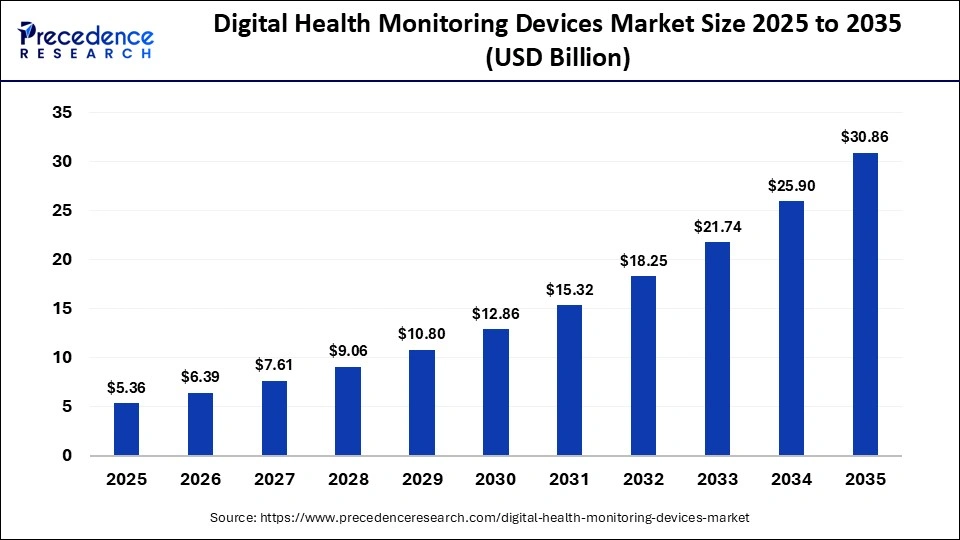
Digital Health Monitoring Devices Market Key Insights
- The market hit USD 5.36 billion in 2025 and eyes USD 30.86 billion by 2035 at a 19.13% CAGR.
- North America commands 38% share, propelled by advanced infrastructure and high consumer adoption.
- Smartwatches with health sensors led device types, while home healthcare users dominated end-users.
- Bluetooth-enabled devices held the top connectivity spot, with online/e-commerce leading distribution.
- Asia Pacific emerges as the fastest-growing region, driven by urbanization and digital health initiatives.
Market Valuation Snapshot
| Metric | Value |
|---|---|
| 2025 Market Size | USD 5.36 Billion |
| 2026 Projection | USD 6.39 Billion |
| 2035 Projection | USD 30.86 Billion |
| CAGR (2026-2035) | 19.13% |
| North America 2025 | USD 2.04 Billion |
| U.S. 2025 | USD 1.53 Billion |
Artificial intelligence supercharges digital health monitoring by sifting through vast wearable data for predictive insights, enabling early detection of risks like arrhythmias or glucose spikes. AI algorithms in devices like continuous glucose monitors and ECG wearables analyze biomarkers in real-time, alerting providers via cloud platforms for timely interventions. This shifts healthcare from reactive to preventive, cutting hospital burdens.
Integration with RPM systems amplifies AI’s impact, as seen in tools like Dozee’s contactless sensors that convert vibrations into actionable health metrics. Leading firms like GE HealthCare deploy AI for 58 FDA-cleared features, from chest X-ray triage to vital sign anomaly detection. These advancements promise personalized wellness at scale.
What Fuels Digital Health Monitoring Devices Market Growth?
Chronic diseases are skyrocketing, with diabetes and heart conditions demanding continuous monitoring—future demand here rates very high. Telehealth expansion requires real-time data devices, further amplifying growth. Smart wearables with ECG and SpO2 tracking boost consumer uptake, while the home-care shift cuts hospital visits.
What Opportunities and Trends Shape the Future?
How is remote patient monitoring reshaping device adoption? Hospitals now track vitals remotely, slashing readmissions via wearables and apps.
Why are medical-grade wearables surging? Smartwatches now rival clinical tools with ECG and rhythm monitoring for everyday use.
What role does preventive care play? Consumers track sleep, stress, and fitness to avert issues early.
How do telehealth ecosystems expand reach? Platforms sync devices for live consultations and data sharing.
What miniaturization trends improve usability? Lighter, battery-efficient sensors enable all-day comfort.
“Digital health monitoring devices are not just gadgets—they’re lifelines transforming how we preempt illness in an aging world,” says Elena Vasquez, Principal Consultant at Precedence Research. “With AI and 5G convergence, expect a USD 30 billion ecosystem by 2035, prioritizing equity and precision.”
Digital Health Monitoring Devices Market Segmentation Spotlight
Device Type: Smartwatches with health sensors dominated in 2025 via ECG, sleep, and app integration, appealing to fitness enthusiasts. Smart patches/skin sensors grow fastest, offering non-invasive biomarker tracking for chronic care.
Connectivity: Bluetooth devices lead with low-power smartphone syncs, ideal for home use. Cellular/5G surges for hospital-grade remote data transmission.
End-User: Home healthcare users topped charts, driven by self-monitoring trends. Monitoring providers expand rapidly with RPM and EHR links.
Distribution: Online/e-commerce ruled with convenience and reviews. Direct-to-consumer channels rise via subscriptions.
Digital Health Monitoring Devices Market Regional Dynamics
- North America leads at USD 2.04 billion in 2025 (19.27% CAGR to USD 11.88 billion by 2035), fueled by U.S. telehealth policies and wearables.
- The U.S. alone hits USD 1.53 billion, with smart tech penetration.
- Asia Pacific grows fastest via smartphone booms in India and China. Europe thrives on regulations and R&D in Germany; Latin America and MEA advance with urbanization in Brazil and UAE.
Digital Health Monitoring Devices Market Top Companies and Breakthroughs
Key players include Medtronic, Philips Healthcare, GE Healthcare, Abbott Laboratories, Siemens Healthineers, OMRON Healthcare, Dexcom, Fitbit (Google), ResMed, Withings, AliveCor, Apple Inc., Samsung Electronics, Garmin Ltd., Boston Scientific, Johnson & Johnson MedTech, Stryker, Masimo, Honeywell, iRhythm, Oura, Biotronik, and Mindray.
-
Wearable Devices Ltd’s January 2025 Mudra Link neural wristband debuted at CES with gesture-control health tracking.
-
June 2025 saw their AI-LMM platform expand for predictive biosignals.
-
Medtronic’s GI Genius and LINQ II AI cut false positives in monitoring.
-
GE HealthCare’s 58 AI-cleared tools lead in radiology triage.
Challenges and Cost Pressures
Data accuracy varies across wearables, eroding clinical trust amid inconsistent heart rate tracking. Privacy risks loom with PHI collection, sparking cybersecurity and regulatory hurdles in the U.S. and EU. High development costs for AI/5G integration pressure affordability, while equity gaps limit access in underserved areas.
Real-World Impact: A Home Monitoring Success
In the U.S., a Texas clinic deployed Bluetooth smart patches for 500 diabetes patients, reducing ER visits by 30% via AI alerts on glucose trends—mirroring RPM’s potential to save billions in care costs.
Get this report to explore global market size, share, CAGR, and trends, featuring detailed segmental analysis and an insightful competitive landscape overview @ https://www.precedenceresearch.com/sample/7235
You can place an order or ask any questions. Please feel free to contact us at [email protected] |+1 804 441 9344

- ESG Software Market 2025: Comprehensive Company Ecosystem and Revenue Overview - May 20, 2026
- ESG Software Market Surges Toward USD 31.96 Billion by 2035 as AI-Powered Compliance and Sustainability Reporting Transform Global Enterprises - May 20, 2026
- Hematopoietic Stem Cell Transplantation Market Surges Toward USD 24.32 Billion by 2035 as Precision Medicine and AI Reshape Blood Cancer Treatment - May 20, 2026