
Rapid Adoption, AI Integration and Global Demand Drive Unprecedented Growth
The global Fixed-Wing Vertical Take-Off and Landing (VTOL) UAV market is on an exponential growth trajectory, forecasted to reach approximately USD 2,178.21 million by 2035, a dramatic rise from USD 712.06 million in 2025. This expansion represents a robust compound annual growth rate (CAGR) of 11.83% during 2026–2035, fueled by technological breakthroughs, cross-sector adoption, and increasing demand for autonomous, hybrid-endurance UAVs across defense, commercial, and industrial domains.
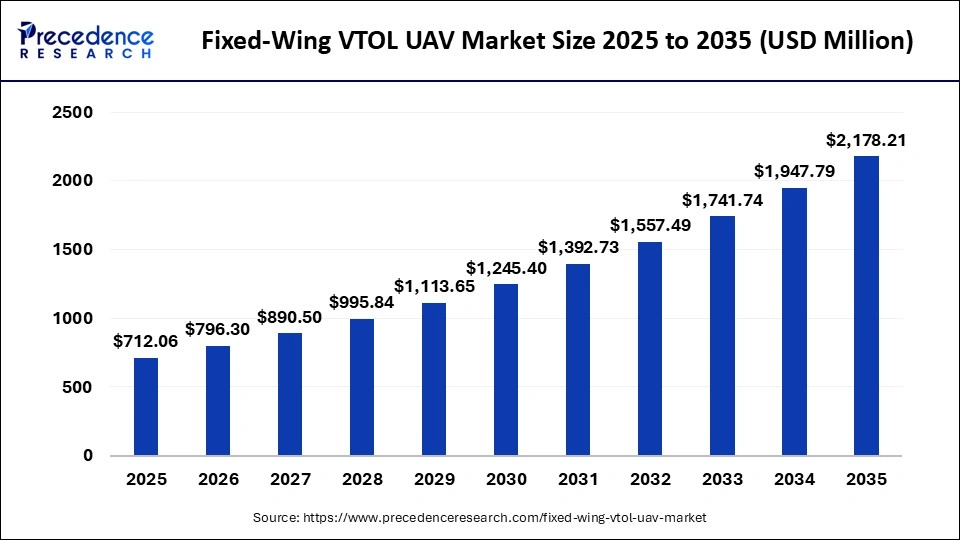
Dynamic market forces, including intensified military procurement, fast-tracked smart agriculture adoption, and the surge in autonomous inspection solutions, are propelling the Fixed-Wing VTOL UAV market. With a projected CAGR of 11.83%, stakeholders worldwide are leveraging these aircraft for missions that demand both range and vertical dexterity.
Fixed-Wing VTOL UAV Market Key Points
-
Global market value in 2025: USD 712.06 million.
-
Forecasted value by 2035: USD 2,178.21 million.
-
CAGR for 2026–2035: 11.83%.
-
Leading region: North America (driven by defense spending and regulatory support).
-
Top use cases: Intelligence, Surveillance and Reconnaissance (ISR), disaster management, logistics, and precision agriculture.
-
Notable players: AeroVironment, General Atomics, Northrop Grumman, and BlueHalo.
-
In 2024, ISR platforms accounted for nearly 47% of application share, with electric propulsion models capturing over half the market.
Fixed-Wing VTOL UAV Market Revenue Overview
| Year | Revenue (USD Million) |
|---|---|
| 2025 | 712.06 |
| 2035 | 2,178.21 |
AI is fundamentally reshaping the Fixed-Wing VTOL UAV industry by powering everything from navigation and mission planning to advanced image recognition. Algorithms embedded within UAVs enable real-time threat assessment and precision targeting for defense, while supporting robust anomaly detection and predictive maintenance in industrial and commercial deployments. AI-empowered UAVs can autonomously adapt flight paths for energy efficiency, optimize multi-drone coordination, and analyze vast sensor datasets mid-mission for actionable insights.
Commercial enterprises are utilizing AI for aerial mapping, crop health analysis, and logistics optimization. This deployment streamlines operations, minimizes human intervention, and drastically shortens response times in dynamic environments. The resulting gains in operational reliability and scalability are making AI-infused VTOL UAVs an integral pillar of next-generation unmanned aviation.
What Drives the Growth of the Fixed-Wing VTOL UAV Market?
The surging demand for runway-independent aviation solutions with both vertical lift and fixed-wing endurance is spurring extraordinary market expansion. Key drivers include:
-
Rising defense and security outlays for ISR, border surveillance, and disaster response, especially in North America and Asia-Pacific.
-
Growing adoption across agriculture, mining, and energy sectors for survey and mapping missions.
-
Technological advancements in propulsion, autonomy, and payload integration, including lighter composites, AI, and longer-lasting electric or hybrid powertrains.
-
Accelerated procurement by commercial operators as regulatory frameworks support more routine and beyond-visual-line-of-sight (BVLOS) operations.
Where Are the Untapped Opportunities and What’s Trending?
What innovations and trends are reshaping the market’s future prospects?
-
AI-based autonomy and swarm control: Strategic defense agencies and industrial users are piloting fully autonomous swarms for rapid area coverage and dynamic mission updates, opening up specialized roles in logistics and critical infrastructure.
-
Expansion into civilian supply chain and medical logistics: Hybrid VTOL UAVs are increasingly being deployed for urgent deliveries in hard-to-reach terrains, disaster zones, and densely populated urban centers, driven by improved energy density and multi-sensor navigation.
-
Green propulsion and smart batteries: There is notable investment into fuel-cell powered UAVs and next-gen battery chemistries to unlock longer sorties while meeting sustainability targets.
-
Regulatory evolution enabling larger, heavier UAVs: Progressive policies in North America and select Asia-Pacific economies are unlocking demand for large-payload models, spurring new revenue streams for both defense and industrial operators.
Fixed-Wing VTOL UAV Market Regional and Segmentation Analysis
-
North America: Dominates with the highest share, driven by defense budgets, early adoption for industrial inspections, and a robust manufacturing ecosystem. U.S. and Canada are major demand centers, especially in defense and public safety applications.
-
Asia-Pacific: Fastest-growing region, propelled by China, India, and Japan leveraging UAVs for both military modernization and resource management. Government policies in these economies provide strong tailwinds.
-
Europe: Steady growth with adoption in smart city planning, agriculture, and maritime security.
Fixed-Wing VTOL UAV Market Key Segments
-
By Propulsion: Electric (dominant), Fuel-cell (fastest growing)
-
By Application: Defense ISR, commercial delivery, mapping, environmental monitoring
-
By Range: Predominantly extended visual line-of-sight and BVLOS.
Fixed-Wing VTOL UAV Market Key Segments Top Companies
-
AeroVironment: Major contracts for ISR UAVs with 10-hour endurance capabilities.
-
General Atomics: Innovations in multi-role defense UAVs for hybrid missions.
-
Northrop Grumman: Heavy-lift VTOL UAV platforms for defense and commercial integration.
-
BlueHalo: Strategic acquisition to scale autonomous system production and AI integration.
What Are the Challenges and Cost Pressures?
-
High R&D and procurement costs for advanced propulsion and autonomy systems constrain smaller market entrants.
-
Stringent regulatory certification, particularly for heavy-payload and BVLOS operations, delays time-to-market and limits large-scale commercial deployment.
-
Trade tariffs and global supply chain disruptions can elevate costs and stifle cross-border technology transfer, impacting pricing and adoption rates.
Case Study: Powering Border Security in North America
A leading U.S. defense contractor recently adopted fixed-wing VTOL UAVs equipped with AI-enabled ISR payloads for border security, dramatically improving detection rates and reducing operational costs. Results included faster response to incursions and optimized patrol coverage, validating the economic and tactical impact of these advanced UAVs for public safety agencies.
Get this report to explore global market size, share, CAGR, and trends, featuring detailed segmental analysis and an insightful competitive landscape overview @ https://www.precedenceresearch.com/sample/7164
You can place an order or ask any questions. Please feel free to contact us at [email protected] |+1 804 441 9344

- ESG Software Market 2025: Comprehensive Company Ecosystem and Revenue Overview - May 20, 2026
- ESG Software Market Surges Toward USD 31.96 Billion by 2035 as AI-Powered Compliance and Sustainability Reporting Transform Global Enterprises - May 20, 2026
- Hematopoietic Stem Cell Transplantation Market Surges Toward USD 24.32 Billion by 2035 as Precision Medicine and AI Reshape Blood Cancer Treatment - May 20, 2026