
The global humanoid robots in construction market is forecasted to expand robustly from 2026 to 2035 with a strong CAGR, propelled by increasing demand for automation to address labor shortages, improve safety, and enhance operational efficiency. Key drivers include rising infrastructure demands, technological advancement in AI-enabled robotics, and growing adoption in Asia Pacific, North America, and Europe.
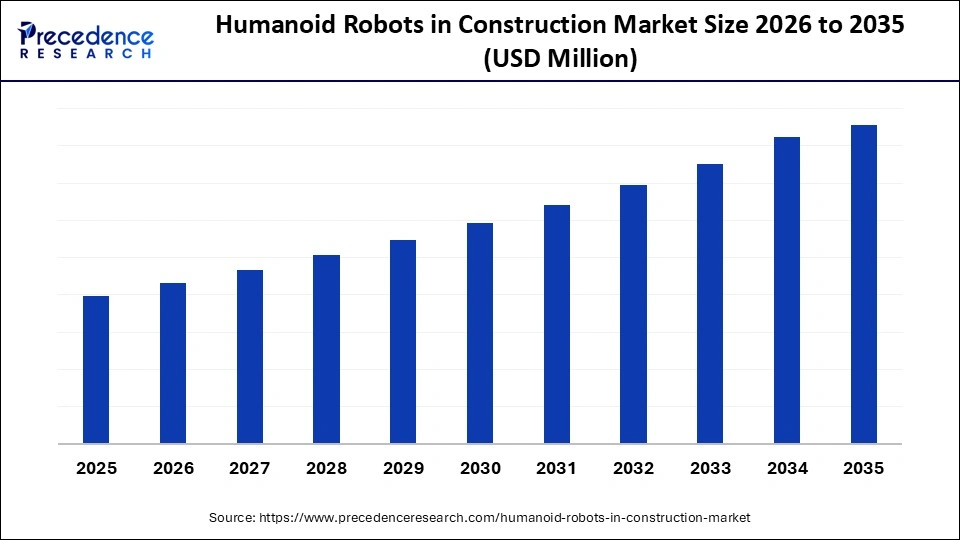
Humanoid Robots in Construction Market Key Takeaways
-
The market’s largest share in 2025 was held by the Asia Pacific region, reflecting rapid industrialization and infrastructure growth there.
-
North America is expected to witness the fastest market growth from 2026 through 2035.
-
Material handling and logistics stood as the top application segment by revenue in 2025.
-
Bipedal humanoid robots with advanced manipulation capabilities dominated the robot type segment in 2025.
-
Semi-autonomous and tele-assisted humanoid robots had the highest share by autonomy level.
-
Heavy industry, shipyards, and large contractors constitute the largest end-user segment.
-
Deployment models such as pilot projects and robot rentals are expanding rapidly, supporting market penetration.
How Is Artificial Intelligence Shaping the Humanoid Robots in Construction Market?
AI is central to the evolution of humanoid robots on construction sites, providing them with perception, decision-making, and autonomous operational abilities. Robots utilize AI-integrated LiDAR, computer vision, and deep neural networks to navigate complex, dynamic construction environments safely and precisely. These AI systems allow humanoids to perform tasks like welding, inspection, and material handling with human-level dexterity and situational awareness.
Beyond perception, AI-driven motion planning and reinforcement learning enable stable bipedal locomotion on uneven surfaces and the adaptive manipulation of tools and materials, improving efficiency and safety in challenging construction contexts. As AI algorithms mature, task-level autonomy is expected to advance further, freeing human operators from routine oversight.
What Are the Key Growth Factors for the Market?
-
Increasing construction labor shortages globally are forcing automation adoption to meet project timelines.
-
Enhanced focus on worker safety drives demand for robots to perform hazardous or repetitive tasks.
-
Significant advancements in robot mobility, manipulation, and AI cognition expand robot capabilities.
-
Government incentives and rising infrastructure spend in developed and emerging markets.
-
Expansion of pilot programs and flexible deployment models like robot-as-a-service lower adoption barriers.
What Opportunities and Trends Are Emerging in Humanoid Robots for Construction?
Why is the Asia Pacific region dominating this market?
Asia Pacific leads due to massive infrastructure projects, well-funded robotics R&D, government backing, and urgent labor shortages, especially in China, Japan, and South Korea.
Which applications are witnessing the fastest adoption?
Material handling and logistics gain ground owing to humanoids’ human-like mobility suitable for uneven job sites, but welding and heavy-trade tasks show strong growth driven by safety and precision needs.
Are hybrid robot platforms becoming popular?
Combining humanoid arms with wheeled bases offers a cost-effective balance between mobility and manipulation for semi-structured tasks, gaining traction in certain industrial segments.
Can rental and pilot deployment models support market penetration?
Asset-as-a-service models allow flexibility and reduced upfront costs, enabling mid-sized contractors to experiment with humanoids without high capital expenditure.
What challenges could restrain market growth? High development and deployment costs, integration complexity, and the need for further AI advancements to handle unpredictable construction conditions remain obstacles.
Who are the key players pushing innovation in humanoid construction robots?
-
Agility Robotics (Apollo humanoid)
-
Tesla (Optimus platform)
-
Boston Dynamics (Atlas)
-
Agility Robotics
-
UBTECH Robotics
-
Deep Robotics
-
Construction Robotics Inc.
-
Unitree Robotics
-
ANYbotics
-
Built Robotics (though more focused on autonomous heavy equipment)
Recent breakthroughs include Deep Robotics’ DR02, the first all-weather humanoid robot launched in October 2025, and UBTECH’s Walker S2 featuring autonomous battery switching for extended operations.
What Are the Market Segments and Regional Dynamics?
-
Applications include material handling & logistics, welding, masonry, inspection, surface finishing, demolition, and teleoperation.
-
Robot types range from bipedal humanoids with manipulation suites to tele-operated systems and hybrid platforms.
-
Autonomy levels vary from semi-autonomous tele-assist to fully autonomous general-purpose humanoids, though full autonomy remains a longer-term goal.
-
Deployment models cover pilot trials, robot rentals, in-house deployments by large firms, and integrator partnerships.
-
End users span heavy industries, specialty trade shops, residential and commercial contractors, and infrastructure utilities.
Regionally, Asia Pacific dominates with a combination of high construction demand and robotics expertise. North America is rapidly growing due to venture capital investment, infrastructure needs, and tech innovation hubs. Europe sees steady growth supported by regulatory safety standards and its aging workforce.
What Challenges and Cost Pressures Exist in This Market?
The high initial cost of humanoid robots and the complexity of integrating them into existing construction workflows create cost pressures. Skepticism about reliability under highly variable conditions and the need for continual AI improvements also challenge widespread adoption. However, flexible pricing models like rentals and pilot programs mitigate some investment risks.
Are There Case Studies Demonstrating Impact?
While detailed case studies are emerging, early pilots in shipyards and large contractors’ facilities have shown improved material handling efficiency and reductions in on-site accidents by deploying semi-autonomous humanoids for logistics and welding assistance.
Expert Commentary:
“Humanoid robots will redefine construction operations by addressing chronic labor shortages and elevating safety standards. As AI and robotics integration deepen, the potential to automate complex, hazardous tasks will grow exponentially. Firms adopting humanoids early stand to gain significant competitive advantages,” says Dr. Ananya Singh, Principal Consultant at Precedence Research.
Also Read: Fixed-Wing VTOL UAV Market
Get this report to explore global market size, share, CAGR, and trends, featuring detailed segmental analysis and an insightful competitive landscape overview @ https://www.precedenceresearch.com/sample/7168
You can place an order or ask any questions. Please feel free to contact us at [email protected] |+1 804 441 9344

- ESG Software Market 2025: Comprehensive Company Ecosystem and Revenue Overview - May 20, 2026
- ESG Software Market Surges Toward USD 31.96 Billion by 2035 as AI-Powered Compliance and Sustainability Reporting Transform Global Enterprises - May 20, 2026
- Hematopoietic Stem Cell Transplantation Market Surges Toward USD 24.32 Billion by 2035 as Precision Medicine and AI Reshape Blood Cancer Treatment - May 20, 2026