The global mixed signal IC market, valued at USD 129.04 billion in 2024, is poised for significant expansion, expected to grow to approximately USD 211.20 billion by 2034 at a compound annual growth rate (CAGR) of 5.05%. 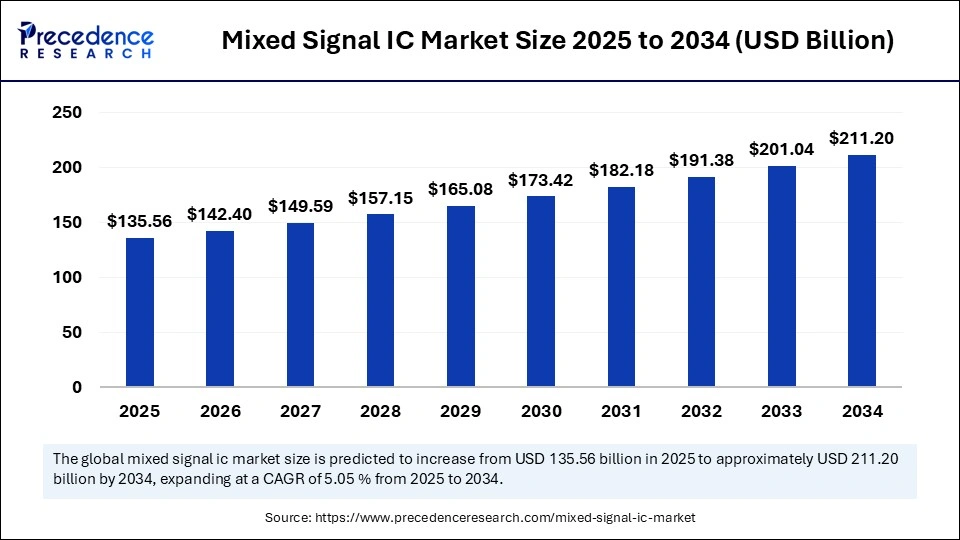
This growth is fueled by rapid advancements in the Internet of Things (IoT), increasing adoption of advanced automotive technologies, and the global rollout of 5G networks. These factors collectively drive the demand for integrated circuits capable of processing both analog and digital signals efficiently.
What’s Powering the Mixed Signal IC Market’s Growth?
Mixed signal integrated circuits blend analog and digital functionalities on a single chip, enabling devices to convert real-world signals into digital data for processing. Their vital role spans multiple sectors, including consumer electronics, industrial controls, automotive systems, and IoT devices. The rise of smart gadgets and connected infrastructures demands sophisticated mixed-signal ICs, underpinning the estimated CAGR of 5.05% from 2025 through 2034.
Mixed Signal IC Market Key Insights
-
The market size stood at USD 129.04 billion in 2024, growing to USD 135.56 billion by 2025.
-
By 2034, the market is forecasted to reach USD 211.20 billion.
-
North America currently dominates with approximately 38% market share.
-
Asia Pacific is the fastest-growing regional market, fueled by manufacturing expansion and technology adoption.
-
The consumer electronics sector accounted for roughly 35% of the market share in 2024.
-
Data converters, including ADCs and DACs, held about 30% of the overall market share, leading the technology segments.
-
Key market players include Analog Devices, Texas Instruments, Intel, and Broadcom.
Get this report to explore global market size, share, CAGR, and trends, featuring detailed segmental analysis and an insightful competitive landscape overview @ https://www.precedenceresearch.com/sample/6880
Revenue Breakdown and Market Size Table
| Year | Market Size (USD Billion) |
|---|---|
| 2024 | 129.04 |
| 2025 | 135.56 |
| 2034 | 211.20 |
Artificial Intelligence (AI) is revolutionizing the mixed signal IC landscape by enhancing design automation processes. AI accelerates testing and verification by analyzing large simulation data sets, which helps in optimizing circuit performance and power usage. Additionally, AI enables designers to explore a broader range of configurations more efficiently than traditional manual methods, achieving superior design optimization and power efficiency.
Moreover, AI-powered mixed signal ICs empower applications such as sensor fusion in autonomous vehicles and smart devices, where real-time processing of complex signals is critical. This integration boosts the ICs’ performance in handling multiple data streams at reduced power consumption levels, aiding industries like automotive, healthcare, and consumer electronics.
Factors Driving Market Growth
The growth trajectory of the mixed signal IC market is primarily propelled by the expanding IoT ecosystem and the rollout of 5G technology worldwide. The increasing complexity of electronic devices and demand for advanced automotive features, including electric vehicles and ADAS, intensifies the need for versatile ICs that handle both analog and digital signals. Additionally, rising disposable incomes and consumer preference for smart wearables and devices push market growth.
Market Opportunities and Trends
What are the latest opportunities in the mixed signal IC market?
Advancements in energy-efficient IC designs and the integration of AI offer substantial growth opportunities. The growing need for application-specific ICs tailored to sectors like medical devices, automotive, and industrial automation also opens new avenues.
How is the market adapting to rising complexity and design costs?
Manufacturers are investing in AI-driven design tools and automation to mitigate development challenges. Collaborative innovations and increasing R&D funding further support overcoming these hurdles.
What trends are shaping regional markets?
North America remains a leader due to advanced infrastructure and government initiatives such as the CHIPS Act. Asia Pacific’s rapid growth is led by electronics manufacturing hubs in China and India committing expansive investments toward semiconductor fabrication and 5G deployment.
Market Segmentation and Regional Analysis
By type/function, data converters like ADCs and DACs led with about 30% market share, essential in bridging analog and digital signals. Sensor interface ICs are growing rapidly due to increased sensor adoption across industries.
Consumer electronics dominated end-use sectors (35%), while automotive is fastest-growing, driven by electrification and autonomous technologies.
Analog-focused mixed-signal ICs commanded 40% market share due to their importance in signal conditioning and conversion.
Regionally, North America dominates with 38% share, bolstered by advanced manufacturing, robust R&D, and government support. The U.S. market alone was valued at USD 34.32 billion in 2024, expected to reach USD 57.32 billion by 2034.
Asia Pacific presents the fastest growth, propelled by emerging economies and governmental incentives focusing on semiconductor development. Canada distinguishes itself in AI-driven semiconductor and sensor IC design.
Mixed Signal IC Market Companies
- Texas Instruments (TI)
- Analog Devices (ADI)
- ON Semiconductor
- STMicroelectronics
- Infineon Technologies
- Maxim Integrated (now part of ADI)
- NXP Semiconductors
- Renesas Electronics
- Cypress Semiconductor (Infineon)
- Broadcom
- Microchip Technology
- Skyworks Solutions
- Qualcomm
- MediaTek
- ROHM Semiconductor
- Dialog Semiconductor (Renesas)
- Semtech Corporation
- Silicon Labs
- InvenSense / TDK
- Cirrus Logic
Challenges and Cost Pressures
The primary challenges include the technical complexity of integrating analog and digital signals on a single chip, requiring highly specialized skills and tools. Development costs remain substantial, posing barriers to smaller market entrants. Additionally, supply chain disruptions and raw material price fluctuations contribute to cost pressures in this highly competitive market.
Case Study: AI-Powered Sensor Fusion in Autonomous Vehicles
A leading automotive electronics company integrated advanced mixed-signal ICs with AI capabilities allowing real-time processing of multiple sensor inputs in autonomous driving systems. This integration improved decision-making accuracy and power efficiency, showcasing how AI-driven mixed-signal innovations create tangible benefits in high-stakes applications.
Read Also: Gate-All-Around (GAA) Transistor Market
You can place an order or ask any questions. Please feel free to contact us at [email protected] |+1 804 441 9344

- ESG Software Market 2025: Comprehensive Company Ecosystem and Revenue Overview - May 20, 2026
- ESG Software Market Surges Toward USD 31.96 Billion by 2035 as AI-Powered Compliance and Sustainability Reporting Transform Global Enterprises - May 20, 2026
- Hematopoietic Stem Cell Transplantation Market Surges Toward USD 24.32 Billion by 2035 as Precision Medicine and AI Reshape Blood Cancer Treatment - May 20, 2026