
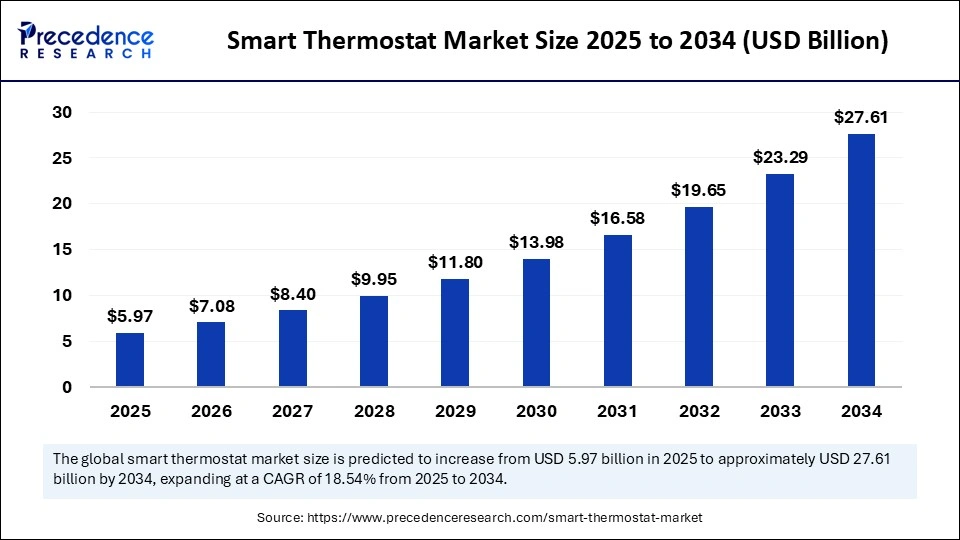
The global smart thermostat market is projected for explosive growth, reaching a valuation of approximately USD 27.61 billion by 2034, up from USD 5.97 billion in 2025. This expansion, at a robust CAGR of 18.54% through 2034, is being propelled by the widespread adoption of smart home technologies and energy-efficiency initiatives worldwide.
Introduction: What’s Driving the Smart Thermostat Market’s Rapid Expansion?
Smart thermostats—AI-enabled, internet-connected devices that optimize heating and cooling—are transforming how consumers manage their energy consumption. Key drivers of this market include rising electricity costs, government mandates on energy conservation, and the integration of smart thermostats with renewable energy systems and smart grids. Technological advances such as machine learning-enabled predictive analytics and seamless connectivity with voice assistants and home ecosystems have transformed these devices into essential components of modern smart homes.
Smart Thermostat Market Key Insights
-
The global smart thermostat market was valued at USD 5.04 billion in 2024 and is forecast to grow to USD 27.61 billion by 2034.
-
North America leads the market with a 40% share in 2024, driven by stringent energy regulations and rapid smart home adoption.
-
Asia Pacific is the fastest-growing region, fueled by urbanization and increasing disposable incomes in countries like China and India.
-
The hardware component segment dominated the market in 2024, while AI-enabled software and learning/adaptive technology segments are rapidly gaining traction.
-
The U.S. smart thermostat market alone was valued at USD 1.41 billion in 2024, projected to reach USD 7.88 billion by 2034.
-
Major players contributing to this growth include Ecobee, Honeywell Home, Google Nest, Emerson Sensi, and semiconductor suppliers like Texas Instruments and STMicroelectronics.
Get this report to explore global market size, share, CAGR, and trends, featuring detailed segmental analysis and an insightful competitive landscape overview @ https://www.precedenceresearch.com/sample/6851
Market Scope
| Report Coverage | Details |
| Market Size in 2024 | USD 5.04 Billion |
| Market Size in 2025 | USD 5.97 Billion |
| Market Size by 2034 | USD 27.61 Billion |
| Market Growth Rate from 2025 to 2034 | CAGR of 18.54% |
| Dominating Region | North America |
| Fastest Growing Region | Asia Pacific |
| Base Year | 2024 |
| Forecast Period | 2025 to 2034 |
| Segments Covered | Component, Technology, Connectivity, Deployment Model, End-Use Application, and Region |
| Regions Covered | North America, Europe, Asia-Pacific, Latin America, and Middle East & Africa |
Market Revenue Breakdown and Segmentation
The smart thermostat market segmentation features various angles such as component, technology, connectivity, deployment model, and end-use application.
-
By Component: Hardware leads due to its essential role in precise temperature regulation; software follows, thanks to AI/ML-enabled energy optimization.
-
By Technology: Learning/adaptive thermostats dominate, offering personalized comfort and energy savings, while connected/remote-controlled units are the fastest-growing segment.
-
By Connectivity: Wi-Fi dominates for ease of integration and broad consumer access, with Zigbee providing energy-efficient mesh networking.
-
By Deployment: Residential applications currently dominate, but commercial sectors are growing fast with demand in offices, retail, and educational buildings.
-
By End-Use: HVAC control and energy optimization applications lead, while smart grid and demand response integration take a rapid growth trajectory as consumers seek automated energy management.
AI’s Role in Revolutionizing Smart Thermostats
Artificial intelligence acts as the backbone of modern smart thermostat functionality. Machine learning algorithms analyze user behaviors and environmental data to create adaptive schedules, optimizing comfort and minimizing energy waste. Real-time data from connected sensors enable these devices to dynamically adjust temperature settings, reducing electricity costs while enhancing user convenience.
Moreover, AI empowers predictive maintenance by continuously monitoring system performance and signaling potential issues before failures occur. This intelligent integration not only elevates user experience but also supports broader energy conservation goals by aligning thermostat operations with grid requirements and renewable energy availability.
What Are the Key Factors Fueling Market Growth?
Several converging factors drive the rapid growth of smart thermostats worldwide:
-
Increasing consumer demand for energy-efficient, cost-saving home automation devices.
-
Government incentives, rebates, and energy conservation mandates promoting adoption.
-
Continuous innovations in wireless connectivity and AI-enabled software enhance device capabilities.
-
Expansion of smart home and smart city ecosystems requiring seamless integration of energy management tools.
-
Rising awareness of environmental sustainability and the need for demand response to stabilize electric grids .
What Opportunities and Trends Are Emerging in the Smart Thermostat Market?
Why is Asia Pacific the fastest-growing region in this sector?
Rapid urbanization, growing middle-class disposable income, and aggressive smart city initiatives in countries such as China and India are fueling demand. Government policies incentivizing energy conservation and IoT infrastructure development further accelerate adoption.
How are technology advancements driving adoption?
AI-enabled thermostats that learn occupation and weather patterns provide superior personalized comfort and energy savings, differentiating them from basic models. Connectivity improvements, particularly Wi-Fi and Zigbee, offer easier installation and integration with broader smart home systems.
Which market segments are poised for fastest growth?
Connected/remote-controlled thermostat technologies and commercial applications are expected to grow fastest due to rising demand for centralized monitoring, HVAC optimization, and energy cost reduction in offices, retail, and institutional buildings.
Could rising costs be a barrier to wider adoption?
The upfront expense of advanced smart thermostats and their professional installation can deter budget-conscious consumers. However, government incentives and lower operating costs over time help offset initial investments.
Regional and Segmentation Insights
North America dominates with its 40% market share, supported by stringent energy regulations and widespread smart home adoption. The U.S. is the key market with major innovators like Ecobee and Google Nest launching affordable, interoperable devices.
Asia Pacific is the fastest-growing region, led by China and India, where government smart city programs and expanding IoT infrastructure drive rapid adoption. Europe follows, supported by energy efficiency directives.
Residential deployments remain the largest segment globally, with consumers prioritizing convenience and savings. Commercial sectors are quickly catching up, leveraging smart thermostats for operational cost reduction and centralized control.
Hardware continues to be the dominant component, but software with AI/ML capabilities is vital for future market differentiation. Learning/adaptive thermostats lead technology preference, while Wi-Fi remains the prevalent connectivity mode for ease of use.
Smart Thermostat Market Companies
- Alphabet Inc. (Google Nest)
- Amazon.com, Inc. (ecobee, Honeywell partnerships)
- Honeywell International Inc. (Resideo Technologies)
- Emerson Electric Co.
- Johnson Controls International plc
- Schneider Electric SE
- Siemens AG
- Bosch Thermotechnology
- Lennox International Inc.
- Carrier Global Corporation
- tado° GmbH
- Netatmo (Legrand)
- Ecobee Inc. (acquired by Generac)
- LG Electronics Inc.
- Panasonic Corporation
- Trane Technologies plc
- Centrica Connected Home (Hive)
- Ingersoll Rand Inc.
- Leviton Manufacturing Co., Inc.
- Lutron Electronics Co., Inc.
Challenges and Cost Pressures
While the smart thermostat market is rapidly growing, challenges remain around high initial investment and installation complexity. Integration with existing HVAC systems demands expert setup, raising costs and limiting accessibility for some consumer segments. Compatibility issues and maintaining up-to-date software offerings also pose ongoing hurdles for manufacturers and users alike .
Case Study: U.S. Market Adoption of AI-Enabled Smart Thermostats
The U.S. smart thermostat market, valued at USD 1.41 billion in 2024, exemplifies the broader market trends. Consumer preference for energy-saving, convenient devices combined with government rebates has boosted sales. AI-powered learning thermostats, pioneered by companies like Ecobee and Google Nest, have achieved prominent market penetration by offering personalized schedules and remote controls via smart home ecosystems, significantly reducing energy consumption while enhancing user comfort.
Read Also: Connected Game Console Market
You can place an order or ask any questions. Please feel free to contact us at [email protected] |+1 804 441 9344

- ESG Software Market 2025: Comprehensive Company Ecosystem and Revenue Overview - May 20, 2026
- ESG Software Market Surges Toward USD 31.96 Billion by 2035 as AI-Powered Compliance and Sustainability Reporting Transform Global Enterprises - May 20, 2026
- Hematopoietic Stem Cell Transplantation Market Surges Toward USD 24.32 Billion by 2035 as Precision Medicine and AI Reshape Blood Cancer Treatment - May 20, 2026