
Consumer Metaverse Market Companies
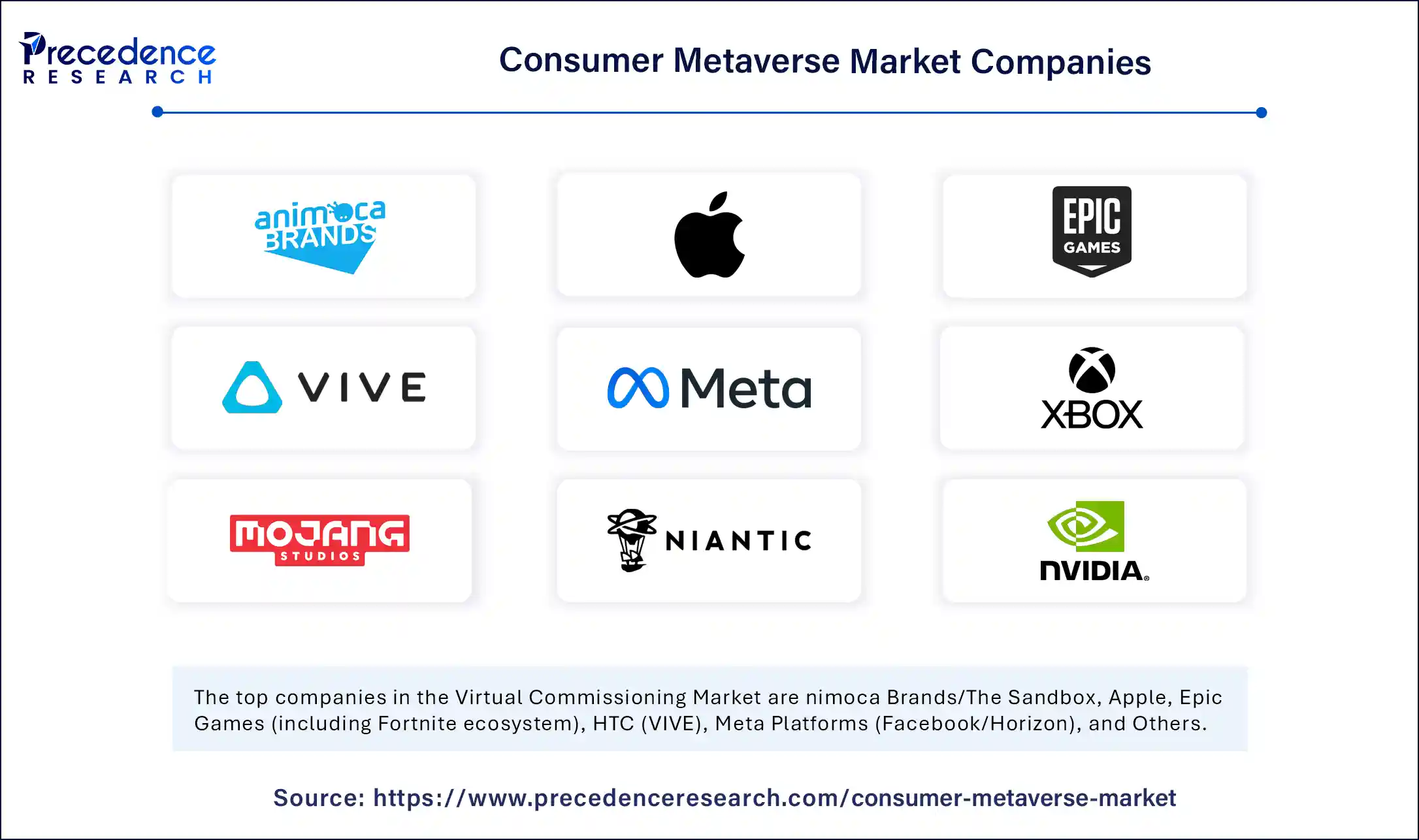
- Animoca Brands/The Sandbox
- Apple
- Epic Games (including Fortnite ecosystem)
- HTC (VIVE)
- Meta Platforms (Facebook/Horizon)
- Microsoft (Xbox/Mesh consumer initiatives)
- Mojang/Microsoft (Minecraft consumer metaverse use-cases)
- Mozilla/WebXR contributors (browser-based metaverse tooling)
- Niantic
- NVIDIA
- Roblox Corporation
- Samsung (XR devices and displays)
- Snap Inc. (Lens Studio/AR experiences)
- Unity Technologies
- Wemade/Playable/Decentraland ecosystem partners
Animoca Brands/The Sandbox
-
Company Name and Headquarters: Animoca Brands (Hong Kong), The Sandbox (Distributed team, a subsidiary of Animoca Brands)
-
Product Offerings related to Consumer Metaverse:
-
The Sandbox: A decentralized virtual world where players can own, build, and monetize their gaming experiences using NFTs and SAND cryptocurrency. It includes LAND parcels, avatar customization, and a game maker for user-generated content.
-
NFTs and Blockchain Gaming: Extensive portfolio of over 400 investments and acquisitions in blockchain gaming, metaverse platforms, and NFT-related companies (e.g., Axie Infinity, Dapper Labs, OpenSea).
-
Web3 Infrastructure: Developing tools and infrastructure for the open metaverse, including wallets and decentralized identity solutions.
-
-
Market Share and Estimated Revenue from Consumer Metaverse Segment: Difficult to isolate, as revenue comes from various sources including LAND sales, SAND token transactions, NFT royalties, and investments. The Sandbox alone has seen significant transaction volumes and land sales worth hundreds of millions of dollars. Animoca Brands as a whole is a major investor and enabler in the Web3 space.
-
Recent Developments, Partnerships, or Innovations:
-
Numerous partnerships with celebrities (Snoop Dogg), brands (Adidas, Warner Music Group), and IP holders to bring content into The Sandbox.
-
Continued expansion of its play-to-earn mechanics and metaverse events.
-
Focus on interoperability and an open metaverse vision.
-
-
Competitive Positioning and Strategic Focus: A leader in the decentralized, blockchain-powered metaverse segment. Its strategic focus is on digital property rights, user-generated content, and a play-to-earn economy. Competes with other Web3 metaverses and aims to differentiate through true digital ownership and an open ecosystem.
-
Key Customers or Industries Served: Crypto enthusiasts, NFT collectors, blockchain gamers, brands looking to enter the Web3 space, artists, and content creators.
Apple
-
Company Name and Headquarters: Apple Inc. (Cupertino, California, USA)
-
Product Offerings related to Consumer Metaverse:
-
Vision Pro: Apple’s entry into spatial computing, offering high-resolution passthrough AR/VR experiences, a new “visionOS” operating system, and a focus on productivity, entertainment, and communication in a 3D environment.
-
ARKit: A robust augmented reality development framework for iOS devices, enabling developers to create AR experiences for millions of iPhone and iPad users.
-
App Store Ecosystem: A massive distribution platform for apps, including those with AR/VR or metaverse-like functionalities.
-
Hardware Ecosystem: iPhones, iPads, and other devices provide a foundation for AR experiences.
-
-
Market Share and Estimated Revenue from Consumer Metaverse Segment: Currently nascent, with Vision Pro just entering the market. ARKit-enabled apps contribute to overall App Store revenue but are not separately reported. Apple is expected to become a significant player in premium XR hardware.
-
Recent Developments, Partnerships, or Innovations:
-
Launch of Apple Vision Pro in early 2024, marking a significant step into spatial computing.
-
Continuous updates and improvements to ARKit and RealityKit.
-
Developing a strong developer ecosystem around visionOS and spatial applications.
-
-
Competitive Positioning and Strategic Focus: Positioned as a premium hardware and software provider for spatial computing. Apple’s strategy is to integrate AR/VR seamlessly into its existing ecosystem, focusing on user experience, privacy, and high-quality content. It aims to define the next generation of personal computing.
-
Key Customers or Industries Served: Consumers seeking high-end spatial computing experiences, developers, enterprise users (potential future expansion).
Epic Games (including Fortnite ecosystem)
-
Company Name and Headquarters: Epic Games, Inc. (Cary, North Carolina, USA)
-
Product Offerings related to Consumer Metaverse:
-
Fortnite: Transformed from a battle royale game into a social hub and metaverse platform. It features creative modes (Fortnite Creative, Unreal Editor for Fortnite – UEFN), concerts, brand activations, and a vast array of user-generated content and experiences.
-
Unreal Engine: A leading real-time 3D creation tool used for games, film, architectural visualization, and metaverse development. It provides the foundational technology for many virtual worlds.
-
Epic Games Store: A digital storefront for games, including those with metaverse potential.
-
-
Market Share and Estimated Revenue from Consumer Metaverse Segment: Fortnite is one of the largest consumer metaverse platforms by active users, with hundreds of millions of registered accounts. Revenue comes from in-game purchases (V-Bucks) for skins, emotes, and battle passes, as well as revenue share from UEFN creators. Estimated billions of dollars annually from the Fortnite ecosystem.
-
Recent Developments, Partnerships, or Innovations:
-
Release of UEFN, allowing creators to build and monetize experiences within Fortnite, significantly expanding its metaverse capabilities.
-
Ongoing partnerships with major brands (e.g., Marvel, Star Wars, Nike) and artists for in-game events and cosmetics.
-
Acquisition of companies like Bandcamp and Harmonix, hinting at further expansion into music and social experiences.
-
-
Competitive Positioning and Strategic Focus: A frontrunner in the “game-first” metaverse approach. Epic’s strategy is to build an open, interoperable metaverse powered by Unreal Engine, empowering creators and fostering a vibrant social ecosystem within Fortnite. They advocate for an open payment system and compete fiercely with platform holders like Apple and Google.
-
Key Customers or Industries Served: Gamers, content creators, brands, IP holders, virtual event organizers.
HTC (VIVE)
-
Company Name and Headquarters: HTC Corporation (Taoyuan, Taiwan)
-
Product Offerings related to Consumer Metaverse:
-
HTC VIVE VR Headsets: A range of virtual reality headsets, including VIVE XR Elite (standalone and PC VR), VIVE Pro series, and VIVE Focus series, targeting both consumers and enterprises.
-
VIVEPORT: HTC’s VR content platform and subscription service, offering games, experiences, and applications.
-
VIVEVERSE: HTC’s own metaverse platform, aiming to connect various virtual experiences and provide a social space for users.
-
-
Market Share and Estimated Revenue from Consumer Metaverse Segment: Historically a pioneer in VR, HTC’s market share in consumer VR headsets has been challenged by Meta and others. Revenue from its VIVE division contributes to overall company revenue but is not separately disclosed for “consumer metaverse.”
-
Recent Developments, Partnerships, or Innovations:
-
Launch of the VIVE XR Elite, a modular headset designed for both VR and mixed reality.
-
Focus on enterprise VR solutions alongside its consumer offerings.
-
Developing VIVERSE as a cross-device metaverse experience.
-
-
Competitive Positioning and Strategic Focus: Positioned as a premium, high-quality VR hardware and platform provider. HTC’s strategy is to offer versatile headsets that cater to both advanced consumers and enterprise clients, emphasizing open ecosystems and professional-grade performance. It faces strong competition from Meta’s Quest line and new entrants like Apple.
-
Key Customers or Industries Served: VR enthusiasts, developers, arcades, enterprises (design, training, collaboration).
Meta Platforms (Facebook/Horizon)
-
Company Name and Headquarters: Meta Platforms, Inc. (Menlo Park, California, USA)
-
Product Offerings related to Consumer Metaverse:
-
Meta Quest VR Headsets: Dominant lineup of standalone VR headsets (Quest 2, Quest 3, Quest Pro), offering accessible VR for gaming, entertainment, and social interaction.
-
Horizon Worlds: Meta’s flagship social VR platform, allowing users to create, explore, and interact in virtual spaces.
-
Horizon Workrooms: Enterprise-focused virtual collaboration, but with consumer crossover potential for social meetups.
-
Metaverse R&D: Extensive research and development in haptic technology, AI avatars, neural interfaces, and AR glasses (Project Cambria/Quest Pro, future AR glasses).
-
Presence Platform: Tools for developers to create mixed reality experiences on Quest headsets.
-
-
Market Share and Estimated Revenue from Consumer Metaverse Segment: Meta Quest holds the largest market share in standalone VR headsets. Reality Labs (Meta’s metaverse division) reported billions in losses but also billions in revenue, primarily from Quest hardware and software sales. Meta is investing tens of billions annually into metaverse development.
-
Recent Developments, Partnerships, or Innovations:
-
Launch of Quest 3, a mixed reality headset with improved passthrough and performance.
-
Integration of AI into avatars and virtual assistants.
-
Expansion of Horizon Worlds features and content.
-
Continued R&D into haptics, body tracking, and lighter AR glasses.
-
-
Competitive Positioning and Strategic Focus: The most aggressive investor in the metaverse space, aiming to build the foundational infrastructure and platforms for the next computing paradigm. Meta’s strategy is to create a comprehensive metaverse ecosystem encompassing hardware, social platforms, and developer tools, with a strong focus on mass consumer adoption.
-
Key Customers or Industries Served: Gamers, social VR users, developers, enterprises (for collaboration).
Microsoft (Xbox/Mesh consumer initiatives)
-
Company Name and Headquarters: Microsoft Corporation (Redmond, Washington, USA)
-
Product Offerings related to Consumer Metaverse:
-
Xbox Platform: While primarily a gaming console, Xbox is evolving with cloud gaming (Xbox Cloud Gaming) and social features that can integrate with broader metaverse initiatives. Xbox avatars and user profiles represent digital identities.
-
Microsoft Mesh: Initially enterprise-focused for collaborative mixed reality, Mesh has consumer implications for social virtual gatherings and events.
-
Flight Simulator: A highly realistic simulation game that creates a digital twin of the Earth, offering a vast virtual world.
-
Azure Cloud Services: Provides the backend infrastructure crucial for scaling metaverse applications.
-
AltspaceVR (discontinued consumer version): While the consumer version was retired, it provided valuable insights into social VR.
-
-
Market Share and Estimated Revenue from Consumer Metaverse Segment: Difficult to quantify a specific “consumer metaverse” revenue. Xbox contributes billions to Microsoft’s gaming segment. Microsoft’s approach is more distributed, leveraging existing platforms and technologies.
-
Recent Developments, Partnerships, or Innovations:
-
Increased focus on Mesh for collaborative virtual spaces, expanding its reach beyond pure enterprise.
-
Integration of cloud gaming and cross-device play through Xbox.
-
Ongoing development in AI for virtual agents and content generation within virtual environments.
-
-
Competitive Positioning and Strategic Focus: Microsoft’s strategy is to provide underlying platforms, cloud infrastructure, and tools that enable metaverse experiences, rather than exclusively owning a single consumer metaverse. It aims to integrate metaverse concepts across its Xbox, Teams, and Azure ecosystems, leveraging its strengths in gaming, enterprise software, and cloud computing.
-
Key Customers or Industries Served: Gamers, businesses, developers, cloud-native metaverse projects.
Mojang/Microsoft (Minecraft consumer metaverse use-cases)
-
Company Name and Headquarters: Mojang Studios (Stockholm, Sweden), owned by Microsoft Corporation (Redmond, Washington, USA)
-
Product Offerings related to Consumer Metaverse:
-
Minecraft: One of the most successful games of all time, Minecraft is an open-world sandbox game where players can build, explore, and create. Its robust modding community, vast user-generated content, persistent worlds (Realms), and cross-platform play make it a de facto metaverse.
-
Minecraft Education Edition: Utilizes the game’s metaverse-like qualities for educational purposes.
-
-
Market Share and Estimated Revenue from Consumer Metaverse Segment: Minecraft boasts over 170 million monthly active players and has sold over 300 million copies. Its revenue comes from game sales, in-game purchases (Marketplace items), and Realms subscriptions, generating billions for Microsoft annually.
-
Recent Developments, Partnerships, or Innovations:
-
Continuous updates and content additions, expanding the game’s mechanics and biomes.
-
Ongoing support for its vast creator community and the Minecraft Marketplace.
-
Partnerships for educational initiatives and real-world tie-ins.
-
-
Competitive Positioning and Strategic Focus: Minecraft is a leading example of an organic, game-driven metaverse. Its strategy focuses on fostering creativity, community, and exploration within its blocky world. It thrives on user-generated content and provides a flexible platform for diverse experiences, from survival games to elaborate role-playing servers.
-
Key Customers or Industries Served: Children, teenagers, casual gamers, educators, creative communities.
Mozilla/WebXR contributors (browser-based metaverse tooling)
-
Company Name and Headquarters: Mozilla Foundation & Corporation (Mountain View, California, USA) and a decentralized community of WebXR contributors.
-
Product Offerings related to Consumer Metaverse:
-
WebXR API: An open standard that allows developers to create immersive virtual and augmented reality experiences directly within web browsers, accessible on various devices without app installation.
-
Firefox Reality (discontinued): Mozilla’s dedicated VR web browser that showcased WebXR capabilities.
-
Hubs by Mozilla: A social VR platform built on WebXR, allowing users to create and share custom 3D spaces for meetings, events, and casual hangouts directly in a browser.
-
Open Source Tools & Standards: Mozilla actively champions open web standards and provides open-source tools for web development, including those relevant to 3D and immersive web.
-
-
Market Share and Estimated Revenue from Consumer Metaverse Segment: WebXR itself is an open standard, not a single product with direct revenue. Hubs has a niche but dedicated user base. Mozilla’s revenue comes from search engine partnerships and other services, not directly from a “consumer metaverse” segment. Its impact is primarily infrastructural and ideological.
-
Recent Developments, Partnerships, or Innovations:
-
Continued development and adoption of the WebXR API across browsers.
-
Ongoing improvements and features for Hubs by Mozilla.
-
Advocacy for an open, interoperable, and privacy-respecting metaverse built on web technologies.
-
-
Competitive Positioning and Strategic Focus: Mozilla and WebXR contributors are focused on creating an open, accessible, and platform-agnostic metaverse that is not controlled by a single company. Their strategy is to empower developers with web standards to build immersive experiences that can be accessed universally through a browser, promoting decentralization and interoperability.
-
Key Customers or Industries Served: Web developers, open-source advocates, users seeking accessible VR/AR experiences, organizations looking for browser-based virtual collaboration tools.
Niantic
-
Company Name and Headquarters: Niantic, Inc. (San Francisco, California, USA)
-
Product Offerings related to Consumer Metaverse:
-
Pokémon GO: A groundbreaking augmented reality mobile game that overlays digital content onto the real world using GPS and smartphone cameras. It pioneered location-based AR gaming.
-
Ingress & Pikmin Bloom: Other successful location-based AR games.
-
Lightship Platform: Niantic’s AR development platform, providing tools for creating persistent, shared AR experiences that interact with the real world’s geography and objects. This includes features like real-time mapping, semantic segmentation, and multiplayer AR.
-
AR Headset R&D: Actively researching and developing AR glasses, signaling a future move beyond smartphone AR.
-
-
Market Share and Estimated Revenue from Consumer Metaverse Segment: Pokémon GO alone has generated billions of dollars in revenue and has hundreds of millions of downloads globally, making it a major player in mobile AR. Lightship is positioning itself as a key platform for location-based AR experiences.
-
Recent Developments, Partnerships, or Innovations:
-
Continued content updates and events for Pokémon GO, maintaining its massive player base.
-
Strategic acquisitions (e.g., 8th Wall) to enhance its Lightship platform’s capabilities.
-
Partnerships with various brands and IP holders for new AR games and experiences.
-
Focus on “real-world metaverse” where digital content is anchored to physical locations.
-
-
Competitive Positioning and Strategic Focus: A leader in the “real-world metaverse” and location-based AR gaming. Niantic’s strategy is to build a platform (Lightship) that bridges the digital and physical worlds, encouraging exploration and social interaction in real-world environments. They are preparing for a future with lightweight AR glasses.
-
Key Customers or Industries Served: Mobile gamers, AR developers, brands seeking real-world engagement, city planners (potential future).
NVIDIA
-
Company Name and Headquarters: NVIDIA Corporation (Santa Clara, California, USA)
-
Product Offerings related to Consumer Metaverse:
-
Omniverse Platform: A platform for 3D design, collaboration, and simulation. While heavily enterprise-focused (digital twins, industrial design), its core technology for real-time 3D rendering and simulation is foundational for consumer metaverse experiences.
-
RTX Graphics Cards: High-performance GPUs that are essential for rendering realistic metaverse environments and powering advanced VR/AR experiences.
-
Cloud Computing/AI: Provides AI and cloud infrastructure that can power intelligent avatars, content generation, and scalable metaverse operations.
-
Cloud Gaming (GeForce NOW): While not direct metaverse, it offers high-fidelity gaming streamed from the cloud, a potential delivery mechanism for rich virtual worlds.
-
-
Market Share and Estimated Revenue from Consumer Metaverse Segment: NVIDIA does not have a direct “consumer metaverse” revenue segment. Its contribution is enabling technology. Its GPUs dominate the high-end PC gaming market, indirectly powering many metaverse applications.
-
Recent Developments, Partnerships, or Innovations:
-
Continuous advancements in GPU architecture (e.g., Ada Lovelace, Blackwell) and rendering technologies (ray tracing, DLSS).
-
Expansion of Omniverse capabilities, including AI integration and broader developer tools.
-
Investment in AI for content generation (e.g., text-to-3D models).
-
-
Competitive Positioning and Strategic Focus: Positioned as the foundational technology provider for the metaverse. NVIDIA’s strategy is to provide the computing power, rendering engines, and development platforms (Omniverse) that enable others to build, simulate, and experience complex virtual worlds. They are a critical enabler for high-fidelity, real-time 3D experiences.
-
Key Customers or Industries Served: Game developers, 3D artists, designers, engineers, cloud service providers, consumers buying high-end GPUs.
Roblox Corporation
-
Company Name and Headquarters: Roblox Corporation (San Mateo, California, USA)
-
Product Offerings related to Consumer Metaverse:
-
Roblox Platform: A global immersive platform where users can create, share, and play millions of user-generated 3D experiences (games). It features persistent virtual worlds, customizable avatars, social interaction, and a virtual economy powered by Robux.
-
Roblox Studio: A free development environment that allows anyone to create experiences and assets for the platform.
-
Developer Economy: A robust system where creators can earn real money from their creations.
-
-
Market Share and Estimated Revenue from Consumer Metaverse Segment: Roblox is a dominant player, particularly among younger audiences, with over 70 million daily active users. Revenue is in the billions annually, primarily from Robux sales (in-game currency) used for avatar items and experiences.
-
Recent Developments, Partnerships, or Innovations:
-
Expansion beyond its core youth audience to older demographics, including new social features and professional brand activations.
-
Increased focus on immersive advertising and commerce within experiences.
-
Continuous improvements to Roblox Studio and developer tools.
-
Partnerships with major brands (e.g., Nike, Gucci, NFL) for virtual experiences and merchandise.
-
-
Competitive Positioning and Strategic Focus: A leading user-generated content (UGC) metaverse platform. Roblox’s strategy is to empower a vast community of creators, foster social connection, and enable immersive entertainment. It prioritizes accessibility, safety, and a thriving creator economy.
-
Key Customers or Industries Served: Children, teenagers, young adults, developers, brands, educators.
Samsung (XR devices and displays)
-
Company Name and Headquarters: Samsung Electronics Co., Ltd. (Suwon, South Korea)
-
Product Offerings related to Consumer Metaverse:
-
XR Devices (Future Focus): Rumored to be developing new mixed reality/VR headsets in partnership with Google and Qualcomm, indicating a renewed push into the XR hardware space. (Historically Gear VR and Odyssey headsets).
-
Smartphones and Displays: Provides the mobile hardware (Galaxy phones) that power mobile AR experiences and the high-quality displays (OLED) critical for all XR devices.
-
Smart TVs & Home Appliances: Exploring ways to integrate metaverse concepts into broader smart home ecosystems (e.g., virtual experiences, digital twins of homes).
-
Semiconductor Division: Manufactures critical components (memory, processors) for XR devices from other companies.
-
-
Market Share and Estimated Revenue from Consumer Metaverse Segment: Currently, direct consumer metaverse revenue is negligible for Samsung, as its past XR efforts were limited. However, its massive scale in consumer electronics positions it to be a significant hardware player if its new XR devices gain traction.
-
Recent Developments, Partnerships, or Innovations:
-
Announced a partnership with Google and Qualcomm to build a new XR platform, suggesting a significant investment in next-gen XR hardware.
-
Continued R&D in display technology (e.g., micro-LED, advanced OLED for XR).
-
Exploring AI integration across its device ecosystem.
-
-
Competitive Positioning and Strategic Focus: Samsung’s strategy is to leverage its strength in consumer electronics manufacturing, display technology, and global distribution to become a key hardware provider for the metaverse. It aims to compete with Apple and Meta in the next generation of XR devices, potentially offering a more open platform compared to Apple.
-
Key Customers or Industries Served: General consumers, mobile users, XR developers (for potential future devices).
Snap Inc. (Lens Studio/AR experiences)
-
Company Name and Headquarters: Snap Inc. (Santa Monica, California, USA)
-
Product Offerings related to Consumer Metaverse:
-
Snapchat: A highly influential AR platform where users interact with Lenses (AR filters), World Lenses, and AR games. It’s a massive mobile AR “metaverse” where digital content is overlaid onto the real world.
-
Lens Studio: A powerful, free desktop application that allows creators and developers to build and publish custom AR Lenses for Snapchat.
-
Spectacles (AR Glasses): While not yet a mass consumer product, Spectacles are a long-term R&D initiative into true AR glasses, offering a glimpse into future wearable AR.
-
Connected Lenses: Multiplayer AR experiences within Snapchat.
-
Scan: AI-powered visual search that uses AR to identify objects and provide information or experiences.
-
-
Market Share and Estimated Revenue from Consumer Metaverse Segment: Snapchat has hundreds of millions of daily active users, making it a dominant force in mobile AR. Revenue from AR experiences is integrated into its advertising model, which generates billions annually.
-
Recent Developments, Partnerships, or Innovations:
-
Continuous innovation in AR Lenses, pushing the boundaries of mobile AR effects and interactivity.
-
Expansion of Lens Studio features and its creator community.
-
Partnerships with brands and artists for AR campaigns and experiences.
-
Ongoing development of Spectacles as a vision for wearable AR.
-
-
Competitive Positioning and Strategic Focus: A leader in mobile AR and a proponent of a “camera-first” metaverse. Snap’s strategy is to bring AR to the masses through accessible smartphone experiences, empowering a vast creator community, and pioneering the future of wearable AR with Spectacles. It focuses on communication, self-expression, and real-world augmentation.
-
Key Customers or Industries Served: Young consumers, content creators, brands, advertisers.
Unity Technologies
-
Company Name and Headquarters: Unity Technologies (San Francisco, California, USA)
-
Product Offerings related to Consumer Metaverse:
-
Unity Engine: One of the most widely used real-time 3D development platforms for creating games, AR/VR applications, simulations, and virtual worlds. Many consumer metaverse experiences are built on Unity.
-
Unity Ads: A monetization platform for developers, often integrated into games and apps that could be considered part of the metaverse.
-
Professional Services & Tools: Offers a suite of tools for artists, designers, and developers to create 3D content, including asset stores and cloud services.
-
Pixyz: Tools for data preparation and optimization of 3D models for real-time applications.
-
-
Market Share and Estimated Revenue from Consumer Metaverse Segment: Unity doesn’t directly operate a consumer metaverse but is a crucial enabling technology. Its engine is used in a significant portion of the world’s games and AR/VR experiences. Revenue comes from engine licenses, asset store sales, and ad monetization, totaling billions annually.
-
Recent Developments, Partnerships, or Innovations:
-
Continuous updates and feature additions to the Unity Engine, focusing on performance, visual fidelity, and developer workflows.
-
Acquisitions (e.g., Weta Digital) to bolster its tools for high-fidelity content creation.
-
Increased focus on AI and machine learning integration for content generation and optimization.
-
Controversial pricing changes in 2023 caused developer backlash but were partially walked back.
-
-
Competitive Positioning and Strategic Focus: A dominant platform provider for 3D content creation. Unity’s strategy is to provide a comprehensive ecosystem of tools and services that empower developers to build and monetize interactive 3D experiences across various platforms, including games, AR, VR, and industrial applications. It is a key enabler of the metaverse.
-
Key Customers or Industries Served: Game developers (indie to AAA), AR/VR developers, architects, automotive designers, filmmakers, educational institutions.
Wemade/Playable/Decentraland ecosystem partners
-
Company Name and Headquarters:
-
Wemade Co., Ltd. (Seongnam, Gyeonggi Province, South Korea)
-
Playable (Decentralized, ecosystem contributor)
-
Decentraland Foundation (Decentralized, DAO-governed)
-
-
Product Offerings related to Consumer Metaverse:
-
Wemade (WEMIX platform): A major blockchain gaming platform that hosts various play-to-earn games. WEMIX provides infrastructure, tokens, and NFT marketplaces for its ecosystem. While not a metaverse itself, it facilitates numerous metaverse-like game experiences.
-
Decentraland: A decentralized 3D virtual world (metaverse) where users can buy, build, and monetize virtual land (LAND NFTs), explore scenes, play games, and attend events. It’s governed by a DAO (Decentraland DAO) and uses MANA cryptocurrency.
-
Playable: Refers to the numerous experiences, games, and applications developed by various creators and partners within decentralized metaverse platforms like Decentraland, The Sandbox, and others. It signifies the user-generated, interactive content that brings these metaverses to life.
-
-
Market Share and Estimated Revenue from Consumer Metaverse Segment:
-
Wemade/WEMIX: Significant player in blockchain gaming, with its platform and games generating substantial transaction volumes and token value. Revenue from game sales, NFT trades, and tokenomics.
-
Decentraland: One of the earliest and most well-known decentralized metaverses. Revenue primarily comes from LAND sales, marketplace fees, and MANA token value. Transaction volumes have been in the hundreds of millions over its lifetime, though fluctuating with crypto markets.
-
-
Recent Developments, Partnerships, or Innovations:
-
Wemade: Continuous expansion of its WEMIX game lineup, integration with new blockchain technologies, and partnerships with game studios.
-
Decentraland: Ongoing development by the community and the DAO, hosting virtual events (MVMF, Metaverse Art Week), and partnerships with brands (e.g., Sotheby’s, Adidas for virtual stores/experiences).
-
Playable: Constant influx of new user-generated content, experiences, and developer tools within decentralized metaverses.
-
-
Competitive Positioning and Strategic Focus:
-
Wemade: Focuses on building a robust, interconnected blockchain gaming ecosystem with play-to-earn mechanics, aiming to be a leader in the Web3 gaming and entertainment space.
-
Decentraland: Champions a truly decentralized, user-owned, and community-governed metaverse. Its strategy is to provide the foundational virtual land and tools for creators to build any experience they desire, emphasizing true digital ownership and open standards.
-
-
Key Customers or Industries Served: Crypto investors, NFT collectors, blockchain gamers, content creators, artists, brands exploring Web3 and virtual events.

- ESG Software Market 2025: Comprehensive Company Ecosystem and Revenue Overview - May 20, 2026
- ESG Software Market Surges Toward USD 31.96 Billion by 2035 as AI-Powered Compliance and Sustainability Reporting Transform Global Enterprises - May 20, 2026
- Hematopoietic Stem Cell Transplantation Market Surges Toward USD 24.32 Billion by 2035 as Precision Medicine and AI Reshape Blood Cancer Treatment - May 20, 2026