
Global Vision-Language Models Market Set for Transformative CAGR of 25.4 % Driven by Multimodal Integration, Cloud Deployment, and Enterprise Automation
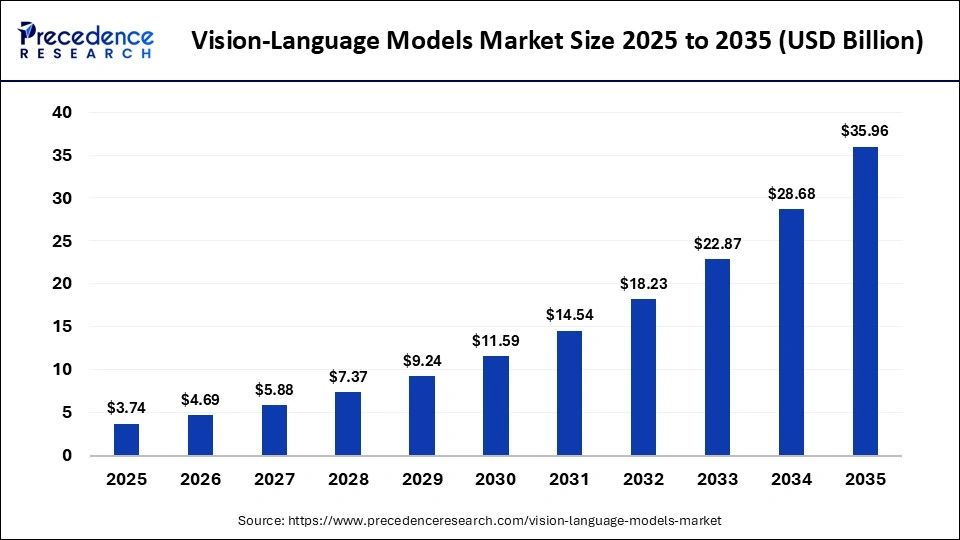
The global Vision-Language Models Market is experiencing explosive growth, projected to escalate from USD 3.74 billion in 2025 to USD 35.96 billion by 2035, at a robust CAGR of 25.41 % during the forecast period. This surge is propelled by rapid advancements in multimodal artificial intelligence technologies, broader enterprise adoption of automated visual-text understanding systems, and a rising need for intuitive human-machine interaction across industries.
Introduction: The Multimodal AI Revolution
Vision-Language Models (VLMs) are at the forefront of the AI evolution, bridging the gap between visual perception and natural language understanding. These models empower systems to interpret, reason across, and generate insights from combined visual and textual inputs a capability that is reshaping sectors like healthcare, retail, automotive automation, robotics, BFSI (Banking, Financial Services & Insurance), and media. As companies invest more heavily in generative and multimodal AI, VLMs are unlocking new efficiencies and decision-making potential never seen before.
Vision-Language Models Market Key Points
-
Market Valuation: USD 3.74 billion in 2025, projected to reach USD 35.96 billion by 2035.
-
Growth Forecast: Strong CAGR of 25.41 % between 2026 and 2035.
-
Top Region: North America holds the largest share of approximately 42 % in 2025.
-
Fastest-Growing Region: Asia Pacific due to digital transformation and AI initiatives.
-
Leading Segment: Image-Text VLMs dominate with nearly 46 % share.
-
Deployment Mode: Cloud-based solutions contribute the largest share at ~64 %.
-
Top Players: Google, Microsoft, Amazon Web Services (AWS), Meta, NVIDIA, OpenAI and others are steering innovation.
AI’s Transformative Role: Beyond Text and Vision
AI as the Market Catalyst
Vision-Language Models combine state-of-the-art deep learning architectures, like transformers and multimodal pre-training techniques, to jointly interpret imagery and language. This fusion enables unparalleled capabilities such as image captioning, visual search, multimodal chatbots, video understanding, and automated document interpretation. AI continually improves these systems through advanced training methods — reducing errors, enhancing context awareness, and enabling real-time insights.
New Frontiers in Multimodal Interaction
Unlike traditional single-modality AI systems, VLMs process vast quantities of visual and textual data simultaneously — powering applications like medical image annotation tied to clinical context, augmented reality experiences enriched with semantic understanding, and autonomous vehicle perception systems that read signs and comprehend environment narratives. These strides are redefining user-computer interaction.
Key Growth Drivers Powering Vision-Language Models Market Expansion
-
Enterprise Automation: Organizations are deploying VLM-powered solutions to automate tasks previously dependent on human visual inspection and interpretation.
-
Generative AI Adoption: Enhanced multimodal capabilities extend generative AI beyond text to visuals — a major trend in customer engagement and content creation.
-
Cloud-Native Platforms: Scalability, reduced cost of entry, and flexible infrastructure accelerate adoption, especially among mid-size and enterprise cloud users.
-
Cross-Industry Applications: Healthcare imaging, retail visual search, BFSI fraud detection and security analytics are strong use cases.
Vision-Language Models Market Opportunities & Trends
Businesses are now using VLMs to power next-generation human-computer experiences like multimodal assistants, enhanced AR/VR features, and intelligent robotics that can visually perceive and linguistically respond. Early movers in retail, healthcare diagnostics, and autonomous driving are already realizing significant competitive advantages.
Expect deeper multimodal fusion (combining text, vision and even audio), edge-optimized models for on-device inference, and explainable AI features that make model predictions more transparent and trustworthy — critical for regulated sectors like healthcare and finance.
Vision-Language Models Market Scope
| Report Coverage | Details |
| Market Size in 2025 | USD 3.74 Billion |
| Market Size in 2026 | USD 4.69 Billion |
| Market Size by 2035 | USD 35.96 Billion |
| Market Growth Rate from 2026 to 2035 | CAGR of 25.41% |
| Dominating Region | North America |
| Fastest Growing Region | Asia Pacific |
| Base Year | 2025 |
| Forecast Period | 2026 to 2035 |
| Segments Covered | Model Type, Deployment Mode, Industry Vertical, and Region |
| Regions Covered | North America, Europe, Asia-Pacific, Latin America, and Middle East & Africa |
Vision-Language Models Market Regional Analysis
North America: With a mature AI ecosystem, robust R&D investment, and early enterprise adoption, North America retains a commanding lead with approximately 42 % market share in 2025. Advancements by Silicon Valley and research hubs fuel continuous innovation.
Asia Pacific: Fueled by digital transformation strategies and government AI initiatives, Asia Pacific is the fastest-growing region, with significant growth expected in China, India, South Korea, and Japan.
Europe: Europe’s growth is supported by strong AI governance frameworks and adoption across automotive, manufacturing, and media sectors.
Other Regions: Latin America, Middle East & Africa show steady progress, fueled by expanding digital infrastructure and government AI agendas.
Vision-Language Models Market Segment Analysis
Model Type Insights
Image–text vision-language models held the largest share of the market at 46% in 2025, driven by their ability to seamlessly connect visual data with natural language understanding. These models excel at interpreting complex images, documents, charts, and visual relationships, making them highly effective across diverse use cases.
Their dominance is supported by the abundance of paired image–text datasets, rapid advancements in transformer-based architectures, and widespread adoption in AI-driven platforms focused on accessibility, automation, and enhanced user interaction.
Video–text vision-language models are projected to grow at the fastest CAGR from 2026 to 2035, as they enable deeper understanding of dynamic and time-based visual content.
Rising demand for real-time video analytics in applications such as surveillance, entertainment, autonomous systems, and social media moderation is accelerating adoption. The rapid expansion of video content is further driving demand for automated, scalable video understanding solutions.
Deployment Mode Insights
Cloud-based deployment dominated the vision-language models market with a 64% share, due to its scalability, flexibility, and cost efficiency. Cloud platforms allow organizations to access advanced AI capabilities without significant upfront hardware investments.
They support rapid model experimentation, frequent updates, and seamless integration with existing AI and data ecosystems. Access to high-performance computing resources and large datasets has further strengthened cloud adoption across industries.
Hybrid deployment is expected to grow at the fastest rate, as it combines the advantages of cloud scalability with on-premises control.
This approach is particularly attractive to regulated industries such as healthcare, finance, and government, where data security and compliance are critical. Hybrid models enable edge deployment, improved performance, and cost optimization while maintaining integration with existing IT infrastructure.
Industry Vertical Insights
The IT & telecom sector led the market with approximately 16% share in 2025, driven by heavy use of vision-language models for network monitoring, security analysis, fraud detection, and customer service automation.
Telecom providers increasingly deploy AI-powered chatbots and virtual assistants to enhance customer experience and network reliability. The shift toward edge-based AI for real-time visual analysis is further sustaining growth in this segment.
Retail and e-commerce are expected to register the fastest CAGR during the forecast period, as companies leverage vision-language models to enhance product discovery and customer engagement.
Advanced visual search capabilities allow customers to upload images to find similar products, while multimodal understanding enables personalized recommendations and automated support. These capabilities are improving conversion rates, boosting customer satisfaction, and transforming digital shopping experiences.
Vision-Language Models Market Recent Breakthroughs
Leading innovators are pushing envelopes across vision-language research and real-world applications:
-
Google’s vision AI & multimodal frameworks advancing integrated image-text reasoning.
-
Meta’s open research and datasets enabling transparency and broader academic engagement.
-
Microsoft Azure AI Vision Services expanding VLM integration in enterprise workflows.
-
AWS cloud-based APIs simplifying deployment for developers and businesses.
-
NVIDIA hardware optimizations supporting accelerated training and inference.
Vision-language Models Market Companies
- NVIDIA
- OpenAI
- DeepMind
- Meta
- Microsoft
- Amazon Web Services (AWS)
- ByteDance AI Lab
- Salesforce Research
- SAP AI
- Oracle
- IBM Research
- Apple
- Alibaba DAMO Academy
- Baidu, Tencent AI Lab
- Huawei Cloud AI
- Samsung Research
- Adobe Research.
Segments Covered in the Report
By Model Type
- Image-Text Vision-Language Models
- Image captioning models
- Visual question answering
- Video-Text Vision-Language Models
- Video understanding
- Video summarization
- Document Vision-Language Models (DocVLMs)
- OCR + reasoning
- Layout understanding
- Other Multimodal VLM Types
By Deployment Mode
- Cloud-based
- On-premise
- Hybrid
By Industry Vertical
- IT & Telecom
- BFSI
- Retail & E-commerce
- Healthcare & Life Sciences
- Media & Entertainment
- Manufacturing
- Automotive & Mobility
- Government & Defense
- Other Industries
By Region
- North America
- Europe
- Asia-Pacific
- Latin America
- Middle East & Africa
Get this report to explore global market size, share, CAGR, and trends, featuring detailed segmental analysis and an insightful competitive landscape overview @ https://www.precedenceresearch.com/sample/7594
You can place an order or ask any questions. Please feel free to contact us at sales@precedenceresearch.com |+1 804 441 9344