
What is the Spacecraft Avionics Market Size in 2026?
The global spacecraft avionics market size accounted for USD 4.48 billion in 2025 and is predicted to increase from USD 4.84 billion in 2026 to approximately USD 9.76 billion by 2035, expanding at a CAGR of 8.10% from 2026 to 2035. Advancements in technology, AI integration, and increasing funding for aerospace and aviation are key factors driving growth in the spacecraft avionics market.
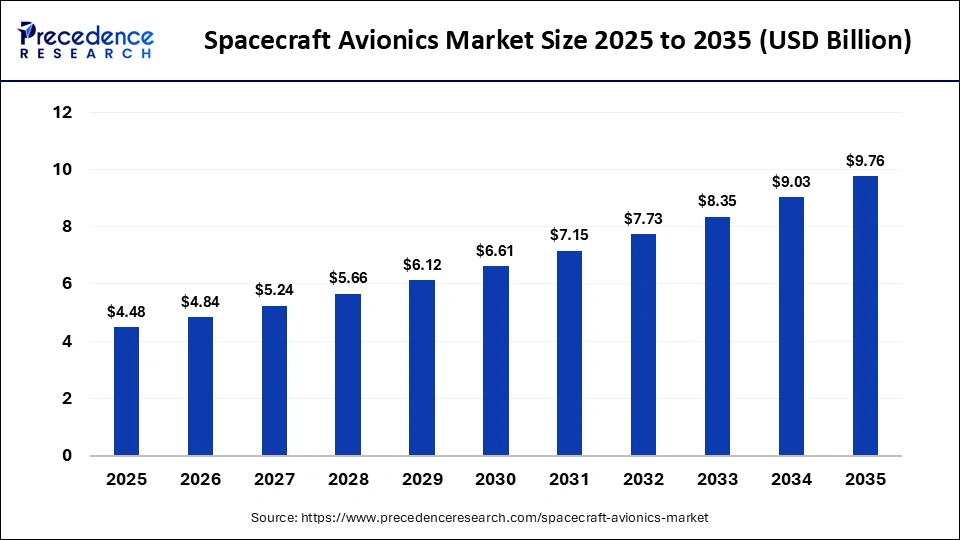
Key Takeaways
- North America led the spacecraft avionics market in 2025 with approximately 41% share.
- The Asia Pacific is projected to experience the fastest growth in the upcoming period.
- By system, the command & data handling system segment dominated the market in 2025 with a 30% share.
- By system, the navigation & guidance system segment accounted for 18% market share in 2025 and is expected to grow at the fastest rate over the forecast period.
- By platform, the satellites segment dominated the market with a 52% share in 2025.
- By platform, the crew spacecraft segment accounted for a 16% market share in 2025 and is projected to register the fastest growth over the forecast period.
- By orbit type, the low-earth orbit segment dominated the market with a 58% share in 2025.
- By orbit type, the deep space segment accounted for an 8% market share in 2025 and is anticipated to register the fastest growth over the forecast period.
- By end user, the commercial segment dominated the market with a 60% share in 2025.
- By end user, the government & defense segment accounted for a 40% market share in 2025 and is expected to register the fastest growth over the forecast period.
Market Overview
Spacecraft avionics are essential systems that manage and control various functions of a spacecraft, including communication, data handling, power management, and navigation. These systems ensure that spacecraft can successfully carry out scientific, commercial, and government missions.
Avionics refers to the electronic systems used in both aircraft and spacecraft, such as navigation, collision avoidance, and display systems. In spacecraft, these systems help determine position, speed, and orientation while supporting key functions like communication, flight control, fuel management, weather monitoring, and overall system health tracking.
The spacecraft avionics market is highly advanced and continuously evolving, driven by rapid technological innovation. As space missions become more complex, the demand for reliable and efficient avionics systems continues to grow, making them a critical part of modern aerospace operations.
Impact of Artificial Intelligence on the Spacecraft Avionics Market
Artificial intelligence (AI) is playing a transformative role in the spacecraft avionics market. It enables predictive analysis and real-time condition monitoring, helping identify potential issues before they affect mission performance.
AI-powered systems allow spacecraft to operate more efficiently by supporting faster decision-making, long-distance operations, and quick orbital adjustments. They also improve coordination across multiple systems and enable better performance even when communication is limited or disrupted.
By analyzing large volumes of data, AI helps optimize mission planning, detect patterns, and enhance automation. This leads to more intelligent and responsive avionics systems that can manage complex tasks with minimal human intervention. Overall, AI is improving mission reliability, safety, and operational efficiency.
Spacecraft Avionics Market Trends
One of the key trends in the market is the shift toward energy-efficient, electric, and hybrid systems. This transition is influencing avionics development by improving power management, reducing energy consumption, and enhancing overall system performance.
Another important trend is the advancement in command and data handling (C&DH) and space situational awareness (SSA) technologies. These innovations are enabling better data processing, improved monitoring of space environments, and more effective mission execution.
Additionally, the need for radiation-tolerant computing is becoming increasingly important. Space environments expose electronic systems to high levels of radiation, which can affect performance and reliability. As a result, the development of radiation-hardened systems is critical to ensure consistent and reliable operation of spacecraft avionics in harsh conditions.
Market Scope
| Report Coverage | Details |
| Market Size in 2025 | USD 4.48 Billion |
| Market Size in 2026 | USD 4.84 Billion |
| Market Size by 2035 | USD 9.76 Billion |
| Market Growth Rate from 2026 to 2035 | CAGR of 8.10% |
| Dominating Region | North America |
| Fastest Growing Region | Asia-Pacific |
| Base Year | 2025 |
| Forecast Period | 2026 to 2035 |
| Segments Covered | System, Platform, Orbit Type, End User, and Region |
| Regions Covered | North America, Europe, Asia-Pacific, Latin America, and Middle East & Africa |
Regional Insights
North America dominates the spacecraft avionics market, accounting for the largest share. This leadership is driven by strong government funding, advanced research capabilities, and the presence of major space agencies like NASA along with private space companies. The region benefits from high investments in satellite launches, defense programs, and deep-space missions, which continuously drive demand for advanced avionics systems. Additionally, the United States plays a central role due to its well-established aerospace ecosystem and technological leadership.
Europe holds a significant position in the market, supported by increasing investments in space exploration and satellite programs. Organizations such as the European Space Agency (ESA) and collaborations between aerospace companies are driving innovation in avionics systems. The region is also focused on developing reliable, energy-efficient, and high-performance avionics solutions to support both commercial and scientific missions, contributing to steady market growth.
Asia Pacific is the fastest-growing region, fueled by rising space initiatives in countries like China, India, and Japan. Governments across the region are investing heavily in satellite launches, space exploration missions, and domestic aerospace capabilities. The growing presence of private space companies and increasing demand for communication and Earth observation satellites are further accelerating the adoption of advanced avionics systems in this region.
The Middle East and Africa region is gradually emerging as a potential market, driven by increasing interest in space programs and investments in satellite technology. Countries in the Middle East are particularly focusing on space research and satellite deployment to support communication, defense, and environmental monitoring. Although still in the early stages, the region is expected to witness steady growth in the coming years.
Latin America shows moderate growth potential in the spacecraft avionics market. The region is gradually expanding its space capabilities through satellite programs and international collaborations. While the market is still developing, improving technological infrastructure and growing interest in space-based applications are expected to support gradual adoption of avionics systems in the future.
Spacecraft Avionics Market Key Players
- Honeywell International Inc.
- Collins Aerospace (RTX Corporation)
- Northrop Grumman Corporation
- Lockheed Martin Corporation
- Thales Group
- Airbus Defence and Space
- BAE Systems plc
- L3Harris Technologies, Inc.
- General Dynamics Corporation
- Safran S.A.
- Cobham Limited
- Leonardo S.p.A.
- Sierra Nevada Corporation
- Ball Aerospace
- Mitsubishi Electric Corporation
Recent Developments
- In March 2026, Aurora Avionics, a young aerospace electronics firm based in Edinburgh, announced that it would supply onboard data acquisition systems for the PHOENIX 2.1 mission, being developed by European re-entry logistics company ATMOS Space Cargo. With this contract, the small Scottish avionics company is quietly positioning itself within one of Europe’s most closely watched space logistics programs.
- In January 2026, a U.S.-based defense and industrial technology company specializing in embedded AI-powered autonomy, advanced avionics, precision components, UAVs, and aerospace engineering announced that its subsidiary, GuideTech, had secured a contract with Portal Space Systems to develop next-generation, maneuverable spacecraft platforms. This deal expands Palladyne AI’s presence into the space domain and reinforces its role as a trusted autonomy partner across multiple operational domains.
Segment Covered in the Report
By System
- Command & Data Handling System
- Communication System
- Navigation & Guidance System
- Power Management System
- Flight Control System
By Platform
- Satellites
- Launch Vehicles
- Space Probes
- Crew Spacecraft
By Orbit Type
- Low Earth Orbit (LEO)
- Medium Earth Orbit (MEO)
- Geostationary Orbit (GEO)
- Deep Space
By End User
- Commercial
- Government & Defense
By Region
- North America
- Latin America
- Europe
- Asia-pacific
- Middle and East Africa
Get Sample Link: https://www.precedenceresearch.com/sample/8263
Also Read : https://www.businesswebwire.com/next-gen-aircraft-propulsion-system-market/