
The global small nuclear reactor market is emerging as one of the most transformative segments in the energy sector, driven by the urgent need for clean, reliable, and scalable power generation. In 2025, the market was valued at USD 7.49 billion, and it is projected to rise to USD 8.16 billion in 2026. Over the forecast period, the market is expected to reach approximately USD 17.37 billion by 2035, growing at a CAGR of 8.78% from 2026 to 2035.
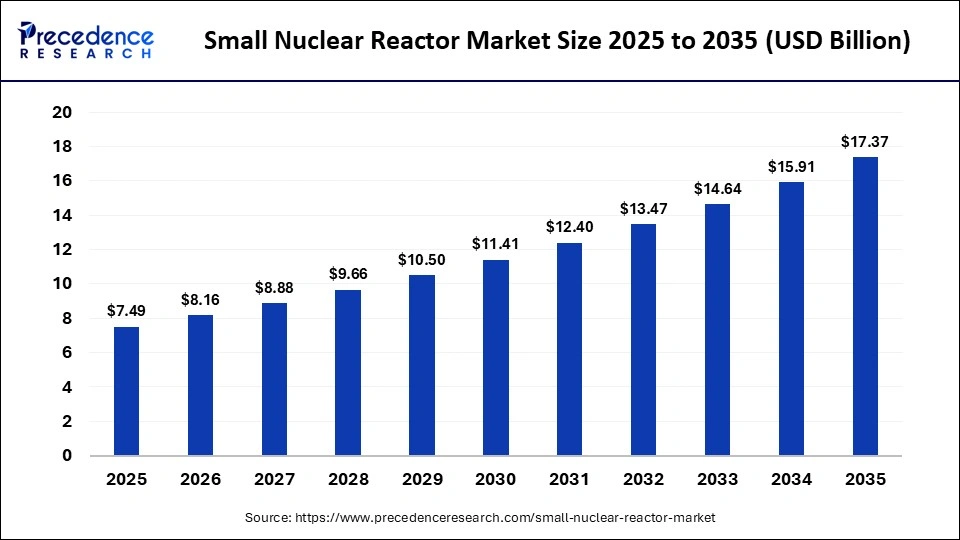
The increasing focus on decarbonization, energy security, and modular nuclear technologies is accelerating global adoption of SMRs across power generation, industrial heat, and remote energy applications.
Read Also: Firefighting Aircraft Market
Market Overview
Small nuclear reactors, also known as small modular reactors (SMRs), are advanced nuclear systems designed to generate low-carbon electricity with improved safety, flexibility, and scalability compared to traditional large nuclear plants.
These reactors typically offer capacities below 300 MW and are engineered for:
- Factory-based modular construction
- Faster installation timelines
- Enhanced passive safety systems
- Flexible deployment in remote or industrial locations
SMRs are gaining strong attention due to their ability to support baseload power generation, especially as renewable energy sources expand but remain intermittent.
Key Market Takeaways
- Market size was USD 7.49 billion in 2025 and will reach USD 8.16 billion in 2026
- Expected to grow to USD 17.37 billion by 2035
- Asia Pacific dominated with a 35% share in 2025
- Europe is projected to grow at the fastest rate
- Heavy water reactors led with a 43% share in 2025
- Light water reactors are expected to expand rapidly
- 201–300 MW segment held the largest share at 40%
- Power generation accounted for 44% of total applications
- Utilities dominated with a 50% market share in 2025
Market Drivers
1. Rising Demand for Clean Energy
Global net-zero targets are pushing countries toward low-carbon energy solutions. SMRs offer reliable and continuous clean power, making them a key alternative to fossil fuels.
2. Growing Electricity Demand
Increasing industrialization, urbanization, and data center expansion are driving demand for stable baseload electricity.
3. Modular Construction Advantages
SMRs are built using factory-based modular systems, reducing construction time, costs, and project risks.
4. Expanding Industrial Applications
SMRs are increasingly used for hydrogen production, desalination, and industrial process heat applications.
5. Strong Government Support
Countries like the U.S., China, Canada, the UK, and India are heavily investing in SMR development through subsidies, pilot projects, and regulatory reforms.
Market Restraints
Despite strong growth potential, the market faces several challenges:
- High upfront capital investment
- Complex regulatory approval processes
- Long commercialization timelines
- Nuclear waste management concerns
- Limited operational SMR deployments globally
Market Opportunities
The SMR market presents significant opportunities in:
- Remote and off-grid power generation
- Industrial decarbonization initiatives
- Hydrogen economy development
- AI-driven energy demand (data centers)
- Defense and strategic energy infrastructure
Segment Analysis
By Reactor Type
Heavy water reactors dominated the market due to fuel flexibility and proven operational efficiency. However, light water reactors are expected to grow fastest, supported by established technology and global familiarity.
Emerging technologies like high-temperature gas-cooled reactors, fast neutron reactors, and molten salt reactors are gaining traction for advanced applications.
By Power Capacity
The 201–300 MW segment led the market in 2025, driven by strong utility-scale demand and high power output requirements.
The 101–200 MW segment is expected to grow rapidly, offering an optimal balance between cost, scalability, and deployment flexibility.
By Application
The power generation segment dominated the market with a 44% share in 2025, as SMRs provide reliable baseload electricity and complement renewable energy systems.
Industrial process heat and hydrogen production are emerging as high-growth applications, supporting global decarbonization goals.
By End User
Utilities accounted for the largest share at 50% in 2025, due to rising electricity demand and grid reliability needs.
The industrial sector is expected to grow fastest, driven by demand for clean, continuous energy in manufacturing, oil refining, and hydrogen production.
By Component
Reactor equipment held the largest share due to its critical role in ensuring safety and performance. Meanwhile, turbines and generators are expected to grow rapidly due to advancements in energy conversion efficiency.
Regional Insights
Asia Pacific
Asia Pacific dominated the global market with a 35% share in 2025, led by rapid nuclear expansion in China and India. Strong government backing and rising energy demand continue to drive regional growth.
Europe
Europe is expected to grow at the fastest rate due to strong decarbonization policies, energy security concerns, and investments in advanced nuclear technologies.
North America
North America remains a key innovation hub with strong government funding and private sector participation in SMR development programs.
Latin America & Middle East & Africa
These regions are gradually adopting SMRs to support energy diversification and infrastructure expansion.
Market Trends
1. AI and Digital Integration
AI is being integrated into reactor monitoring and safety systems to enhance efficiency and reduce operational risks.
2. Rising Demand for Baseload Clean Energy
SMRs are increasingly seen as a stable complement to renewable energy sources.
3. Expansion of Hydrogen Economy
SMRs are playing a key role in supporting low-carbon hydrogen production.
4. Growth of Factory-Built Nuclear Systems
Modular construction is reducing deployment time and improving cost efficiency.
Competitive Landscape
Key companies operating in the small nuclear reactor market include:
- NuScale Power
- Rolls-Royce SMR
- TerraPower
- Westinghouse Electric Company
- GE Hitachi Nuclear Energy
- EDF
- China National Nuclear Corporation (CNNC)
- Rosatom
- X-energy
- Holtec International
These players are focusing on advanced reactor designs, government collaborations, and commercialization strategies to strengthen their global presence.
Recent Developments
- April 2026: Nano Nuclear Energy submitted a construction permit for its Kronos microreactor to the U.S. NRC.
- March 2026: Blykalla announced development of a lead-cooled SMR park in Sweden.
- March 2026: Ontario Power Generation advanced SMR construction at the Darlington site in Canada.
- March 2026: UK government approved Rolls-Royce SMR design for deployment readiness.
- February 2026: U.S. DOE accelerated SMR deployment through the Advanced Reactor Pilot Program.
Conclusion
The global small nuclear reactor market is set for strong long-term growth, reaching USD 17.37 billion by 2035. Driven by clean energy transitions, rising electricity demand, and technological innovation, SMRs are expected to play a critical role in the future global energy mix.
With expanding applications across power generation, industry, and hydrogen production, SMRs are positioned as a key solution for achieving energy security and decarbonization goals worldwide.
Get Sample Report: https://www.precedenceresearch.com/sample/8289
For inquiries regarding discounts, bulk purchases, or customization requests, please contact us at [email protected]
