
What is the Ocular Hypertension Market Size in 2026?
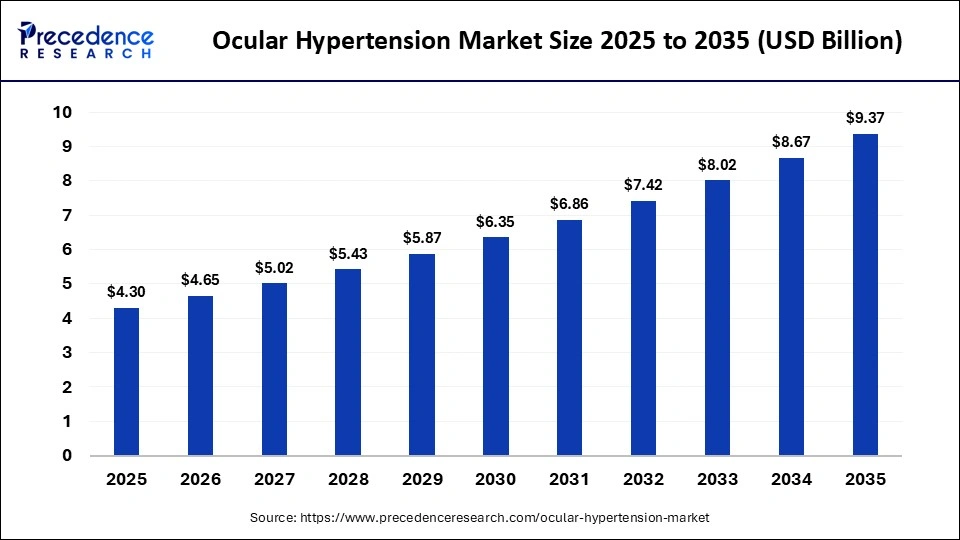
The global ocular hypertension market size accounted for USD 4.30 billion in 2025 and is predicted to increase from USD 4.65 billion in 2026 to approximately USD 9.37 billion by 2035, expanding at a CAGR of 8.10% from 2026 to 2035. The expansion of healthcare infrastructure and the growing awareness regarding ocular health are propelling market growth.
Key Takeaways
- North America led the ocular hypertension market in 2025 with approximately 42.50% share.
- The Asia Pacific is projected to experience the fastest growth during the forecast period.
- By drug type, the prostaglandin analogs segment dominated the market in 2025 with about 42% share.
- By drug type, the beta-blockers segment held the second-largest share of the market in 2025.
- By treatment type, the medical treatment segment led the market with around 70% share in 2025.
- By treatment type, the surgical treatment segment held the second-largest share of the market in 2025 and is expected to grow at a significant rate between 2026 and 2035.
- By route of administration, the topical segment dominated the market with about 78% share in 2025.
- By route of administration, the oral segment was the second-largest shareholder in 2025 and is expected to grow at a significant rate during the projection period.
- By distribution channel, the retail pharmacies segment dominated the market with nearly 45% share in 2025.
- By distribution channel, the hospitals & clinics segment held the second-largest share of 40% in 2025 and is expected to grow at the fastest rate between 2026 and 2035.
Market Overview
Ocular hypertension is a condition characterized by elevated intraocular pressure (IOP) within the eye, typically resulting from impaired drainage of aqueous humor. Under normal conditions, IOP ranges between 11 and 21 mmHg, and levels exceeding this threshold are classified as ocular hypertension. The condition is relatively common, particularly among individuals over the age of 40, and poses a significant risk if left untreated.
A sustained increase in intraocular pressure can lead to optic nerve damage, initially causing peripheral vision loss and potentially progressing to central vision impairment in advanced stages. Current treatment approaches include a range of pharmacological therapies such as prostaglandin analogs, beta-blockers, alpha-adrenergic agonists, carbonic anhydrase inhibitors, and rho kinase inhibitors. Growing awareness of eye health and early diagnosis is supporting the expansion of the ocular hypertension treatment market.
Impact of Artificial Intelligence on the Ocular Hypertension Market
Artificial intelligence is increasingly transforming the field of ophthalmology, including the diagnosis and management of ocular hypertension. AI-powered technologies are being integrated into clinical workflows to enhance early detection, risk assessment, and treatment planning.
Advanced algorithms and neural networks can analyze imaging data, intraocular pressure trends, and patient-specific risk factors to deliver accurate prognostic insights. This enables personalized treatment strategies and more effective monitoring of disease progression. As a result, AI-driven diagnostic platforms and decision-support systems are improving clinical outcomes while enhancing efficiency in ophthalmic care.
Ocular Hypertension Market Trends
- Development of Targeted Therapies:
Advancements in understanding intraocular pressure regulation are leading to the development of targeted therapies that effectively control IOP while minimizing systemic side effects. - Strategic Collaborations and Portfolio Expansion:
Key market players are engaging in mergers, acquisitions, and partnerships with biotechnology firms to expand their product portfolios and strengthen capabilities in advanced ocular drug delivery systems. - Growing Adoption of Topical Eye Drops:
The increasing use of topical eye drops that regulate aqueous humor dynamics is driving market growth, offering effective, non-invasive solutions for managing elevated intraocular pressure.
Market Scope
| Report Coverage | Details |
| Market Size in 2025 | USD 4.30 Billion |
| Market Size in 2026 | USD 4.65 Billion |
| Market Size by 2035 | USD 9.37 Billion |
| Market Growth Rate from 2026 to 2035 | CAGR of 8.10% |
| Dominating Region | North America |
| Fastest Growing Region | Asia-Pacific |
| Base Year | 2025 |
| Forecast Period | 2026 to 2035 |
| Segments Covered | Drug Type, Treatment Type, Route of Administration, Distribution Channel, and Region |
| Regions Covered | North America, Europe, Asia-Pacific, Latin America, and Middle East & Africa |
Regional Insights
North America represents a key market, supported by advanced healthcare systems, high awareness of eye-related disorders, and early adoption of innovative diagnostic technologies. The presence of leading pharmaceutical and medical device companies, along with strong investment in research and development, is driving the adoption of advanced therapies and AI-enabled diagnostic tools. Additionally, routine eye screening practices and favorable reimbursement frameworks contribute to early diagnosis and effective disease management.
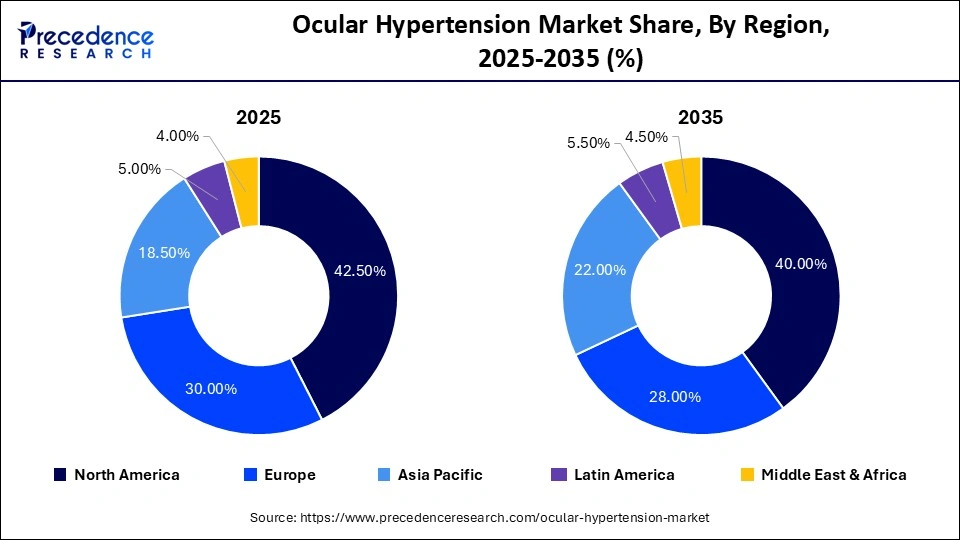
Europe continues to show steady growth, driven by an aging population and increasing prevalence of ocular conditions. Strong regulatory frameworks and a focus on improving patient outcomes are encouraging the adoption of advanced treatment options. Countries across the region are investing in modern ophthalmic care infrastructure and promoting early detection programs, which support the demand for ocular hypertension therapies and diagnostic solutions.
Asia-Pacific is emerging as a rapidly growing region due to rising healthcare awareness, expanding middle-class populations, and improving access to medical services. Countries such as China, India, and Japan are witnessing increased demand for eye care treatments as the prevalence of ocular conditions rises. Government initiatives aimed at strengthening healthcare systems, along with growing adoption of advanced diagnostic technologies, are further accelerating market growth in the region.
Ocular Hypertension Market Companies
- Allergan, Inc.
- Novartis AG
- Johnson & Johnson
- Pfizer Inc.
- Santen Pharmaceutical Co., Ltd.
- Merck & Co., Inc.
- GlaxoSmithKline plc
- Aerie Pharmaceuticals, Inc.
- Bausch Health Companies Inc.
- Teva Pharmaceutical Industries Ltd.
- Otsuka Pharmaceutical Co., Ltd.
- Visus Therapeutics, Inc.
- Mylan N.V.
- Inotek Pharmaceuticals
- Sun Pharmaceutical Industries Ltd
Recent Developments
- In January 2026, SpyGlass Pharma submitted its application for an initial public offering on the Nasdaq Global Select Market, using the ticker “SGP.” This late-stage biopharmaceutical company is focused on developing sustained-release drug delivery systems for glaucoma and related ocular conditions, with its flagship product being the bimatoprost drug pad-IOL system. Jefferies, Leerink Partners, Citigroup, and Stifel are serving as joint bookrunners for this offering.
- In September 2025, Sagent Pharmaceuticals officially launched its travoprost ophthalmic solution, USP 0.004%, marking the company’s entry into the ophthalmic market. Travoprost is indicated for the reduction of elevated intraocular pressure (IOP) in patients diagnosed with open-angle glaucoma or ocular hypertension.
- In April 2025, Akums introduced an ophthalmic drop designed for the treatment of glaucoma and ocular hypertension. This combination therapy operates on a dual mechanism of action: Ripasudil facilitates the outflow of aqueous humor, while Timolol decreases its production.
Segments Covered in the Report
By Drug Type
- Prostaglandin Analogs
- Latanoprost
- Bimatoprost
- Beta-Blockers
- Timolol
- Betaxolol
- Alpha Agonists
- Brimonidine
- Carbonic Anhydrase Inhibitors
- Dorzolamide
- Brinzolamide
- Combination Drugs
- Fixed-dose combinations
By Treatment Type
- Medical Treatment
- Topical Drugs
- Oral Drugs
- Surgical Treatment
- Laser Surgery
- Trabeculectomy
- Implantable Devices
- Others
- Lifestyle Modifications
By Route of Administration
- Topical
- Eye Drops
- Oral
- Oral Medications
- Others
- Injectable
By Distribution Channel
- Hospitals & Clinics
- Ophthalmology Clinics
- Hospitals
- Retail Pharmacies
- Chain Pharmacies
- Independent Pharmacies
- Online Pharmacies
By Region
- North America
- Latin America
- Europe
- Asia-pacific
- Middle and East Africa
Get Sample Link: https://www.precedenceresearch.com/sample/8283