
What is the Next-Gen Aircraft Propulsion System Market Size in 2026?
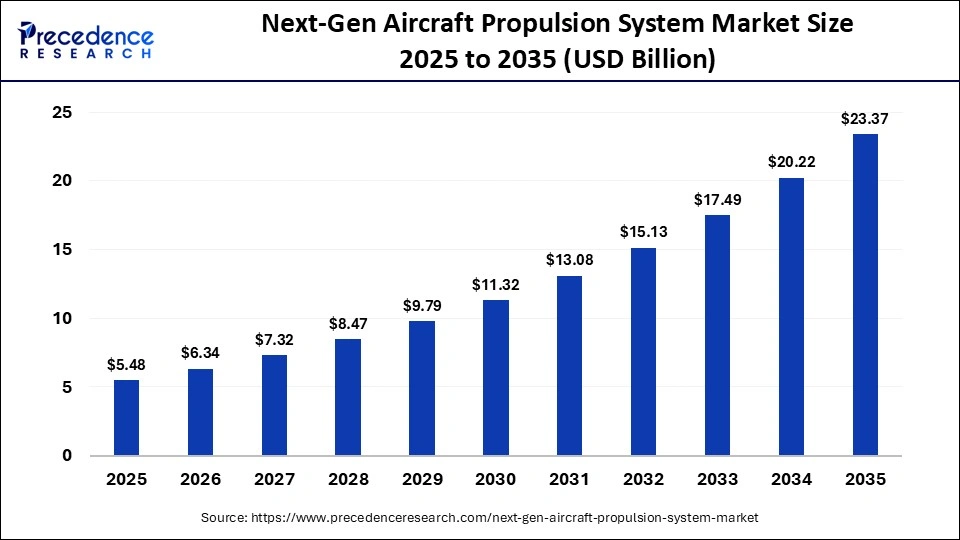
The global next-gen aircraft propulsion system market size accounted for USD 5.48 billion in 2025 and is predicted to increase from USD 6.34 billion in 2026 to approximately USD 23.37 billion by 2035, expanding at a CAGR of 15.61% from 2026 to 2035. The market is significantly expanding due to growing environmental regulations, shifts toward greener flights, increasing air-travel demand, and lower operational costs requirements.
Key Takeaways
- North America held the largest market share of 39% in 2025.
- The Asia Pacific is expected to witness the fastest growth during the foreseeable period.
- By propulsion type, the conventional turbofan/turboprop segment held the largest market share of nearly 58% in 2025.
- By propulsion type, the hybrid-electric propulsion segment is the second largest shareholder and is expected to grow at the fastest rate between 2026 and 2035.
- By component, the engine systems segment held the largest market share of 50% in 2025
- By component, the energy storage systems segment is the second largest shareholder and is expected to grow at a significant rate between 2026 and 2035.
- By platform, the commercial aircraft segment held the largest market share of nearly 52% in 2025.
- By platform, the military aircraft segment is the second largest shareholder and is expected to grow at a significant rate between 2026 and 2035.
- By technology, the conventional propulsion segment held the largest market share of nearly 55% in 2025.
- By technology, the hybrid propulsion segment is the second largest shareholder and is expected to grow at the fastest rate between 2026 and 2035.
Market Overview
The next-generation aircraft propulsion system market is centered around developing cleaner and more efficient alternatives to traditional jet engines. As the aviation industry faces increasing pressure to reduce carbon emissions and meet strict environmental regulations, companies are actively exploring advanced technologies such as hybrid-electric, fully electric, hydrogen-powered, and open-rotor systems.
Among these, hybrid-electric engines are already gaining attention in commercial aviation due to their ability to balance performance and sustainability. At the same time, ongoing advancements in high-density batteries, hydrogen propulsion, and solid oxide fuel cells are pushing the boundaries of what modern aircraft engines can achieve. These innovations are playing a key role in transforming the future of aviation toward more sustainable operations.
How is AI Influencing the Next-Gen Aircraft Propulsion System Market?
Artificial intelligence (AI) is playing a major role in reshaping the next-generation aircraft propulsion system market. One of its biggest advantages is the ability to optimize engine performance in real time, helping improve fuel efficiency while reducing emissions.
AI also enables predictive maintenance by working with IoT-connected sensors to continuously monitor engine health. This allows airlines and manufacturers to detect potential issues early, reducing unexpected failures, downtime, and maintenance costs.
In addition, AI is speeding up the development of advanced propulsion systems. It helps engineers design more efficient and lightweight components and improves the integration of hybrid, electric, and hydrogen technologies. Overall, AI is accelerating innovation and supporting the aviation industry’s shift toward more sustainable and efficient propulsion solutions.
Next-Gen Aircraft Propulsion System Market Trends
- There is a rapid push toward zero-emission flights, driven by advances in hydrogen storage, fuel technologies, and robust infrastructure for airport refueling.
- Many aircraft manufacturing companies are adopting hybrid and electric propulsion systems, incorporating advanced battery technologies such as lithium-sulfur and solid-state batteries, alongside high-efficiency, low-noise electric motors.
- The increasing development of next-gen jet engines, such as the CFM Leap Family, which uses ceramic matrix composites for high-temperature operation, maximizes fuel efficiency, and reduces weight, is further supporting the market growth.
- There is a rising integration of AI for real-time propulsion optimization and IoT-based predictive maintenance , enabling the minimization of ground time and operational costs.
- The industry is also embracing biofuels and synthetic fuels to lower carbon emissions from turbine engines, reinforcing its focus on sustainability and environmental compliance.
Market Scope
| Report Coverage | Details |
| Market Size in 2025 | USD 5.48 Billion |
| Market Size in 2026 | USD 6.34 Billion |
| Market Size by 2035 | USD 23.37 Billion |
| Market Growth Rate from 2026 to 2035 | CAGR of 15.61% |
| Dominating Region | North America |
| Fastest Growing Region | Asia-Pacific |
| Base Year | 2025 |
| Forecast Period | 2026 to 2035 |
| Segments Covered | Propulsion Type, Component, Platform, Technology, and Region |
| Regions Covered | North America, Europe, Asia-Pacific, Latin America, and Middle East & Africa |
Regional Insights
North America leads the next-generation aircraft propulsion system market, accounting for the largest share globally. This dominance is mainly driven by strong investments in research and development, modernization of military and commercial aircraft, and the presence of major aerospace innovators. The region is at the forefront of developing hybrid-electric and hydrogen propulsion technologies, supported by both government funding and private sector initiatives. As a result, North America continues to be a hub for technological advancements and early adoption of sustainable propulsion systems.
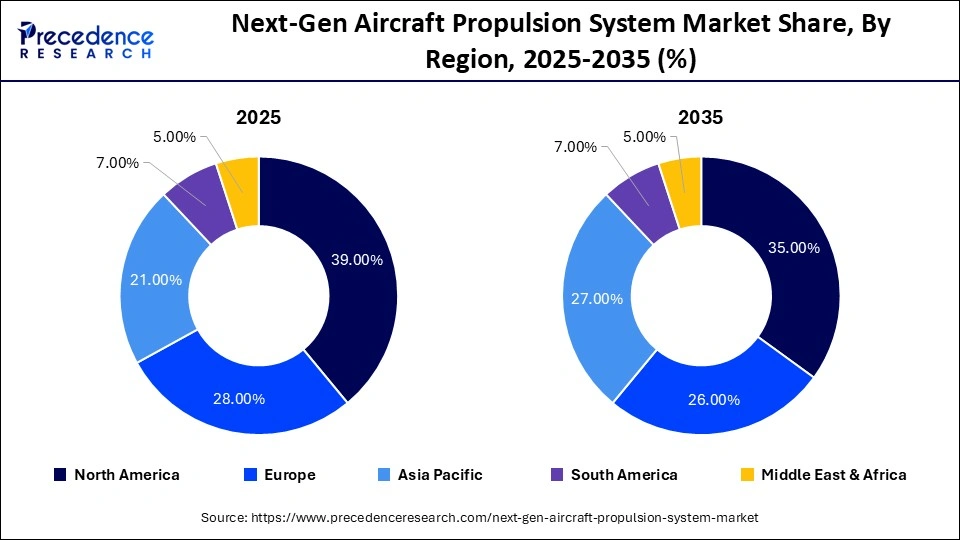
Europe is a key region in the market, characterized by its strong focus on sustainability and environmental compliance. Strict regulations aimed at reducing aviation emissions are pushing companies to innovate in areas such as electric propulsion, hydrogen-powered aircraft, and open-rotor engine designs. The region benefits from close collaboration between aircraft manufacturers, research institutions, and governments, which accelerates the development and deployment of next-generation propulsion technologies.
Asia Pacific is expected to be the fastest-growing region, driven by increasing air travel demand and rapid expansion of the aviation sector. Countries like China, India, and Japan are investing heavily in advanced propulsion technologies to reduce operating costs and meet environmental standards. Governments in the region are also supporting innovation through subsidies, research programs, and infrastructure development. Additionally, the growing focus on local manufacturing and supply chain development is further strengthening the market in Asia Pacific.
The Middle East and Africa region is gradually emerging as a promising market, supported by expanding airline networks and growing investments in aviation infrastructure. Airlines in the Middle East, in particular, are exploring sustainable aviation solutions, including renewable fuels and advanced propulsion systems, to balance rapid expansion with environmental goals. This is expected to drive steady demand for next-generation propulsion technologies in the coming years.
Next-Gen Aircraft Propulsion System Market Key Players
- General Electric (GE Aerospace)
- Rolls-Royce Holdings plc
- Pratt & Whitney (RTX Corporation)
- Safran S.A.
- Honeywell International Inc.
- MTU Aero Engines AG
- Airbus SE
- Boeing Company
- GKN Aerospac
- MagniX
- ZeroAvia Inc
- Joby Aviation
- Lilium GmbH
- Kawasaki Heavy Industries
- IHI Corporation
Recent Developments
- In January 2026, a leader in the aviation industry, Rolls-Royce, strengthened its footprint in India by introducing its strategy that places the co-development of next-gen combat aircraft engines with high-level adaptability.
- In February 2026, a propulsion system development partner, drive system design, collaborated with Airbus to expand the electrification of aviation with next-gen inverter technology.
- In March 2025, Airbus announced its project to incorporate novel technologies and cutting-edge engineering for next-gen single aisle of Airbus.
Segments Covered in the Report
By Propulsion Type
- Conventional Turbofan/Turboprop
- Hybrid-Electric Propulsion
- Fully Electric Propulsion
- Hydrogen Propulsion
By Component
- Engine Systems
- Energy Storage Systems
- Power Electronics
- Thermal Management Systems
By Platform
- Commercial Aircraft
- Military Aircraft
- Urban Air Mobility (UAM)
- General Aviation
By Technology
- Conventional Propulsion
- Electric Propulsion
- Hybrid Propulsion
By Region
- North America
- Latin America
- Europe
- Asia-pacific
- Middle and East Africa
Get Sample Link: https://www.precedenceresearch.com/sample/8266
Also Read Our Latest Post: https://www.businesswebwire.com/aircraft-turbofan-engine-market/