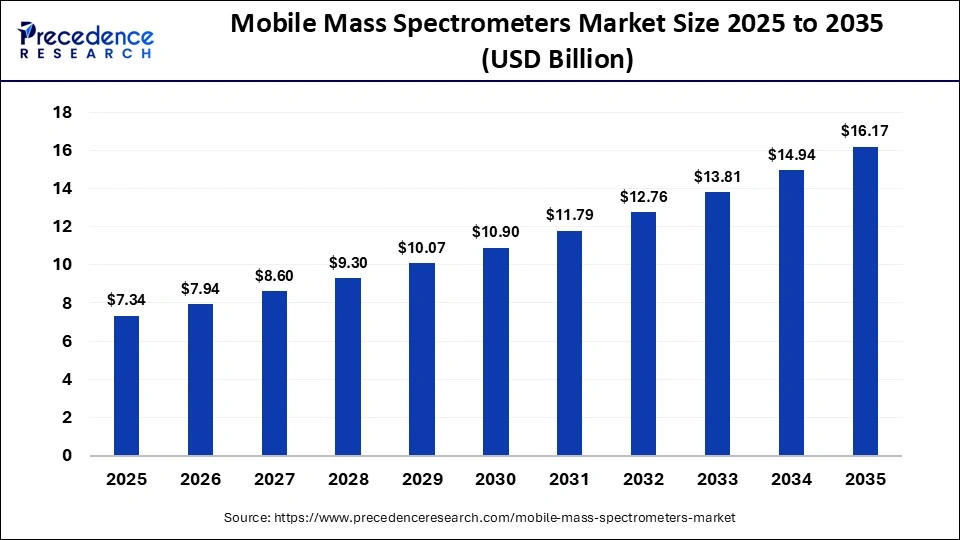
What is the Mobile Mass Spectrometers Market Size in 2026?
The global mobile mass spectrometers market size was calculated at USD 7.34 billion in 2025 and is predicted to increase from USD 7.94 billion in 2026 to approximately USD 16.17 billion by 2035, expanding at a CAGR of 8.22% from 2026 to 2035.The market is experiencing robust growth, driven by the widespread use of onsite molecular detection and real-time analysis of chemical analytes in multiple industries. Field-portable devices are becoming increasingly important over lengthy waiting periods often caused by centralized laboratory testing.
Key Takeaways
- North America held the largest revenue share in the mobile mass spectrometers market in 2025.
- Asia-Pacific is expected to grow at the fastest CAGR in the market during the forecast period.
- By product type, the portable mass spectrometers segment accounted for a considerable revenue share in the market in 2025.
- By product type, the handheld mass spectrometers segment is expected to grow at the fastest CAGR in the market between 2026 and 2035.
- By applications, the environmental testing segment accounted for the highest revenue share in the market in 2025.
- By applications, the homeland security segment is expected to expand rapidly in the market in the coming years.
- By end-user, the government and research institutions segment accounted for a considerable revenue share in the market in 2025.
- By end-user, the industrial segment is expected to grow at the fastest CAGR in the market between 2026 and 2035.
Mobile Mass Spectrometers Market Overview
The mobile mass spectrometers market focuses on portable analytical instruments designed to identify and measure chemical compounds directly at the point of use. These devices work by analyzing the mass-to-charge ratio of ions, enabling fast and accurate detection of substances without the need for traditional laboratory setups. Their ability to deliver real-time results makes them highly valuable across various sectors, including environmental monitoring, security screening, forensic analysis, and industrial applications.
Mobile mass spectrometers are available in different formats such as handheld, portable, and benchtop systems, each designed to meet specific operational needs. These devices use advanced techniques like ion trap mass spectrometry, quadrupole systems, time-of-flight (TOF), and Fourier transform ion cyclotron resonance (FT-ICR) to analyze chemical compositions. Their applications span across pharmaceuticals, biotechnology, food safety testing, agriculture, and environmental assessments, offering flexibility and efficiency in field-based operations.
Impact of Artificial Intelligence on the Mobile Mass Spectrometers Market
Artificial Intelligence (AI) is significantly enhancing the capabilities of mobile mass spectrometers by transforming how chemical data is analyzed and interpreted. Traditionally, experts had to manually study complex fragmentation patterns and compare them with spectral libraries, which was time-consuming and required specialized expertise.
With AI integration, this process has become much faster and more efficient. AI-powered algorithms can instantly identify compounds by analyzing large datasets of molecular signatures, enabling rapid and accurate detection of hazardous materials, pharmaceuticals, and environmental pollutants.
Machine learning models allow these devices to go beyond simple detection by providing deeper insights and real-time analysis. As a result, mobile mass spectrometers are evolving into intelligent field-based analytical tools that can deliver actionable results within minutes. This advancement is particularly beneficial for researchers, investigators, and field professionals who require quick and reliable data for decision-making.
Mobile Mass Spectrometers Market Trends
- Proliferation of On-site Chemical Detection Systems: Portable mass spectrometers are also becoming imperative when waiting for laboratory test results is unrealistic. In the real world, this technology plays an essential role as those deployed in field service (security personnel, environmental monitors, emergency personnel) rely on systems of this type to do their work directly on ground-based safety.
- Integrated with Analytics in the Digital and Cloud Age: There is one trend that is already affecting the market, which is the fusion of mobile spectrometers with digital platforms. Such devices today transport spectral data to cloud storage for storage use, collaborative data-sharing, and even for remote inspection. Researchers from different sites can access their data, without visiting a laboratory.
- Growing Regulatory and Environmental Monitoring:With the tightening of environmental controls and an increased public emphasis on pollution issues, more mobile spectroscopy is being adopted to inspect air quality, water sources, and soil conditions. Portable systems enable inspectors to quickly detect pollutants or chemical spills in situ, thus allowing organizations to meet standards while being more responsive.
Market Scope
| Report Coverage | Details |
| Market Size in 2025 | USD 7.34 Billion |
| Market Size in 2026 | USD 7.94 Billion |
| Market Size by 2035 | USD 16.17 Billion |
| Market Growth Rate from 2026 to 2035 | CAGR of 16.17% |
| Dominating Region | North America |
| Fastest Growing Region | Asia Pacific |
| Base Year | 2025 |
| Forecast Period | 2026 to 2035 |
| Segments Covered | Product Type, Application, End-User, and region |
| Regions Covered | North America, Europe, Asia-Pacific, Latin America, and Middle East & Africa |
Regional Insights
North America leads the mobile mass spectrometers market due to strong investments in advanced analytical technologies and the presence of well-established pharmaceutical, biotechnology, and defense sectors. The region sees high adoption of portable analytical tools for applications such as homeland security, environmental monitoring, and forensic investigations. Government agencies and research institutions are actively deploying mobile mass spectrometers for rapid on-site chemical detection, further supporting market growth. Additionally, continuous advancements in AI and data analytics are enhancing the capabilities of these systems.
Europe is a significant market, driven by strict environmental regulations, food safety standards, and growing demand for forensic and security applications. Countries such as Germany, the UK, and France are investing in advanced analytical solutions to ensure compliance and improve monitoring capabilities. The region also benefits from strong research and development activities, particularly in pharmaceuticals and life sciences, where mobile mass spectrometers are used for real-time analysis and quality control.
Asia-Pacific is emerging as a fast-growing region, supported by expanding industrial activities, increasing environmental concerns, and rising investments in healthcare and research infrastructure. Countries like China, Japan, and India are adopting mobile mass spectrometry solutions for applications in pollution monitoring, food safety testing, and pharmaceutical analysis. The growing focus on industrial safety and regulatory compliance is further driving demand across the region.
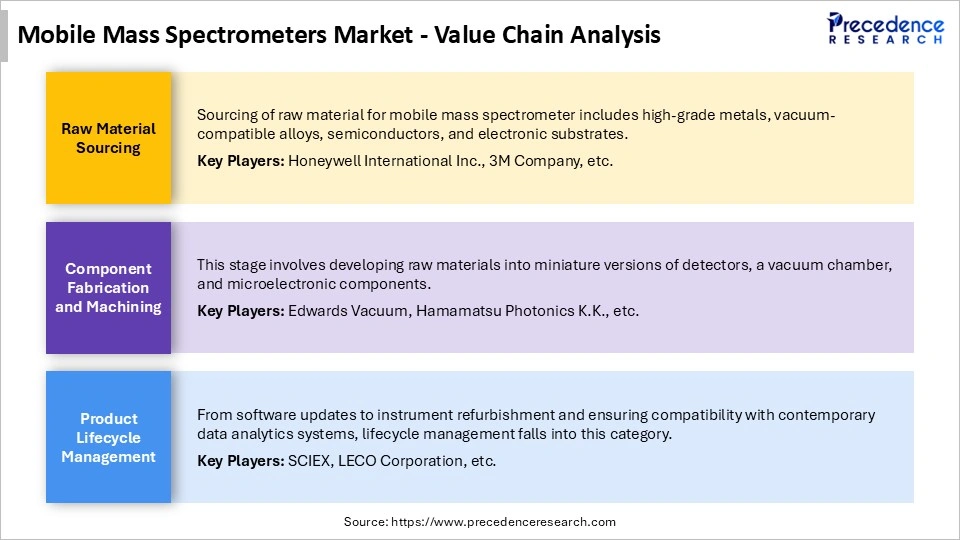
Mobile Mass Spectrometers Market Value Chain Analysis
Mobile Mass Spectrometers Market Companies
- Agilent Technologies
- Thermo Fisher Scientific
- PerkinElmer
- Bruker Corporation
- Shimadzu Corporation
- Focused Photonics
- Advion, Inc.
- FLIR Systems, Inc.
- Hiden Analytical
- Waters Corporation
- SCIEX (a Danaher Company)
- JEOL Ltd.
- LECO Corporation
- Microsaic Systems plc
- IonSense, Inc.
- Owlstone Medical
- 1st Detect Corporation
- Smith’s Detection
- Teledyne FLIR,
- Extrel CMS, LLC
- MassTech Inc.
- Kore technology
- BaySpec, Inc.
- Microsaic Systems plc
- IonSense, Inc.
- Owlstone Medical
- 1st Detect Corporation
- Smith’s Detection
Recent Developments
- In February 2026, 908 Devices Inc. launched upgraded analytical features of the MX908 handheld mass spectrometer that include new drug-target detection capabilities and new software modifications that help first responders detect new narcotics or chemical hazards directly at the scene of an incident. The enhancements included a mission mode for hazardous vapor sampling and addition of five priority drug targets.
- In July 2025, the U.S. Department of Energy’s Pacific Northwest National Laboratory (PNNL) launched VaporID, a portable air sampling system incorporated with a miniature mass spectrometer, to detect trace levels of fentanyl, methamphetamine, cocaine, and explosives like TNT with great accuracy. The instrument will be manufactured and commercialized by BaySpec.
Segments Covered in the Report
By Product Type
- Portable Mass Spectrometers
- Handheld Mass Spectrometers
By Application
- Environmental Testing
- Homeland Security
- Pharmaceutical and Biotechnology
- Food and Beverage Testing
- Others
By End-User
- Government and Research Institutions
- Industrial
- Others
By Region
- North America
- Latin America
- Europe
- Asia-pacific
- Middle and East Africa
Get Sample Link: https://www.precedenceresearch.com/sample/8155
Also Read : https://www.businesswebwire.com/molded-interconnect-device-market/