
What is the Micro Location Technology Market Size in 2026?
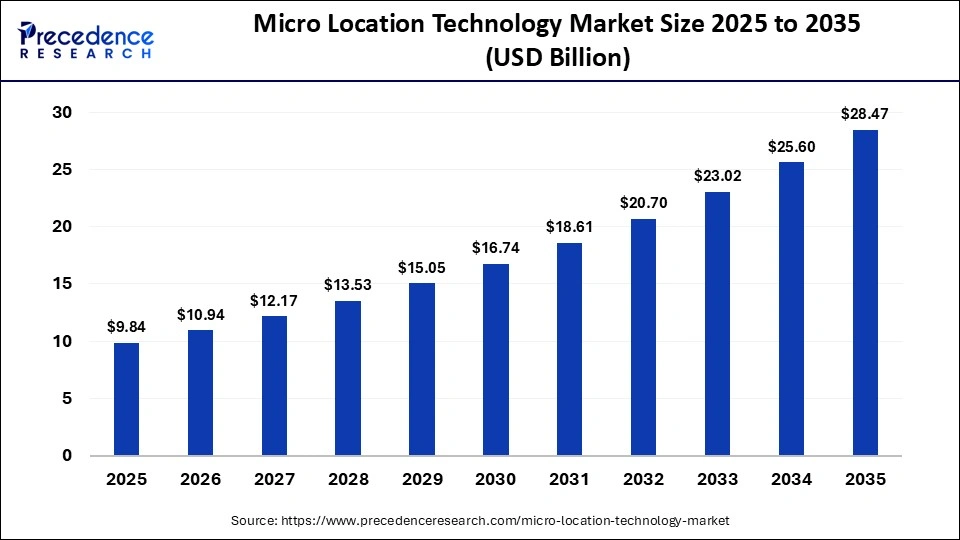
The global micro location technology market size was accounted for USD 9.84 billion in 2025 and is predicted to increase from USD 10.94 billion in 2026 to approximately USD 28.47 billion by 2035, expanding at a CAGR of 11.21% from 2026 to 2035. Technological advancements and the adoption of BLE, UWB, and IoT are key drivers of market growth.
Key Takeaways
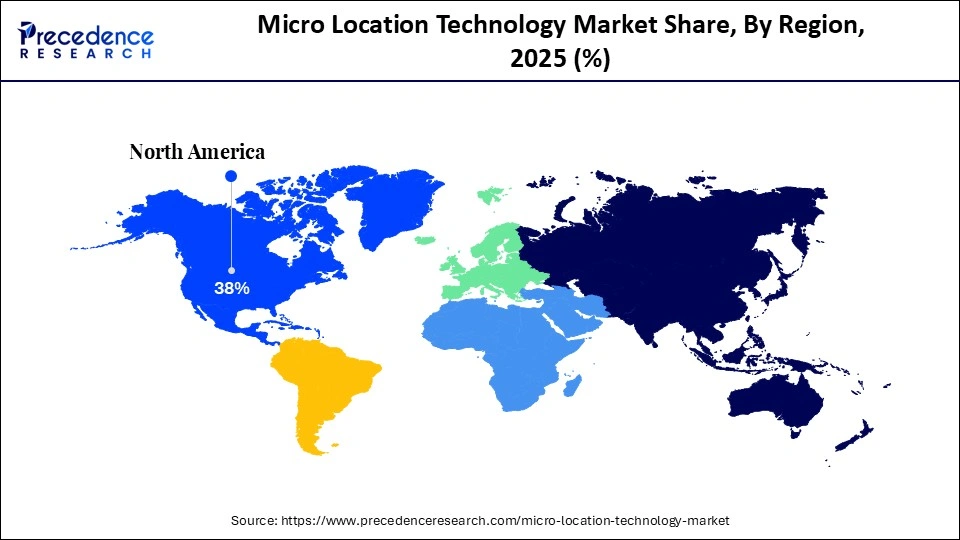
- North America dominated the global market with the largest market share of 38% in 2025.
- Asia-Pacific is expected to grow at the fastest CAGR in the market during the forecast period.
- By technology, the Bluetooth low energy segment led the global market in 2025.
- By technology, the ultra wideband segment is expected to grow at the fastest CAGR in the market between 2026 and 2035.
- By application, the retail segment dominated the market in 2025.
- By application, the healthcare segment is expected to grow with the highest CAGR in the market during the studied years.
- By deployment type, the cloud based segment held a dominant position in the market in 2025.
- By deployment type, the on premises segment is expected to expand rapidly in the market in the coming years.
- By end use, the smartphones segment held the largest market share in 2025.
- By end use, the wearable devices segment is expected to witness the fastest growth in the market over the forecast period.
What is the Micro-Location Technology Market?
The micro-location technology market focuses on advanced solutions that enable highly precise tracking of assets, individuals, or devices often with accuracy within a few centimeters. Unlike geofencing, which establishes virtual boundaries around specific locations, micro-location technologies provide real-time, fine-grained positioning data within indoor and outdoor environments.
Technologies such as Ultra-Wideband (UWB), Bluetooth Low Energy (BLE), Wi-Fi, and RFID are widely used to power micro-location systems. Among these, UWB is gaining significant traction due to its superior accuracy, reliability, and cost-effectiveness compared to conventional tracking methods.
Micro-location technology is increasingly being adopted across industries such as healthcare, retail, logistics, sports, and commercial environments. In healthcare, it supports patient and equipment tracking; in retail, it enhances customer engagement and in-store analytics; while in industrial settings, it improves asset management and operational efficiency. Additionally, its role in enhancing safety is becoming more prominent, as it enables communication between pedestrians, cyclists, and connected vehicles within a defined range, helping reduce the risk of accidents.
Impact of Artificial Intelligence on Micro-Location Technology
Artificial Intelligence (AI) is significantly enhancing the capabilities of micro-location technology by enabling smarter, data-driven insights and decision-making. By integrating AI with micro-location systems, organizations can leverage predictive analytics, real-time tracking, and contextual intelligence to optimize operations and improve user experiences.
AI-powered systems can analyze location data patterns to predict movement, detect anomalies, and automate responses in real time. This is particularly valuable in sectors such as healthcare, logistics, and smart retail, where efficiency and accuracy are critical. Additionally, AI enhances indoor navigation, asset tracking, and personalized services by delivering more precise and context-aware insights.
At the same time, there is growing emphasis on sustainability and energy efficiency. Organizations are increasingly exploring how AI-driven micro-location technologies can support greener, low-carbon operations through optimized resource utilization and smarter infrastructure management.
However, the impact of AI adoption varies across industries, depending on factors such as technological maturity, regulatory environments, and innovation capabilities. Despite these variations, the integration of AI with micro-location technology is expected to play a key role in driving future innovation, improving operational intelligence, and enabling smarter, safer environments.
Market Scope
| Report Coverage | Details |
| Market Size in 2025 | USD 9.84 Billion |
| Market Size in 2026 | USD 10.94 Billion |
| Market Size by 2035 | USD 28.47 Billion |
| Market Growth Rate from 2026 to 2035 | CAGR of 11.21% |
| Dominating Region | North America |
| Fastest Growing Region | Asia-Pacific |
| Base Year | 2025 |
| Forecast Period | 2026 to 2035 |
| Segments Covered | Technology, Application, Deployment Type, End-Use, and Region |
| Regions Covered | North America, Europe, Asia-Pacific, Latin America, and Middle East & Africa |
Regional Insights
North America holds the largest share of the micro-location technology market, driven by its advanced digital infrastructure and early adoption of location-based technologies. The region has seen strong deployment of micro-location solutions across industries such as healthcare, retail, logistics, and manufacturing. The United States, in particular, leads the market due to widespread use of real-time location systems (RTLS) for asset tracking, patient monitoring, and proximity-based services. Additionally, the rapid expansion of 5G networks and edge computing is further accelerating the adoption of high-precision tracking technologies in the region.
Europe represents a significant portion of the global market, supported by increasing investments in smart infrastructure and industrial automation. The region is characterized by a strong focus on data privacy, regulatory compliance, and secure technology deployment. Countries such as Germany, the United Kingdom, and France are at the forefront, adopting micro-location technologies for applications in manufacturing, healthcare, and logistics. The growing emphasis on Industry 5.0 and smart factory initiatives is also contributing to steady market growth across Europe.
Asia-Pacific is expected to witness the fastest growth in the micro-location technology market, fueled by rapid urbanization, expanding digital ecosystems, and increasing government support for smart city development. Countries such as China, India, and Japan are leading adoption, utilizing micro-location solutions in healthcare, retail, transportation, and industrial sectors. The region’s large population base, growing e-commerce industry, and rising demand for efficient asset tracking and indoor navigation systems are key factors driving market expansion.
Latin America is emerging as a promising market, with gradual adoption of micro-location technologies across sectors such as retail, banking, and logistics. Countries like Brazil and Mexico are experiencing growth due to increasing digital transformation initiatives and expanding supply chain networks. However, challenges such as limited infrastructure and budget constraints may impact the pace of adoption compared to more developed regions.
Micro Location Technology Market Companies
- Cisco Systems, Inc .
- Aruba Networks (HPE)
- Zebra Technologies Corporation
- Siemens AG
- Ruckus Networks (CommScope)
- Kontakt.io
- Estimote, Inc.
- Ubisense Ltd.
- CenTrak, Inc.
- Sewio Networks
- BlueCats
- Humatics Corporation
- Apple Inc.
- Google LLC (Alphabet)
- HERE Technologies
Recent Developments
- In September 2025, in a groundbreaking fusion of science fiction and reality, smart dust technology, tiny wireless sensors capable of collecting vast amounts of data, emerged as a potential game-changer for industries ranging from environmental monitoring to healthcare, while also raising serious ethical and privacy concerns.
- In August 2025, U.S. authorities secretly embedded location tracking devices in selected shipments of advanced chips deemed at high risk of being illegally diverted to China, according to two people with direct knowledge of the previously undisclosed law enforcement tactic. The measures are intended to detect AI chips being rerouted to destinations under U.S. export restrictions and apply only to specific shipments under investigation.
Segments Covered in the Report
By Technology
- Bluetooth Low Energy
- Wi-Fi Positioning Systems
- Ultra-Wideband
- Near Field Communication
By Application
- Retail
- Hospitality
- Healthcare
- Transport and Logistics
By Deployment Type
- On-premises
- Cloud-based
By End-Use
- Consumer Electronics
- Smartphones
- Wearable Devices
- IoT Devices
By Region
- North America
- Latin America
- Europe
- Asia-pacific
- Middle and East Africa
Get Free Sample : https://www.precedenceresearch.com/sample/8238
Also Read : https://www.businesswebwire.com/composite-ai-market/