
The global lined valve market is witnessing steady growth as industries increasingly prioritize safety, durability, and corrosion resistance in fluid handling systems. Lined valves, designed with protective coatings such as PTFE, PFA, and other advanced materials, play a critical role in handling aggressive chemicals and corrosive fluids across industrial sectors.
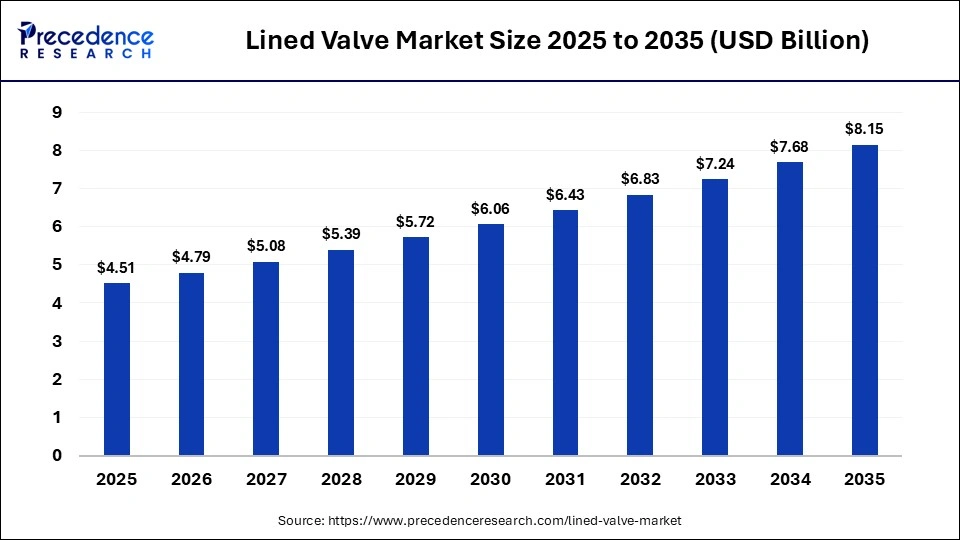
According to recent insights, the market was valued at USD 4.51 billion in 2025 and is projected to grow from USD 4.79 billion in 2026 to USD 8.15 billion by 2035, expanding at a CAGR of 6.10% during the forecast period.
This growth is driven by rising industrialization, stringent safety regulations, and increasing investments in chemical processing and water treatment infrastructure.
Read Also: Visible Light Range Scientific Camera Market
What are Lined Valves?
Lined valves are industrial valves coated internally with corrosion-resistant materials to protect against harsh chemicals and extreme operating conditions. These valves are essential in industries where fluid purity, safety, and durability are critical.
Key Features:
- Excellent corrosion resistance
- Leak-proof and contamination-free operation
- Long operational lifespan
- High reliability in extreme temperatures and pressures
They are widely used in:
- Chemical processing
- Pharmaceuticals
- Oil & gas
- Water and wastewater treatment
Market Dynamics
Key Growth Drivers
1. Rising Demand for Corrosion-Resistant Equipment
Industries such as chemical and petrochemical processing handle highly corrosive substances, increasing the need for durable lined valves to prevent equipment damage and leakage.
2. Expansion of Water & Wastewater Treatment Plants
Global water scarcity and environmental concerns are driving investments in water infrastructure, boosting demand for lined valves that can handle chemical treatments efficiently.
3. Strict Safety & Environmental Regulations
Governments worldwide are enforcing strict regulations to prevent hazardous leaks, encouraging industries to adopt high-performance valve systems.
4. Growth in Industrial Automation
Automation in process industries is increasing the adoption of advanced valve systems integrated with monitoring technologies.
Market Challenges
- High initial cost of advanced lined valves
- Maintenance complexity in extreme environments
- Requirement for specialized installation and operation
Role of AI in the Lined Valve Industry
Artificial Intelligence is transforming the valve industry by enabling smarter, more efficient operations.
Key AI Applications:
- Real-time monitoring of pressure and flow
- Predictive maintenance to reduce downtime
- Automated defect detection in manufacturing
- Smart valve control in industrial plants
AI integration helps improve operational efficiency, reduce costs, and enhance safety across industries.
Lined Valve Market Segmentation Analysis (Detailed)
Understanding the segmentation of the lined valve market is essential to identify growth opportunities, demand patterns, and technological preferences across industries. The market is segmented based on product type, lining material, distribution channel, and end-use industry.
By Product Type (Detailed Analysis)
1. Ball Valves (Largest Segment – ~30%)
Ball valves dominate the market due to their robust sealing performance and ease of operation.
Key Characteristics:
- Quarter-turn operation for quick shutoff
- Excellent leak-proof sealing
- Suitable for high-pressure systems
Applications:
- Oil & gas pipelines
- Chemical processing plants
- Water distribution systems
Why They Lead:
Their durability and low maintenance make them the preferred choice for industries dealing with hazardous fluids.
2. Butterfly Valves (~20%)
Butterfly valves are widely used in large-scale pipeline systems where space and cost efficiency are critical.
Key Features:
- Lightweight design
- Compact structure
- Cost-effective solution
Applications:
- Water treatment plants
- HVAC systems
- Power generation facilities
Growth Insight:
Increasing urban infrastructure projects are boosting demand for butterfly valves globally.
3. Plug Valves (~15%)
Plug valves are ideal for handling corrosive and abrasive media.
Key Advantages:
- Simple design with fewer moving parts
- High resistance to chemical corrosion
- Reliable shut-off capability
Applications:
- Chemical and petrochemical industries
- Slurry handling systems
4. Globe Valves (~17%)
Globe valves are primarily used where precise flow control is required.
Key Features:
- Accurate throttling capability
- Suitable for regulating flow
- Strong sealing performance
Applications:
- Steam systems
- Cooling water systems
- Chemical processing units5. Gate Valves (~10%)
Gate valves are designed for full flow or complete shutoff applications.
Key Characteristics:
- Minimal pressure drop
- Straight-line flow path
- Ideal for large pipelines
Applications:
- Oil & gas industry
- Water supply systems
6. Diaphragm Valves (~8%)
Diaphragm valves are widely used in hygienic and sterile applications.
Key Benefits:
- Contamination-free operation
- Excellent chemical resistance
- Easy maintenance
Applications:
- Pharmaceutical manufacturing
- Food & beverage processing
- Biotechnology industries
By Lining Material (Detailed Analysis)
1. PTFE (Polytetrafluoroethylene) – Dominant (~40%)
PTFE is the most widely used lining material due to its exceptional chemical resistance.
Advantages:
- Resistant to almost all chemicals
- Non-stick surface
- High thermal stability
Applications:
- Chemical processing
- Pharmaceuticals
- Food-grade systems
2. PFA (Perfluoroalkoxy) (~25%)
PFA offers similar properties to PTFE but with enhanced mechanical strength.
Key Benefits:
- Better flexibility
- Higher purity levels
- Superior performance at elevated temperatures
Growth Insight:
Increasing demand in high-purity and semiconductor industries is driving growth.
3. FEP (Fluorinated Ethylene Propylene) (~15%)
FEP is valued for its transparency and excellent electrical insulation.
Features:
- Good chemical resistance
- Smooth surface finish
- Moderate temperature resistance
Applications:
- Specialty chemical handling
- Electrical insulation systems
4. ETFE (Ethylene Tetrafluoroethylene) (~10%)
ETFE is used in high-pressure and mechanically demanding environments.
Advantages:
- High mechanical strength
- Excellent impact resistance
- Good chemical stability
Applications:
- Oil & gas pipelines
- Industrial processing systems
By Distribution Channel
1. Direct Sales (~60%)
Direct sales dominate the market as industries require customized valve solutions.
Key Benefits:
- Tailored product offerings
- Strong technical support
- Long-term service contracts
Industries Served:
- Large-scale industrial plants
- Government infrastructure projects
2. Indirect Sales (~40%)
Indirect channels include distributors, wholesalers, and third-party suppliers.
Advantages:
- Wider market reach
- Faster delivery
- Cost efficiency for smaller buyers
Growth Insight:
E-commerce and digital procurement platforms are accelerating this segment’s growth.
By End-Use Industry (Detailed Analysis)
1. Chemical Processing (Largest Segment – ~18%)
The chemical industry is the primary consumer of lined valves.
Why Demand is High:
- Exposure to highly corrosive chemicals
- Need for leak-proof systems
- Strict safety regulations
2. Water & Wastewater Treatment (Fastest Growing)
Growing global water scarcity is driving investments in water infrastructure.
Applications:
- Filtration systems
- Chemical dosing systems
- Wastewater recycling plants
3. Oil & Gas Industry
This sector requires high-performance valves capable of operating under extreme conditions.
Key Uses:
- Upstream drilling operations
- Midstream transportation
- Downstream refining
4. Pharmaceuticals
Lined valves are essential in maintaining sterile environments.
Key Requirements:
- Contamination-free flow
- Compliance with regulatory standards
- High-purity materials
5. Food & Beverage
Hygiene and safety are critical in this sector.
Applications:
- Beverage processing
- Dairy production
- Food packaging systems
Get Sample: https://www.precedenceresearch.com/sample/8269
For inquiries regarding discounts, bulk purchases, or customization requests, please contact us at sales@precedenceresearch.com