
What is the Japan’s Pharmaceutical Distribution Market Size in 2026?
The Japan’s pharmaceutical distribution market size accounted for USD 5.40 billion in 2025 and is predicted to increase from USD 5.97 billion in 2026 to approximately USD 14.66 billion by 2035, expanding at a CAGR of 10.50% from 2026 to 2035. This market is growing due to the country’s aging population, increasing demand for prescription drugs, and the expansion of cold chain logistics for biologics and specialty medicine.
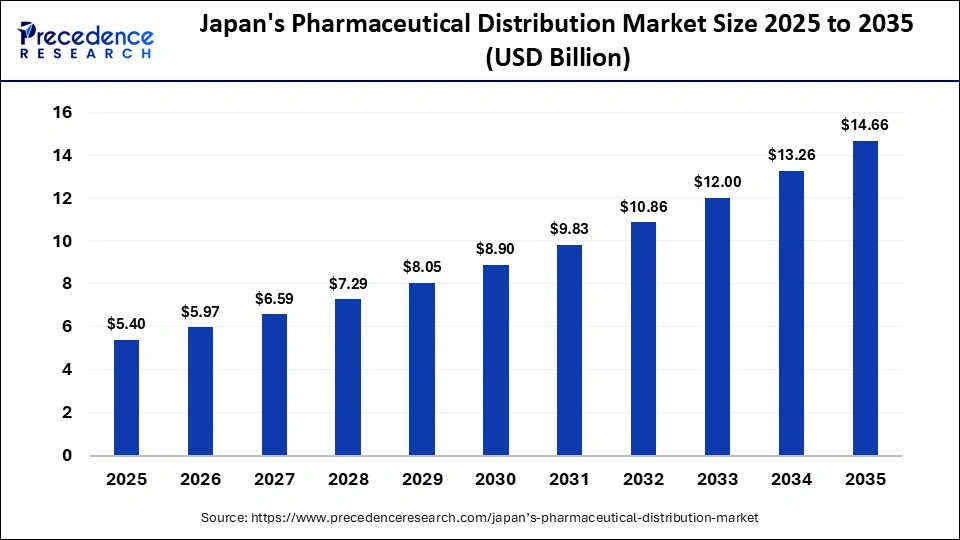
Key Takeaways
- By service type, the transportation & logistics segment dominated the market with a 28% share in 2025.
- By service type, the cold chain management segment is expected to grow at the fastest rate between 2026 and 2035.
- By distribution model, the full-line wholesaling segment dominated the market with a 34% share in 2025.
- By distribution model, the third-party logistics (3PL) segment is the second-largest shareholder and is expected to grow at the fastest rate between 2026 and 2035.
- By product type, the prescription drugs segment dominated the market with a 70% share in 2025.
- By product type, the over-the-counter (OTC) drugs segment is the second-largest shareholder and is expected to grow at a significant rate between 2026 and 2035.
- By end user, the hospitals segment dominated the market with a 45% share in 2025.
- By end user, the retail pharmacies segment is the second-largest shareholder and is expected to grow at a significant rate between 2026 and 2035.
Why is Japan’s Pharmaceutical Distribution Market Gaining Momentum?
Japan’s pharmaceutical distribution market is witnessing steady growth, driven by a rapidly aging population and increasing demand for prescription and specialty medications. As the proportion of elderly individuals rises, the need for consistent and reliable access to medicines continues to expand, placing greater emphasis on efficient distribution systems.
The country benefits from a well-established healthcare infrastructure and highly organized wholesale networks that ensure a stable and timely supply of pharmaceuticals across regions. In addition, advancements in cold chain logistics are supporting the safe transport of temperature-sensitive products such as biologics and vaccines.
The adoption of advanced logistics technologies, including automated systems and digital supply chain solutions, is further enhancing operational efficiency and delivery accuracy. Moreover, government initiatives aimed at improving drug safety, streamlining distribution processes, and promoting e-pharmacy services are playing a crucial role in accelerating market growth.
Impact of Artificial Intelligence on Japan’s Pharmaceutical Distribution Market
Artificial intelligence is transforming pharmaceutical distribution in Japan by improving supply chain efficiency and enabling data-driven decision-making. AI-powered systems analyze real-time data to optimize inventory management, demand forecasting, and route planning, helping to minimize drug shortages and reduce operational inefficiencies.
These intelligent solutions also enhance warehouse automation and logistics coordination, ensuring faster and more reliable delivery of medicines. Furthermore, AI-driven analytics support compliance with regulatory standards, strengthen quality control measures, and enable more personalized distribution strategies. As a result, AI is playing a key role in improving the overall resilience and performance of Japan’s pharmaceutical supply chain.
Major Market Trends
- Expansion of Cold Chain Logistics:
The growing distribution of biologics and vaccines is increasing the demand for advanced temperature-controlled logistics solutions. - Rising Impact of Aging Population:
Japan’s aging demographic is significantly driving demand for prescription drugs and healthcare services. - Supply Chain Digitalization:
Companies are adopting automated warehouses, real-time inventory tracking, and digital logistics platforms to enhance efficiency and transparency. - Growth of Specialty Pharmaceuticals:
The increasing use of specialty and personalized medicines is reshaping distribution requirements and infrastructure. - Direct-to-Pharmacy Distribution Models:
Pharmaceutical manufacturers are increasingly supplying products directly to pharmacies and hospitals, improving supply chain efficiency. - Consolidation Among Distributors:
Mergers and acquisitions among pharmaceutical wholesalers are strengthening distribution networks and improving market competitiveness. - Enhancement of Last-Mile Delivery:
Companies are focusing on improving last-mile delivery capabilities to ensure faster and more reliable medicine supply. - Impact of Government Pricing Regulations:
Strict drug pricing policies in Japan continue to influence distributor margins and operational strategies.
Makret Scope
| Report Coverage | Details |
| Market Size in 2025 | USD 5.40 Billion |
| Market Size in 2026 | USD 5.97 Billion |
| Market Size by 2035 | USD 14.66 Billion |
| Market Growth Rate from 2026 to 2035 | CAGR of 10.50% |
| Base Year | 2025 |
| Forecast Period | 2026 to 2035 |
| Segments Covered | Type, Converter Architecture, Sampling Rate, Application, and End User |
Market Dynamics
Drivers
The country’s rapidly aging population, rising demand for prescription drugs, and expanding distribution of specialty drugs and biologics, all of which call for effective temperature-controlled logistics systems, which are the main drivers of Japan’s pharmaceutical distribution market. A sophisticated healthcare infrastructure and a significant number of pharmaceutical wholesalers also drive market expansion.
Restraint
Strict government regulations, regulated drug prices under Japan’s national healthcare system, and high operating costs associated with cold chain storage and transportation all pose challenges to the market. Additionally, government reimbursement policies put pressure on prices, which lowers distributors’ profit margins.
Opportunity
Opportunities are presented by the expanding cold chain logistics infrastructure, rising use of digital supply chain and automated warehouse management systems, and rising demand for biologics and customized medications. New growth prospects are also being created by the growth of last-mile delivery services and direct-to-pharmacy distribution.
Japan’s Pharmaceutical Distribution Market Key Players
- AS ONE Corporation
- WIN-Partners Co., Ltd.
- Toho Holdings Co., Ltd.
- Vital KSK Holdings, Inc.
- Nippon Express Holdings
- Suzuken Co., Ltd.
- Alfresa Holdings Corporation
- Mediceo Corporation
- McKesson Corporation
- AmerisourceBergen Corporation
- Cardinal Health
- DHL Supply Chain
- Kuehne + Nagel
- UPS Healthcare
- DB Schenker
Recent Developments
- In February 2026, Mitsubishi Logistics, Takeda Pharmaceutical, and JR Freight announced the launch of Japan’s first 31-foot temperature-controlled rail containers for the sustainable, GDP-compliant nationwide distribution of prescription medicines. This joint initiative aims to enhance logistics efficiency while ensuring the secure transport of pharmaceutical products.
- In January 2026, Otsuka Pharmaceutical Co., Ltd. announced a basic agreement with Towa Pharmaceutical Co., Ltd. to establish a strategic collaborative framework for pharmaceutical manufacturing. The partnership aims to ensure a stable supply of long-listed products by transferring manufacturing and creating a mutual backup system. This initiative addresses the social issue of unstable medicine supply in Japan through cooperation between an originator and a generic manufacturer.
Segments Covered in the Report
By Service Type
- Transportation & Logistics
- Storage & Warehousing
- Inventory Management
- Cold Chain Management
- Order Fulfillment
- Value-added Services
By Distribution Model
- Full-line wholesaling
- Short-line Wholesaling
- Direct-to-Pharmacy
- Direct-to-Hospital
- Third-party Logistics (3PL)
By Product Type
- Prescription Drugs
- Over-the-Counter (OTC) Drugs
By End User
- Hospitals
- Retail Pharmacies
- Clinics
- Others (homecare, e-pharmacy)
Get Sample Link: https://www.precedenceresearch.com/sample/8284
Also Read Our Latest Report: https://www.businesswebwire.com/ocular-hypertension-market/