
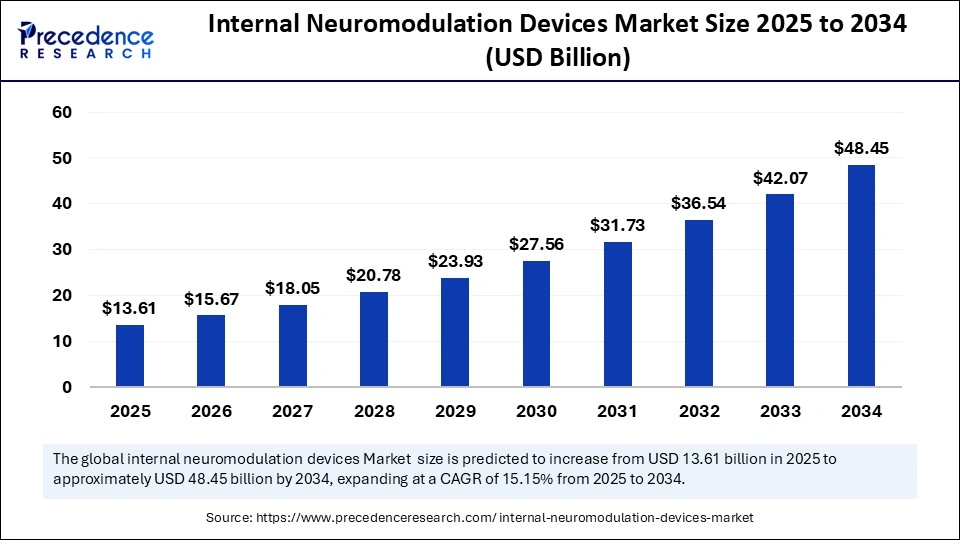
The global internal neuromodulation devices market, valued at USD 11.82 billion in 2024, is forecast to reach approximately USD 48.45 billion by 2034, expanding at a robust CAGR of 15.15% from 2025 to 2034. This dynamic growth is propelled by rising neurological and chronic pain disorders, cutting-edge technological innovations, and expanding applications in psychiatric and cognitive health domains.
Introduction: Neuromodulation’s Rising Role in Complex Disease Management
The internal neuromodulation devices market represents a critical frontier in modern medicine, offering transformative solutions for conditions where traditional therapies fall short. Increasing prevalence of Parkinson’s disease, epilepsy, spinal cord injuries, and chronic pain alongside the aging population drives demand.
Advances in miniaturization, biocompatible materials, and rechargeable technologies have significantly enhanced device safety, durability, and patient compliance. The integration of artificial intelligence is further accelerating the shift toward responsive, personalized therapies, reshaping neurological care paradigms.
Key Highlights
-
The market was valued at USD 11.82 billion in 2024 and is expected to expand to USD 48.45 billion by 2034.
-
North America currently dominates market share, with the Asia Pacific region exhibiting the fastest growth trajectory.
-
Key industry players include Medtronic, Abbott, Boston Scientific, and several emerging innovators.
-
Implantable pulse generators lead as the most adopted component, while spinal cord stimulators hold the largest device segment share.
-
Chronic pain management remains the largest application area, with psychiatric neuromodulation fastest expanding.
-
Electrical stimulation continues as the predominant technology, with closed-loop neuromodulation systems rapidly advancing.
AI’s Role in Revolutionizing Neuromodulation
Artificial intelligence is catalyzing a new era for internal neuromodulation devices by enabling real-time analysis of neural signals and dynamic adjustment of stimulation patterns. AI-driven closed-loop systems personalize therapy, significantly improving efficacy and reducing side effects.
Additionally, AI platforms expedite R&D by optimizing electrode design and simulation, shortening clinical trial cycles. Predictive analytics powered by AI enhance patient selection processes to optimize treatment outcomes while minimizing healthcare expenditures. As a result, neuromodulation devices are evolving from passive implants to intelligent, adaptive systems.
Market Growth Factors
The soaring burden of neurological disorders and chronic pain refractory to conventional treatments is the core growth engine for this market. Technological enhancements such as rechargeable batteries, wireless charging, and biocompatible materials boost device reliability and patient comfort. Increased awareness among clinicians and patients—paired with favorable reimbursement policies, especially in North America and Europe—accelerate adoption.
Additionally, a surge in clinical innovations and regulatory approvals broaden therapeutic indications, reinforced by integration with telemedicine and remote device management.
Market Scope
| Report Coverage | Details |
| Market Size in 2024 | USD 11.82 Billion |
| Market Size in 2025 | USD 13.61 Billion |
| Market Size by 2034 | USD 48.45 Billion |
| Market Growth Rate from 2025 to 2034 | CAGR of 15.15% |
| Dominating Region | North America |
| Fastest Growing Region | Asia Pacific |
| Base Year | 2024 |
| Forecast Period | 2025 to 2034 |
| Segments Covered | Device Type, Application / Therapy Area, Technology / Stimulation Mode, Component, Patient Demographics, End-User, Price / Product Tier, and Region |
| Regions Covered | North America, Europe, Asia-Pacific, Latin America, and Middle East & Africa |
What Trends and Opportunities Are Shaping the Market Landscape?
Why are spinal cord stimulators dominating this market?
Spinal cord stimulators are the cornerstone for chronic pain management worldwide due to their proven clinical efficacy and extensive validation across multiple indications. Their ability to provide targeted pain relief reduces reliance on opioids, generating strong payer and clinician support. Technological refinements continue to enhance user comfort and device longevity.
How is psychiatric neuromodulation emerging as a new frontier?
Expanding neuromodulation into psychiatric disorders such as major depressive disorder and PTSD represents an urgent unmet need. Adaptive closed-loop systems and AI integration differentiate these treatments, offering hope where pharmacotherapy often fails. Regulatory acceptance and growing clinical evidence herald expanding applications.
What are the growth prospects for implantable pulse generators?
Implantable pulse generators (IPGs) remain the indispensable core hardware of neuromodulation therapy, favored for programmability and longevity. Advances in wireless recharging and biocompatible casing assure their continued market dominance.
Which regions show the strongest growth potential?
North America leads due to a sophisticated healthcare ecosystem, high neurological disease prevalence, and intensive innovation by companies like Medtronic and Abbott. Meanwhile, Asia Pacific is the fastest-growing region, fueled by increasing healthcare investment, favorable demographics, and emerging local manufacturers.
Regional Analysis
North America holds the largest share of the internal neuromodulation devices market, driven by a highly developed healthcare infrastructure, strong reimbursement frameworks, and widespread awareness of neurological and chronic pain disorders.
The presence of major market leaders such as Medtronic, Abbott, and Boston Scientific further consolidates this region’s dominance. Additionally, ongoing technological innovations and favorable regulatory policies contribute to accelerated adoption rates in North America.
Europe follows as a significant market region with steady growth attributed to increasing prevalence of neurological disorders, government initiatives to enhance healthcare accessibility, and rising geriatric populations. Western Europe, in particular, benefits from established reimbursement policies and strong clinical research activities.
Asia Pacific is the fastest-growing region in the market, fueled by increasing investments in healthcare infrastructure, growing awareness of neuromodulation therapies, and expanding patient populations in countries like China, India, and Japan. Rapid urbanization, improving healthcare reimbursement systems, and the emergence of local manufacturers drive this dynamic growth, making Asia Pacific a vital area for future market expansion.
Other regions such as Latin America and the Middle East & Africa are gradually contributing to the market growth, with rising healthcare expenditure and increasing focus on neurological health maintenance.
Segmentation Analysis
Device Type:
-
Spinal Cord Stimulators lead the device segment due to their extensive application in chronic pain management and proven clinical efficacy.
-
Deep Brain Stimulators hold a significant share by addressing movement disorders like Parkinson’s disease.
-
Sacral Nerve Stimulators and Vagal Nerve Stimulators are gaining traction for urological and epilepsy indications, respectively.
Technology Type:
-
Electrical Stimulation remains the dominant technology, widely accepted for its effectiveness and safety.
-
Closed-Loop Neuromodulation Systems are emerging rapidly, leveraging AI to provide adaptive therapeutic stimulation.
-
Chemical Neuromodulation holds niche applications, but its adoption is limited compared to electrical methods.
Component Type:
-
Implantable Pulse Generators (IPGs) constitute the largest component segment, being essential for delivering programmable stimulation.
-
Electrodes also form a critical component, with innovations in electrode design enhancing therapeutic precision.
-
Software and Analytics Platforms are an emerging segment, driven by AI integration that enables real-time data analysis and therapy optimization.
Application Area:
-
Chronic Pain Management dominates the application segment, supported by the high prevalence of refractory pain conditions globally.
-
Movement Disorders such as Parkinson’s and essential tremor form another key application area.
-
Psychiatric Disorders and Epilepsy are growing applications due to advancements in neuromodulation technology and regulatory approvals.
End-User:
-
Hospitals constitute the largest end-user segment due to their ability to handle complex surgeries and postoperative care.
-
Specialty Clinics are expanding, driven by ambulatory care trends and outpatient procedures.
-
Homecare End-Users are a nascent but growing segment due to the development of patient-friendly devices and remote monitoring capabilities.
Internal Neuromodulation Devices Market Companies
- Medtronic plc
- Abbott Laboratories
- Boston Scientific Corporation
- Nevro Corp.
- LivaNova PLC
- Axonics, Inc.
- NeuroPace, Inc.
- Nuvectra Corporation
- Aleva Neurotherapeutics SA
- Synapse Biomedical Inc.
- NeuroSigma, Inc.
- Inspire Medical Systems, Inc.
- Saluda Medical Pty Limited
- Mainstay Medical International plc
- Biotronik SE & Co. KG
Challenges and Cost Pressures
Despite strong growth, challenges persist due to the invasive nature of implantation, surgical risks, high upfront device costs, and uneven global reimbursement policies. Limited clinical expertise and ethical concerns on neuropsychiatric applications constrain wider adoption. Additionally, emerging non-invasive therapies and data security concerns for AI-enabled implants pose competitive and regulatory hurdles.
Case Study: Improving Chronic Pain Outcomes Through Closed-Loop Neuromodulation
Recent clinical trials demonstrate that AI-powered closed-loop spinal cord stimulators significantly reduce patient pain scores while lowering battery consumption and hospitalization rates. This personalized approach enables dynamic modulation responsive to neural feedback, improving patient quality of life and reducing long-term treatment costs.
Read Also: Capsule Endoscopy Market
You can place an order or ask any questions. Please feel free to contact us at sales@precedenceresearch.com |+1 804 441 9344