
What is the Hydrodesulfurization Catalyst Market Size in 2026?
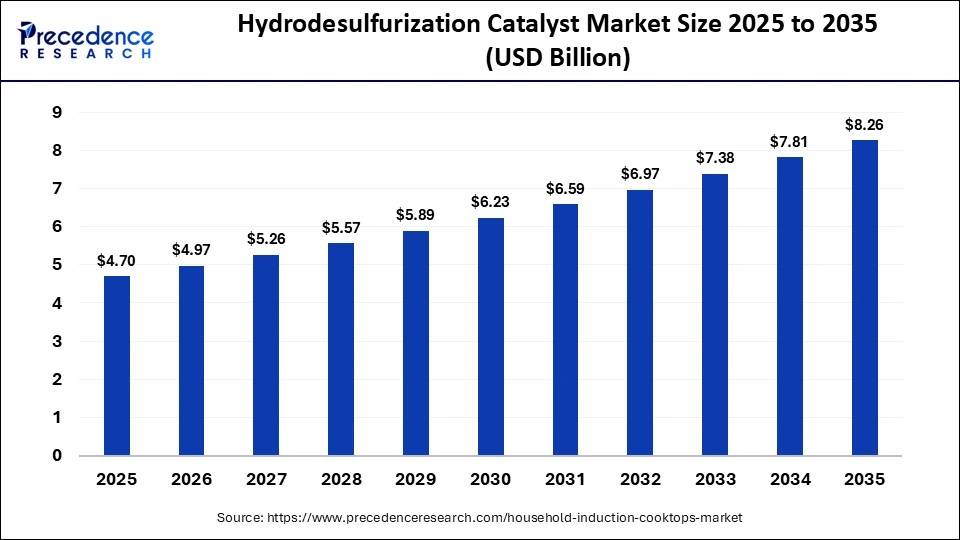
The global hydrodesulfurization catalyst market size accounted for USD 4.70 billion in 2025 and is predicted to increase from USD 4.97 billion in 2026 to approximately USD 8.26 billion by 2035, expanding at a CAGR of 5.80% from 2026 to 2035. The market is significantly growing due to the strict environmental protection regulations, technological advancements in refineries, and increasing demand for desulfurization of heavy crude oil across the globe.
Key Takeaways
- North America held the largest market share of 38% in 2025.
- Europe is the second-largest shareholder and is projected to grow at a significant rate during the forecast period.
- By catalyst type, the cobalt molybdenum segment dominated the market with a 38% share in 2025.
- By catalyst type, the nickel molybdenum segment is the second-largest shareholder and is expected to grow at a significant rate between 2026 and 2035.
- By application, the petroleum refining segment held the largest market share of 72% in 2025.
- By application, the chemical production segment is the second-largest shareholder and is expected to grow at a significant rate between 2026 and 2035.
- By end-user industry, the oil & gas segment held the largest market share of 65% in 2025.
- By end-user industry, the chemicals segment is the second-largest shareholder and is expected to grow at a significant rate between 2026 and 2035.
Market Overview
Hydrodesulfurization (HDS) catalysts are essential chemical agents used in petroleum refining to remove sulfur compounds from fuels such as gasoline, diesel, and jet fuel. The process involves reacting sulfur-containing molecules with hydrogen to produce hydrogen sulfide, thereby reducing harmful emissions.
The market for hydrodesulfurization catalysts is primarily driven by stringent environmental regulations imposed by authorities such as the Environmental Protection Agency (EPA), which mandate the production of ultra-low sulfur fuels to curb air pollution. In response, refineries are increasingly adopting advanced, high-activity catalysts that reduce hydrogen consumption while improving operational efficiency.
Leading industry players, including Haldor Topsoe, BASF, and Shell, are focusing on developing catalysts optimized for fixed-bed reactors used in large-scale refining operations. Overall, these catalysts play a critical role in helping the global oil and gas industry balance fuel production demands with environmental compliance.
Impact of Artificial Intelligence on the Hydrodesulfurization Catalyst Market
Artificial intelligence is transforming the hydrodesulfurization catalyst market by enabling smarter and more efficient refinery operations. AI-powered analytics and machine learning models allow real-time monitoring of catalyst performance, helping operators identify inefficiencies and predict catalyst degradation.
This predictive capability supports optimized catalyst replacement cycles, reduces unplanned downtime, and lowers operational costs. Furthermore, AI-driven research is accelerating the development of more durable and high-performance catalysts, contributing to improved process efficiency and long-term sustainability in refining operations.
Hydrodesulfurization Catalyst Market Trends
- Increasing Demand for Deep Desulfurization: There is a growing need for catalysts capable of removing complex and refractory sulfur compounds, such as 4,6-DMDBT, particularly in heavy crude processing.
- Advancements in Nanostructured Catalysts: The development of nanostructured and edge-enriched MoS₂ nanoflakes is enhancing catalytic activity by increasing surface area and the availability of active sites.
- Use of Advanced Organic Additives: Additives such as citric acid, EDTA, and gluconic acid are being widely used during catalyst preparation to improve metal dispersion and delay sulfidation, resulting in highly active catalyst structures.
- Shift Toward Catalyst Regeneration and Sustainability: Refineries are increasingly focusing on regenerating spent catalysts using advanced techniques, such as metal re-dispersion with organic acids, to reduce hazardous waste and improve overall sustainability.
Market Scope
| Report Coverage | Details |
| Market Size in 2025 | USD 4.70 Billion |
| Market Size in 2026 | USD 4.97 Billion |
| Market Size by 2035 | USD 8.26 Billion |
| Market Growth Rate from 2026 to 2035 | CAGR of 5.80% |
| Dominating Region | North America |
| Fastest Growing Region | Asia-Pacific |
| Base Year | 2025 |
| Forecast Period | 2026 to 2035 |
| Segments Covered | Catalyst Type, Application, End-User Industry, and Region |
| Regions Covered | North America, Europe, Asia-Pacific, Latin America, and Middle East & Africa |
Market Dynamics
Drivers
Increasing Demand for Petrochemicals and Bio-based Feedstocks
With the rapid expansion of refineries in leading regions like the Middle East & Africa and Asia Pacific, the need to process heavier and more challenging crude oil slates boosts the demand for hydrogenation catalysts. Also, the rapid transition toward renewable energy supports the increasing demand for bio-based fuels and the processing of vegetable oils. These processes demand specialized catalysts to handle impurities in bio-feedstocks.
Restraint
Price Volatility
Despite the strong demand and numerous benefits of hydrodesulfurization catalysts, the market faces challenges due to the volatility of raw metal prices, such as palladium, platinum, and others. This unpredictability creates procurement risks, working capital losses, and margin reductions. Additionally, catalyst deactivation caused by impurities like metal contaminants leads to costly operational downtime, further hindering market growth.
Opportunity
Digitalization and AI integration
The market presents significant growth opportunities, driven by the increasing integration of cutting-edge technologies like AI/ML and advanced analytics for real-time monitoring of catalyst performance. These technologies enable refineries to optimize catalyst lifespan and predict when replacements are needed. Additionally, ongoing research into high-performance catalysts based on non-precious metals offers a promising opportunity to reduce dependence on volatile metal prices.
Regional Insights
North America remains a key market, supported by stringent environmental regulations aimed at reducing sulfur emissions in transportation fuels. Regulatory frameworks such as ultra-low sulfur fuel mandates are driving refineries to continuously upgrade their hydrodesulfurization processes. The region’s well-established refining infrastructure and ongoing investments in modernization further contribute to steady demand for advanced catalysts. Additionally, growing focus on cleaner energy and fuel efficiency continues to support market expansion.
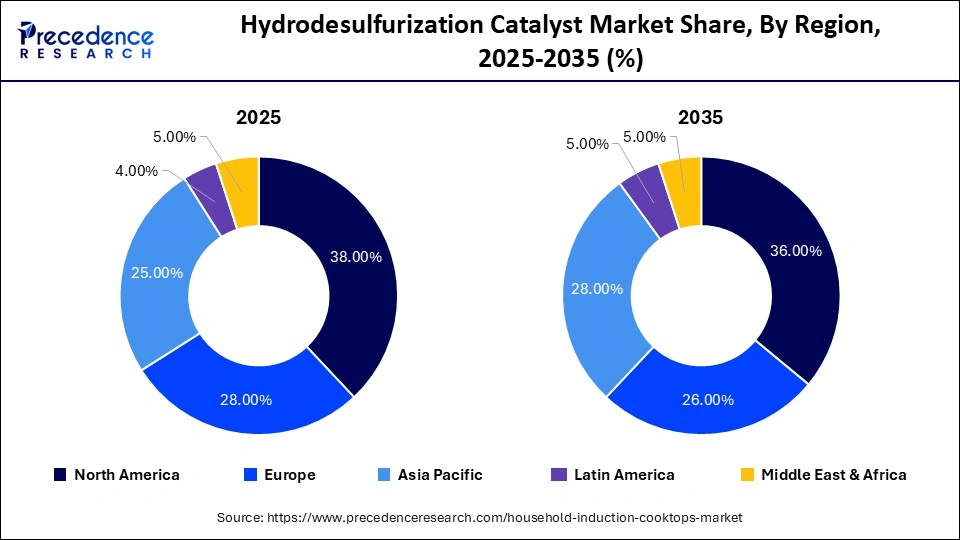
Europe is characterized by strong regulatory pressure and a high emphasis on sustainability and emission reduction. Strict fuel quality standards are compelling refineries to adopt efficient hydrodesulfurization technologies. The region is also witnessing a gradual transition toward cleaner energy systems, which encourages the use of advanced catalysts to meet environmental compliance. Continuous innovation and modernization of refining processes are key factors shaping the market in this region.
Asia-Pacific is emerging as a highly dynamic region, driven by rapid industrialization and increasing demand for refined petroleum products. Countries such as China and India are expanding their refining capacities to meet growing energy needs while complying with stricter emission standards. Government initiatives promoting cleaner fuels and advancements in refining technologies are accelerating the adoption of hydrodesulfurization catalysts. The strong growth of the automotive and transportation sectors further supports regional demand.
Latin America is witnessing gradual growth, supported by expanding refining activities and increasing focus on fuel quality improvements. Countries such as Brazil and Mexico are investing in refinery upgrades to meet international environmental standards. However, economic constraints and limited technological infrastructure may moderate the pace of adoption compared to more developed regions.
The Middle East & Africa region is experiencing steady growth due to its strong presence in oil production and refining. Governments are investing in advanced refining technologies to comply with global sulfur regulations and enhance fuel quality. The expansion of refining capacities and increasing focus on sustainable practices are expected to drive demand for hydrodesulfurization catalysts across the region.
Hydrodesulfurization Catalyst Market Companies
- Albemarle Corporation
- BASF SE
- Clariant AG
- Johnson Matthey PLC
- Chevron Phillips Chemical Company LLC
- Honeywell UOP
- ExxonMobil Chemical Company
- Haldor Topsoe A/S
- Shell Global Solutions International B.V.
- Sinopec Limited
- Standard Energy
- Saudi Aramco
- Grace Catalysts Technologies
- Nippon Ketjen Co.
- PetroChina Company Limited
Recent Developments
- In June 2025, Clariant announced that its ShiftMax 100 RE catalyst is powering INERATEC’s “ERA ONE” e-Fuels plant in Frankfurt Hoechst, Germany, which officially opened on June 3. The facility will recycle 8,000 tons of CO2 annually, converting it into up to 2,500 tons of synthetic fuels and waxes.
- In November 2025, SONATARCH and Chinese firm SINOPEC Guangzhou Engineering Co., LTD, signed a contract for the construction of a hydrotreating and reforming unit aiming to treat heavy Naphtha at the Arzew refinery to boost gasoline production capacity up to 1.2 million tons annually.
Segments Covered in the Report
By Catalyst Type
- Cobalt Molybdenum (CoMo)
- Nickel Molybdenum (NiMo)
- Platinum Group Metals (PGM)
- Others
By Application
- Petroleum Refining
- Diesel Desulfurization
- Gasoline Desulfurization
- Jet Fuel Desulfurization
- Chemical Production
- Production of Fine Chemicals
- Production of Specialty Products
- Others
- Environmental Control
By End-User Industry
- Oil & Gas
- Oil Refining
- Natural Gas Processing
- Chemicals
- Petrochemicals
- Specialty Chemicals
- Energy
- Power Plants
- Others
- Environmental Protection
By Region
- North America
- Latin America
- Europe
- Asia-pacific
- Middle and East Africa
Get Sample Link: https://www.precedenceresearch.com/sample/8285