
Hematopoietic Stem Cell Transplantation (HSCT) Market Companies
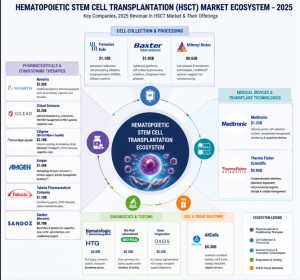
Pharmaceuticals & Conditioning Therapies
Novartis
In 2025, Novartis stands as a major player in the HSCT market with estimated revenue contributions around $2.35 billion from HSCT-related therapies. The company is renowned for its CAR‑T therapy, Kymriah, which is utilized in treating certain blood cancers. Beyond CAR‑T, Novartis provides conditioning regimens, immunosuppressants like tacrolimus, and a suite of supportive care therapies that are crucial for pre- and post-transplant management. Its role in the ecosystem is pivotal, bridging cutting-edge cell therapies with patient care pathways.
Gilead Sciences
Gilead Sciences, generating roughly $2.2 billion from its HSCT-relevant products, has cemented its influence through its Kite division. The company offers CAR‑T therapies such as Yescarta and Tecartus, targeting relapsed or refractory hematologic cancers. Complementing these are antiviral supportive therapies like Letermovir, vital for HSCT patients’ immune protection. Gilead’s portfolio reinforces the transplant ecosystem by providing both curative and protective interventions.
Celgene (Bristol Myers Squibb)
Now integrated with Bristol Myers Squibb, Celgene contributes approximately $2.1 billion in HSCT supportive care. Its offerings include immuno-oncology drugs such as Revlimid® and Pomalyst®, as well as therapies to prevent graft-versus-host disease (GVHD). By delivering essential conditioning and post-transplant pharmaceuticals, Celgene enhances transplant success rates and patient outcomes.
Amgen
Amgen, with estimated HSCT-related revenues of $1.45 billion, specializes in hematology biologics that support stem cell mobilization and post-transplant recovery. Products like Neulasta® and Aranesp® help manage neutropenia and anemia, critical for patient immune reconstitution. Amgen’s offerings strengthen the transplant ecosystem by ensuring patients have the biological support needed for successful engraftment.
Takeda Pharmaceutical Company
Takeda contributes around $1.1 billion with a portfolio that includes conditioning agents, GVHD therapies, and plasma-derived supportive care. These therapies are essential for preparing patients for transplantation and managing post-transplant complications. Takeda’s role ensures continuity of care, making them a core pharmaceutical partner in the HSCT landscape.
Sandoz (Novartis)
Sandoz, Novartis’s generics and biosimilars division, adds roughly $0.7 billion in HSCT support. Its biosimilars and generics, including G-CSF and anti-infectives, offer cost-effective alternatives for conditioning and supportive care. By making essential therapies more accessible, Sandoz strengthens the HSCT infrastructure globally.
Cell Collection & Processing
Fresenius Kabi
Fresenius Kabi, generating approximately $1.1 billion, focuses on cell collection and processing. Their technologies include apheresis platforms, cryopreservation systems, and infusion solutions. These capabilities ensure high-quality stem cell preparation and safe delivery, forming the operational backbone of many transplant centers.
Baxter International
With estimated revenues of $1.05 billion, Baxter International provides cell culture and processing solutions, cryopreservation products, and apheresis systems. Their offerings facilitate the collection, storage, and preparation of stem cells, enabling transplant programs to operate efficiently and safely.
Miltenyi Biotec
Miltenyi Biotec, a specialized biotech with an estimated $0.65 billion in HSCT-related sales, focuses on cell isolation and enrichment through systems like CliniMACS®. Their products ensure precise graft preparation and contribute directly to the quality and safety of stem cell transplants.
AllCells
AllCells, a smaller player generating around $0.3 billion, provides donor-matched stem cells and tissue storage services. They operate cord blood banks and offer transplant support services, ensuring that high-quality cellular material is available for HSCT procedures and research.
Medical Devices & Transplant Technologies
Thermo Fisher Scientific
Thermo Fisher Scientific, with roughly $0.9 billion, offers lab equipment, cryopreservation solutions, and reagents critical for cell therapy manufacturing. Their platforms support both research and clinical HSCT applications, bridging laboratory innovation with patient care.
Medtronic
Medtronic contributes around $1.25 billion through medical devices including infusion pumps, cell collection systems, and patient monitoring technologies. Their equipment underpins the procedural and monitoring aspects of transplantation, safeguarding patient outcomes.
Diagnostics & Testing
Hematologic Technologies
Hematologic Technologies, generating about $0.4 billion, provides diagnostics for HLA typing, chimerism analysis, and transplant monitoring assays. Their products ensure accurate compatibility testing and post-transplant patient monitoring, vital for reducing complications.
Bio-Rad Laboratories
Bio-Rad Laboratories, with estimated HSCT-related revenues of $0.35 billion, offers flow cytometry, HLA typing, and quality control solutions. Their diagnostic tools are central to laboratory operations supporting stem cell transplant programs.
Oasis Diagnostics
Oasis Diagnostics, a smaller diagnostics provider (~$0.25 billion), delivers high-resolution HLA typing and transplant support kits. Their solutions help clinicians screen patients and monitor post-transplant progress, ensuring safety and effectiveness.
Source: https://www.precedenceresearch.com/

- ESG Software Market 2025: Comprehensive Company Ecosystem and Revenue Overview - May 20, 2026
- ESG Software Market Surges Toward USD 31.96 Billion by 2035 as AI-Powered Compliance and Sustainability Reporting Transform Global Enterprises - May 20, 2026
- Hematopoietic Stem Cell Transplantation Market Surges Toward USD 24.32 Billion by 2035 as Precision Medicine and AI Reshape Blood Cancer Treatment - May 20, 2026