
Colombia’s “Seed Guardians” and the Resistance to GM Crops
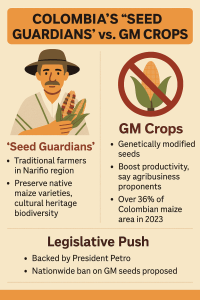
Colombia, a biodiversity-rich nation and one of the cradles of maize cultivation, is at the center of a heated debate over genetically modified (GM) crops. While agribusiness companies push for GM adoption to increase yields and efficiency, local farming communities, particularly in the Nariño region have emerged as defenders of native maize varieties, calling themselves “Seed Guardians.”
This conflict represents more than an agricultural debate; it is a struggle between industrialized food systems and traditional, cultural farming practices.
The Role of Seed Guardians
-
Identity & Heritage: For Indigenous and smallholder farmers, maize is not just food—it is tied to cultural identity, rituals, and heritage.
-
Seed Sovereignty: Seed Guardians preserve and exchange native maize seeds, ensuring biodiversity and resilience against pests, diseases, and climate stress.
-
Opposition to GM Seeds: They view GM seeds as a threat to biodiversity, since cross-pollination could contaminate native varieties. They also fear dependency on multinational seed corporations.
Political & Legal Context
-
In 2023, GM maize already covered 36% of Colombia’s total planted maize area—a 20% rise compared to 2022.
-
The expansion of GM crops triggered policy debates. President Gustavo Petro’s government, influenced by environmental groups and farmer unions, has moved toward a nationwide ban on GM seeds.
-
The push is also linked to Colombia’s environmental policies, which emphasize food sovereignty, biodiversity conservation, and reduced dependency on global agribusiness.
Tensions Between Agribusiness and Tradition
-
Agribusiness Perspective:
-
GM maize can boost productivity, resist pests, and reduce pesticide use.
-
Large-scale producers argue GM adoption is critical for food security and competitiveness.
-
-
Seed Guardians’ Perspective:
-
GM seeds erode indigenous farming knowledge and cultural practices tied to maize.
-
They believe industrial seeds prioritize profit over ecological balance and food sovereignty.
-
Economic & Social Implications
-
For Farmers:
-
Farmers using GM seeds face recurring costs of buying patented seeds each season, unlike saving traditional seeds.
-
Traditional farmers rely on community-based seed exchanges, which are cost-effective and resilient.
-
-
For Consumers:
-
Colombia’s maize is a key ingredient in staples like arepas, tamales, and empanadas. The type of maize cultivated influences not only yield but flavor, nutrition, and cultural authenticity.
-
-
For the Market:
-
A GM ban could shift production toward sustainable, organic, and heirloom maize markets, aligning with global consumer trends for non-GMO and culturally significant foods.
-
Environmental Dimensions
-
Biodiversity Threats: Colombia is home to hundreds of native maize varieties, many at risk of extinction if GM strains dominate.
-
Climate Resilience: Native seeds often withstand local climate variations better than standardized GM seeds.
-
Ecological Risks: Cross-pollination could create unintended ecological effects, undermining conservation efforts.
Future Outlook
-
Policy Direction: If Petro’s government finalizes a GM seed ban, Colombia could become a model for food sovereignty in Latin America, aligning with movements in Mexico and Peru that protect native maize.
-
Agricultural Innovation: Instead of GM crops, Colombia may invest in agroecology, crop rotation, and climate-smart farming practices.
-
Market Evolution: Global demand for non-GMO, organic, and indigenous grains may provide new export opportunities for Colombia’s native maize.
Key Takeaways
-
Seed Guardians represent a cultural and ecological resistance movement, safeguarding maize biodiversity.
-
GM adoption is rising (36% coverage in 2023), but so is political resistance, with President Petro backing a GM seed ban.
-
The debate reflects two agricultural futures: industrialized GM-based production vs. sustainable, biodiversity-based farming.
-
The outcome could reshape Colombia’s agricultural market, influencing food sovereignty, farmer livelihoods, and global trade dynamics.