
Rising Energy Demand and Clean Power Transition to Propel Market at Strong CAGR Through 2034
The global gas turbine market is witnessing accelerated momentum as the world pivots toward cleaner and more efficient power generation technologies. Driven by increasing electricity demand, rapid industrialization, and the transition away from coal-based systems, the market is projected to grow at a notable CAGR over the forecast period. Gas turbines, known for their flexibility, reliability, and lower emissions compared to traditional fossil fuel systems, are becoming a cornerstone in modern energy infrastructure.
What Are the Key Highlights Shaping the Gas Turbine Market?
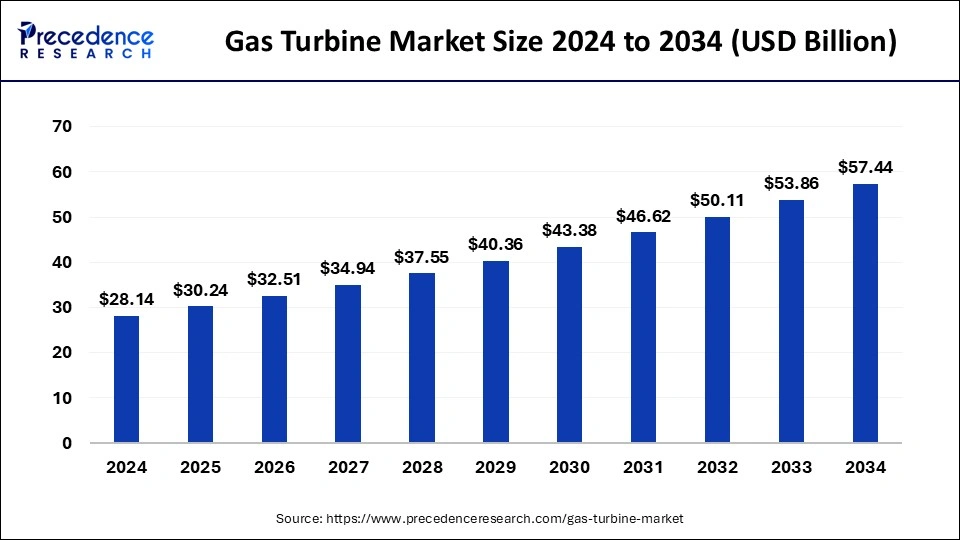
The global gas turbine market was valued at approximately USD 20+ billion in 2024 and is expected to surpass USD 30+ billion by 2034, expanding at a steady CAGR of around 4–5%. North America currently dominates the global market due to advanced infrastructure and high adoption of combined cycle power plants. Asia Pacific is emerging as the fastest-growing region, fueled by expanding energy demand in countries like China and India. Among leading players, companies such as General Electric Company, Siemens Energy AG, and Mitsubishi Heavy Industries Ltd. hold a significant market share due to continuous innovation and global presence.
How Is Artificial Intelligence Transforming the Gas Turbine Market?
Artificial Intelligence (AI) is playing a transformative role in optimizing gas turbine performance and lifecycle management. AI-driven predictive maintenance systems enable real-time monitoring of turbine components, reducing downtime and improving operational efficiency. By analyzing large volumes of sensor data, AI helps detect early signs of wear and potential failures, significantly lowering maintenance costs.
Moreover, AI is enhancing fuel efficiency and emissions control by optimizing combustion processes. Advanced machine learning algorithms allow operators to adjust turbine parameters dynamically, ensuring optimal output while minimizing environmental impact. This technological integration is becoming a key differentiator for manufacturers aiming to deliver next-generation turbine solutions.
What Factors Are Driving the Growth of the Gas Turbine Market?
The market growth is primarily driven by the increasing demand for reliable and efficient power generation systems. Gas turbines offer faster startup times and greater flexibility compared to coal and nuclear plants, making them ideal for balancing renewable energy sources such as wind and solar.
Additionally, the global push toward decarbonization is encouraging the adoption of natural gas and hydrogen-based turbines. Governments across regions are investing heavily in cleaner energy infrastructure, further boosting market expansion. The growing use of gas turbines in aviation and industrial applications also contributes significantly to demand.
Gas Turbine Market Scope
| Report Highlights | Details |
| Market Size in 2025 | USD 30.24Billion |
| Market Size in 2026 | USD 32.51 Billion |
| Market Size by 2035 | USD 61.13Billion |
| Growth Rate from 2026 to 2035 | CAGR of 7.29% |
| Largest Market | North America |
| Fastest Growing Market | Asia Pacific |
| Base Year | 2025 |
| Forecast Period | 2026 to 2035 |
| Segments Covered | Product, Application, Technology, Capacity, Region |
| Regions Covered | North America, Europe, Asia-Pacific, Latin America, and Middle East & Africa |
What Opportunities and Trends Are Emerging in the Market?
Is Hydrogen Fuel the Future of Gas Turbines?
Yes, hydrogen-compatible gas turbines are emerging as a major trend. Manufacturers are developing turbines capable of running on hydrogen or hydrogen-natural gas blends, significantly reducing carbon emissions. This shift aligns with global net-zero targets and opens new growth avenues.
Are Combined Cycle Power Plants Gaining Popularity?
Absolutely. Combined cycle power plants, which integrate gas and steam turbines, are gaining traction due to their high efficiency and lower emissions. These systems maximize energy output and are increasingly being adopted in both developed and developing economies.
Is Distributed Energy Generation Driving Demand?
Yes, decentralized energy systems are boosting demand for smaller and more flexible gas turbines. These systems are ideal for remote areas and industrial facilities, offering reliable power with lower transmission losses.
Gas Turbine Market Insights
Capacity Insights
Within the gas turbine market, the 50 kW – 500 kW segment is expected to see strong growth, with annual installations projected to exceed 2 GW by 2034. This growth is largely driven by ongoing advancements in combustor technology, improved durability, and wider operating ranges. Additionally, the development of more efficient regenerative systems that can handle high heat requirements is further supporting adoption.
Another key factor boosting demand is the rising preference for combined cycle power plants, which offer higher efficiency, reliability, and better overall performance.
Application Insights
In upstream oil operations, especially in remote locations, generating power using locally available fuels is critical. Gas turbines provide a cost-effective and efficient solution for such scenarios.
The power generation sector is expected to witness significant growth over the forecast period, driven by increasing energy demand and the need for reliable electricity supply.
Technology Insights
As of 2024, combined cycle gas turbine (CCGT) technology accounted for over 74% of total market revenue, making it the dominant segment. This technology is expected to continue growing steadily in the coming years.
CCGT systems are highly efficient, requiring less fuel to generate the desired output while also reducing transmission and distribution losses, making them an attractive option for large-scale power generation.
Regional Insights
Asia Pacific
The Asia Pacific gas turbine market was valued at USD 10.41 billion in 2025 and is projected to reach USD 22.62 billion by 2035, growing at a CAGR of 7.29%.
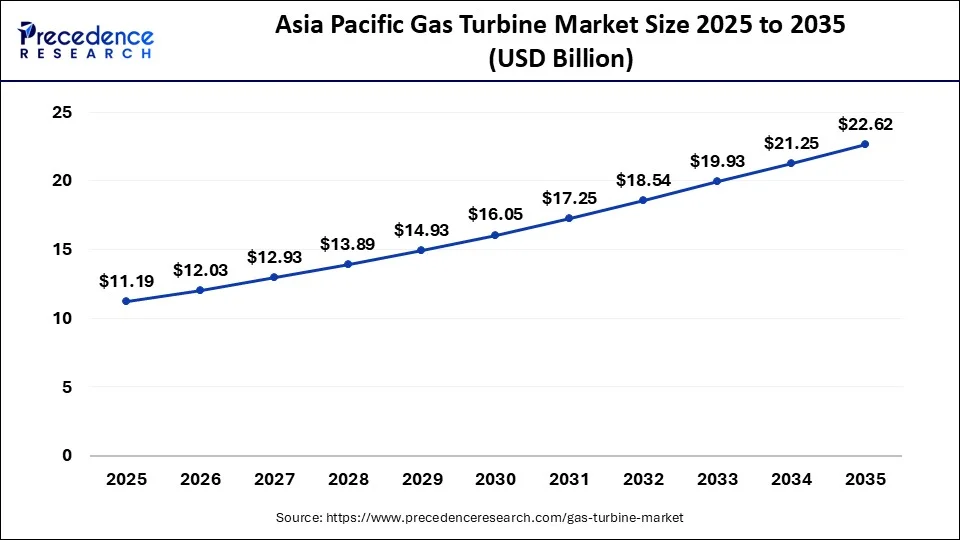
By 2035, annual installations in the region are expected to exceed 10 GW. Growth is driven by:
Easy access to raw materials
Rapid adoption of advanced turbine technologies
Increasing focus on combined cycle power plants
Countries like China, India, and Japan are key contributors:
China leads the region with a 38.1% market share, driven by a shift from coal to cleaner natural gas.
Japan is expanding gas-based power to reduce reliance on nuclear energy.
India is seeing moderate growth, with rising interest in LNG and hydrogen-compatible turbines.
Middle East & Africa (MEA)
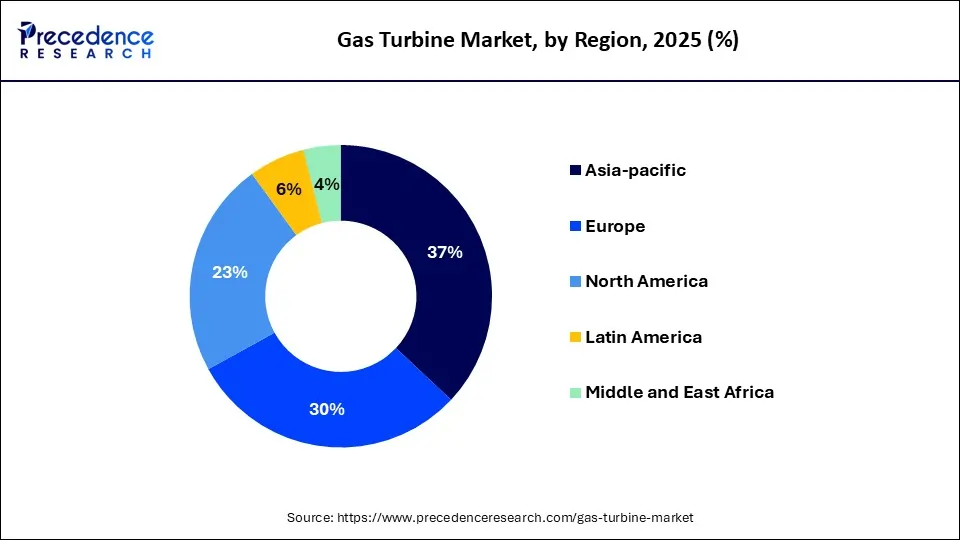
The MEA region is emerging as a significant market due to increased adoption of large-scale, high-efficiency gas turbines. These systems are widely used in power generation and marine applications.
Saudi Arabia leads the region, focusing on integrating gas turbines with renewable energy and developing hybrid energy systems to reduce emissions.
Europe
Europe continues to experience steady growth in the gas turbine market, supported by:
Demand for efficient power generation
Improvements in grid systems
Policies aimed at reducing coal usage
Germany dominates the region, driven by efforts to modernize its energy sector and reduce emissions. The adoption of digital technologies and AI is also enhancing operational efficiency.
North America
The United States accounts for over 80% of the regional market, heavily relying on gas turbines for electricity generation and energy security.
Canada is transitioning from coal to cleaner gas-based power solutions due to environmental policies.
Latin America
Latin America presents strong growth opportunities due to rising electricity demand and industrial expansion. Gas turbines are increasingly used to complement renewable energy sources.
Brazil leads the region with strong natural gas availability and large-scale power generation capacity.
Mexico follows closely, supported by natural gas trade and combined cycle plant installations.
Market Drivers and Challenges
The market is driven by:
Increasing demand for electricity
Stricter environmental regulations encouraging cleaner energy
Growth in natural gas production (including shale gas)
Transition away from coal-based power generation
However, the rapid expansion of renewable energy sources may pose a challenge to gas turbine demand in the long term.
Market Size and Competition
Global gas turbine sales reached around 469 units in 2025
Expected CAGR: 3.6% (2026–2035)
Key Players and Market Share
GE Vernova – 28.1%
Siemens Energy – 24.1%
Mitsubishi Heavy Industries – 18.4%
Baker Hughes – 9.6%
Ansaldo Energia – 7.3%
Solar Turbines (Caterpillar) – 6.0%
Rolls-Royce & others – 6.5%
Company Strategies and Trends
Heavy-Duty Gas Turbine Manufacturers
GE Vernova is expanding manufacturing capacity to meet strong order backlogs while maintaining margins.
Siemens Energy is focusing on executing large-scale projects with selective investments in supply chains.
Mitsubishi Power is investing in advanced and hydrogen-capable turbines, emphasizing technology innovation.
Medium & Aero-Derivative Manufacturers
Solar Turbines (Caterpillar) is expanding service offerings and targeting fast-growing sectors like industrial applications and data centers.
Rolls-Royce (MTU) is investing in new engine platforms and partnerships to support distributed power and backup energy demand.
Asian OEMs
Companies like Kawasaki Heavy Industries are focusing on regional demand and developing hydrogen-compatible turbines, especially in Asia-Pacific markets.
Gas Turbine Market Companies
- Wartsila
- BHEL
- Mitsubishi Hitachi Power Systems
- Harbin Electric International Company
- Siemens AG
- Man Diesel & Turbo
- General Electric
- NPO Saturn
- Kawasaki Heavy Industries
- Solar Turbines
- Capstone Turbine
- Vericor Power Systems
- Cryosta
- AnsaldoEnergia
- Opra Turbines
- Zorya-Mashproekt
Segments Covered in the Report
By Capacity Type
- > 500 kW to 1 MW
- > 1 MW to 30 MW
- < 50 kW
- 50 kW to 500 kW
- > 70 MW to 200 MW
- >30 MW to 70 MW
- > 200 MW
By Product Type
- Heavy Duty
- Aero-Derivative
By Technology Type
- Combined Cycle
- Open Cycle
By Application Type
- Process Plants
- Power Plants
- Oil & Gas
- Aviation
- Marine
- Others
By Region
- North America
- Latin America
- Europe
- Asia-pacific
- Middle and East Africa
Get Sample Link: https://www.precedenceresearch.com/sample/7246
Also Read :https://www.businesswebwire.com/gaas-wafer-market/