
What is GaAs Wafer Market Size in 2026?
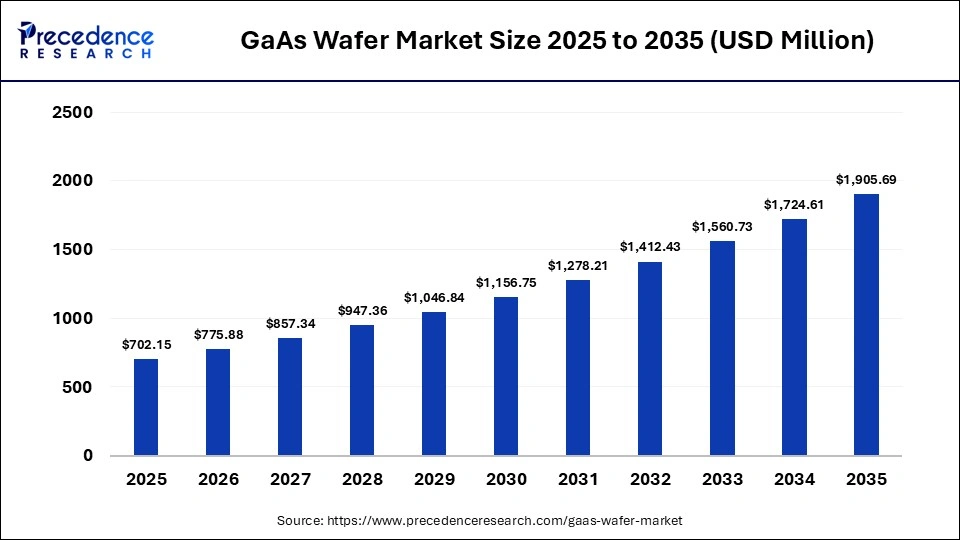
The global GaAs wafer market size was calculated at USD 702.15 million in 2025 and is predicted to increase from USD 775.88 million in 2026 to approximately USD 1,905.69 million by 2035, expanding at a CAGR of 10.50% from 2026 to 2035. This market is growing due to increasing demand for high-frequency and high-speed electronic devices in the telecommunications and aerospace industries.
Key Takeaways
- Asia Pacific dominated the global GaAs wafer market with a 54.80% share in 2025.
- North America is expected to grow at the fastest CAGR between 2026 and 2035.
- By wafer diameter, the 6-inch GaAs wafers segment held the biggest market share of 38.40% in 2025.
- By wafer diameter, the 8-inch GaAs wafers segment is expected to expand at the fastest CAGR of 13.80% between 2026 and 2035.
- By wafer type, the semi-insulating GaAs wafers segment contributed to the highest market share of 57.80% in 2025.
- By wafer type, the N-type GaAs wafers segment is expected to grow at a strong CAGR of 6.50% between 2026 and 2035.
- By application, the RF and microwave devices segment held a major market share of 36.70% in 2025.
- By application, the power electronics segment is expected to expand at a significant CAGR of 7.40% from 2026 to 2035.
- By end use industry, the telecommunications segment held the biggest market share of 34.60% in 2025.
- By end use industry, the automotive electronics segment is expected to expand at the fastest CAGR of 9.10% between 2026 and 2035.
Market Overview
The gallium arsenide (GaAs) wafer market comprises the manufacturing and supply of semiconductor wafers used as substrates for high-performance electronic and optoelectronic devices. GaAs wafers are widely utilized in radio frequency (RF) components, microwave integrated circuits, laser diodes, light-emitting diodes (LEDs), and high-efficiency solar cells. Their direct bandgap structure and superior electron mobility allow devices built on GaAs to operate at higher frequencies and with greater efficiency than many conventional semiconductor materials.
Market growth is being fueled by the increasing demand for high-frequency and high-speed communication technologies. Compared with traditional silicon semiconductors, GaAs offers improved signal performance, higher efficiency, and better thermal stability, making it highly suitable for applications such as mobile devices, satellite communications, RF modules, and advanced optoelectronics. The rapid expansion of 5G infrastructure, high-speed communication networks, and advanced consumer electronics is significantly increasing the demand for GaAs-based components. In addition, rising investments in aerospace, defense electronics, and optoelectronic technologies are expected to further accelerate market growth in the coming years.
Future Market Outlook
- Expansion of 5G Infrastructure: The continued global deployment of 5G networks is expected to create significant opportunities for GaAs-based RF amplifiers and communication components.
- Growth in Electric Vehicles and Automotive Electronics: The integration of advanced sensing, communication, and connectivity systems in modern vehicles is likely to generate new demand for high-performance GaAs devices.
- Rising Demand for High-Performance Computing: Growth in cloud computing, data centers, and artificial intelligence technologies is increasing the need for high-speed communication components, creating opportunities for GaAs-based solutions.
- Increasing Use in Space and Satellite Technologies: The growing number of satellite launches and expanding space exploration programs are driving demand for GaAs-based solar cells and communication devices due to their high efficiency and reliability.
How the Rise of AI is Supporting the GaAs Wafer Market
The growing adoption of artificial intelligence (AI) is playing an important role in accelerating the GaAs wafer market. AI-driven applications require high-speed data processing, advanced communication networks, and efficient signal transmission, all of which rely on high-performance semiconductor components. GaAs-based devices provide the fast signal processing and efficiency needed to support AI-powered data centers, advanced computing systems, and smart communication infrastructure.
In addition, AI technologies are increasingly being used in semiconductor manufacturing processes to optimize wafer production, improve material quality, and enhance device performance. By enabling more efficient fabrication processes and higher production yields, AI is helping manufacturers scale the production of GaAs wafers while maintaining high performance standards. This combination of AI-driven demand and AI-enabled manufacturing is expected to support continued innovation and growth in the GaAs wafer market.
Market Scope
| Report Coverage | Details |
| Market Size in 2025 | USD 702.15 Million |
| Market Size in 2026 | USD 775.88 Million |
| Market Size by 2035 | USD 1905.69 Million |
| Market Growth Rate from 2026 to 2035 | CAGR of 10.50% |
| Dominating Region | Asia Pacific |
| Fastest Growing Region | North America |
| Base Year | 2025 |
| Forecast Period | 2026 to 2035 |
| Segments Covered | Wafer Diameter,Wafer Type,Application,End Use Industry, and region |
| Regions Covered | North America, Europe, Asia-Pacific, Latin America, and Middle East & Africa |
Regional Insights
Asia Pacific dominates the global GaAs wafer market, accounting for over 50–60% of global production and demand, driven by strong semiconductor manufacturing ecosystems in countries such as China, Japan, South Korea, and Taiwan.
The region benefits from a well-established electronics supply chain and large-scale production of smartphones, RF modules, LEDs, and optoelectronic devices. China represents a major demand hub due to rapid growth in consumer electronics and government-backed semiconductor investments. South Korea and Taiwan are also key contributors, supported by advanced semiconductor foundries and innovation in 5G infrastructure and AI-enabled devices.
Additionally, increasing investments in smart cities, telecommunications infrastructure, and advanced semiconductor fabrication are strengthening the region’s position as the global hub for GaAs wafer manufacturing and consumption.
North America represents the second-largest market for GaAs wafers, supported by strong technological innovation and demand from aerospace, defense, and telecommunications industries.
The United States plays a leading role due to its advanced semiconductor R&D capabilities and the presence of major technology companies and research institutions. GaAs wafers are widely used in radar systems, satellite communication technologies, RF components, and photonic devices across the region.
Government initiatives aimed at strengthening domestic semiconductor manufacturing, along with increasing investments in 5G infrastructure, AI technologies, and defense electronics, are expected to further drive market growth in North America.
Europe holds a significant share of the GaAs wafer market, supported by strong demand from the automotive, telecommunications, and industrial electronics sectors.
Countries such as Germany, France, and the United Kingdom are key contributors, with growing adoption of GaAs-based technologies in applications such as advanced driver-assistance systems (ADAS), LiDAR sensors, radar systems, and optical communication networks.
Additionally, European investments in clean energy technologies, advanced photonics, and semiconductor innovation programs are contributing to the increasing adoption of GaAs wafers across industrial and research applications.
The GaAs wafer market in Latin America is still developing but shows promising growth potential. Rising investments in telecommunications infrastructure, consumer electronics adoption, and digital connectivity are gradually increasing demand for RF components and optoelectronic devices.
Countries such as Brazil and Mexico are witnessing growth in telecommunications networks and electronics manufacturing, which may create future opportunities for GaAs wafer applications in wireless communication and data transmission technologies.
The Middle East & Africa region currently represents a smaller share of the GaAs wafer market, but demand is increasing due to expanding telecom infrastructure and defense technology investments.
Countries such as Saudi Arabia, the United Arab Emirates, and South Africa are investing in smart city initiatives, satellite communications, and advanced radar systems. These developments are gradually increasing the adoption of GaAs-based RF and photonic components in the region.
Value Chain Analysis of GaAs Wafers
- Raw Materials Procurement: Gallium and arsenic are the primary raw materials used for manufacturing GaAs wafers, sourced from mining and chemical processing industries. High-purity material supply is essential to ensure wafer quality and performance in semiconductor applications.
Key Players: Umicore, American Elements, 5N Plus - Distribution to OEMs and Integrators: Manufactured GaAs wafers are supplied to semiconductor device manufacturers and integrated circuit producers for RF, optoelectronic, and communication applications. Distribution networks support timely delivery to telecom, aerospace, and electronics OEMs.
Key Players: IQE plc, Sumitomo Electric Industries, AXT Inc. - Lifecycle Support and Recycling: Post-production services include wafer reclaiming, recycling, and material recovery to reduce manufacturing waste and costs. Recycling processes help recover gallium and other materials, supporting sustainability in semiconductor manufacturing.
Key Players: Pure Wafer, RS Technologies, Nihon Superior Co., Ltd.
Top Companies Operating in the Market
- Sumitomo Electric Industries
- Freiberger Compound Materials
- AXT Inc.
- Xiamen Powerway Advanced Material (PAM-XIAMEN)
- DOWA Electronics Materials
- Vital Materials
- Yunnan Germanium
- Skyworks Solutions
- Qorvo
- Broadcom
- MACOM Technology Solutions
- Analog Devices
- Murata Manufacturing
- Mitsubishi Electric
- Renesas Electronics
Recent Developments
- In January 2025, MACOM Technology Solutions announced plans to expand and modernize its semiconductor manufacturing facility to increase production of gallium arsenide (GaAs) and gallium nitride (GaN) devices. The initiative aims to strengthen the semiconductor supply chain and boost the production capacity of advanced RF and communication components used in telecom and aerospace applications.
- In October 2025,Skyworks and Qorvo announced a definitive agreement to combine in a $22 billion deal to form a U.S.-based leader in radio frequency and semiconductor technology. The merger, which aims to leverage combined capabilities in high-performance analog and mixed-signal solutions, is expected to close in early 2027.
- In June 2025,Scientists at the Fraunhofer Institute for Solar Energy Systems ISE, in collaboration with III/V-Reclaim, have produced high-quality InP-on-GaAs wafers up to 150 mm in diameter. These wafers provide a cost-effective alternative to traditional InP, offering a scalable solution for various applications. After a special surface treatment, the epi-ready wafers allow direct growth of III-V epitaxial structures for high-performance InP-based semiconductor devices.
Segments Covered in the Report
By Wafer Diameter
- 2-inch GaAs wafers
- 3-inch GaAs wafers
- 4-inch GaAs wafers
- 6-inch GaAs wafers
- 8-inch GaAs wafers
By Wafer Type
- Semi-insulating GaAs wafers
- N-type GaAs wafers
- P-type GaAs wafers
By Application
- RF and microwave devices
- Optoelectronics devices
- Photovoltaic cells
- Power electronics
- Integrated circuits and MMICs
By End Use Industry
- Telecommunications
- Consumer electronics
- Automotive electronics
- Aerospace and defense
- Industrial electronics
By Region
- North America
- Latin America
- Europe
- Asia-pacific
- Middle and East Africa
Get Sample Link: https://www.precedenceresearch.com/sample/8131
Also Read : https://www.businesswebwire.com/analog-semiconductor-market-companies/