
What is the Firefighting Aircraft Market Size in 2026?
The global firefighting aircraft market size accounted for USD 4.80 billion in 2025 and is predicted to increase from USD 5.16 billion in 2026 to approximately USD 9.80 billion by 2035, expanding at a CAGR of 7.40% from 2026 to 2035. The firefighting aircraft market is driven by the increasing frequency of wildfires and rising investments in aerial firefighting.
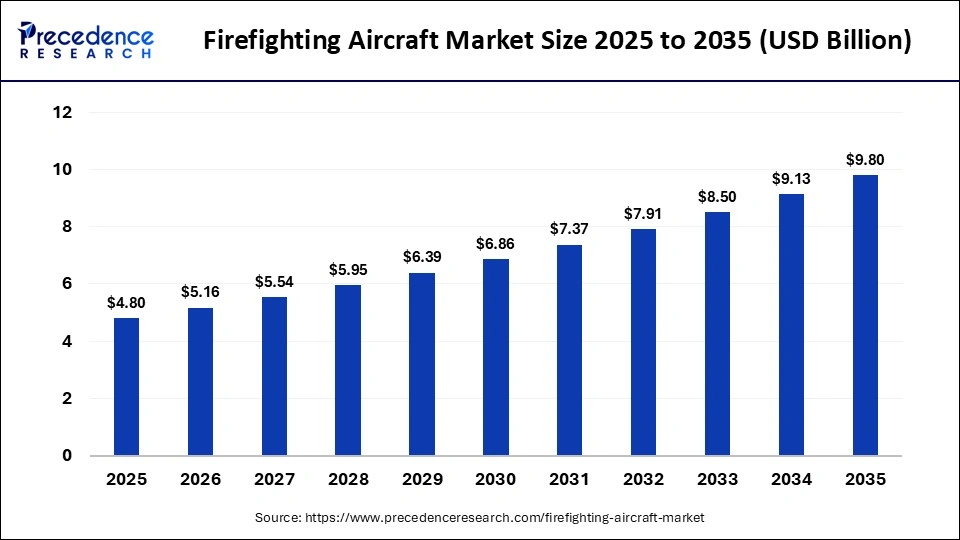
Key Takeaways
- North America dominated the firefighting aircraft market, accounting for 42.00% share in 2025.
- The Asia Pacific is expected to grow at a significant rate in the market during the forecast period.
- By aircraft type, the fixed-wing aircraft segment held a dominant position in the market with a share of 60.00% in 2025.
- By aircraft type, the rotary-wing aircraft segment is the second-largest shareholder and is expected to grow at a significant rate between 2026 and 2035.
- By water tanking capacity, the large capacity segment accounted for a major market share of 42.00% in 2025.
- By water tanking capacity, the medium capacity segment is the second-largest shareholder and is expected to grow at a significant rate between 2026 and 2035.
- By application, the forest firefighting segment led the global market with a share of 50.00% in 2025.
- By application, the structural firefighting segment is the second-largest shareholder and is expected to grow at a significant rate between 2026 and 2035.
- By end user, the government agencies segment dominated the global market with a share of 65.00% in 2025.
- By end user, the private companies segment is the second-largest shareholder and is expected to grow at a significant rate between 2026 and 2035.
Market Overview
Firefighting aircraft are specially designed or modified aerial platforms used to combat wildfires and large-scale fires. These aircraft play a crucial role in delivering water, fire retardants, and foam to remote or inaccessible regions, enabling faster containment and minimizing fire spread. The category includes fixed-wing aircraft, air tankers, scooper planes, and helicopters, many of which are equipped with advanced delivery systems such as internal tanks or Bambi Buckets for accurate deployment.
These aircraft are widely utilized by government agencies, defense organizations, and private contractors across the globe. With the rising frequency and intensity of wildfires, driven by climate change and environmental factors, countries are increasingly investing in expanding their aerial firefighting capabilities, integrating advanced technologies, and strengthening international collaboration to enhance response efficiency.
Impact of AI on the Firefighting Aircraft Market
The integration of artificial intelligence (AI) is transforming the firefighting aircraft market by enhancing the detection, monitoring, and suppression of wildfires. AI-driven systems analyze satellite imagery, drone data, and real-time inputs from manned aircraft to identify fire outbreaks at an early stage and predict their spread patterns.
This enables optimized flight planning and more precise deployment of water and fire retardants, reducing operational costs and resource wastage. Furthermore, AI-powered analytics evaluate environmental conditions such as wind patterns, terrain complexity, and vegetation density, allowing operators to make data-driven decisions. As a result, AI significantly improves mission efficiency, safety, and overall firefighting effectiveness.
Firefighting Aircraft Market Trends
The firefighting aircraft market is witnessing several key trends shaping its future growth:
- Increasing adoption of artificial intelligence, satellite data, and predictive analytics to enable early wildfire detection, optimize flight routes, and improve the accuracy of aerial firefighting operations.
- Rising investments from governments and private operators in advanced and larger fleets, including next-generation air tankers and multi-role aircraft, to enhance coverage and reduce emergency response times.
- Growing use of drones equipped with thermal imaging and advanced sensors for real-time surveillance and reconnaissance, supporting more effective coordination with manned aircraft.
- Development of next-generation firefighting aircraft featuring advanced dispersal systems, precision drop technologies, and hybrid tank configurations to improve efficiency and minimize resource wastage across diverse terrains.
Market Scope
| Report Coverage | Details |
| Market Size in 2025 | USD 4.80 Billion |
| Market Size in 2026 | USD 5.16 Billion |
| Market Size by 2035 | USD 9.80 Billion |
| Market Growth Rate from 2026 to 2035 | CAGR of 7.40% |
| Dominating Region | North America |
| Fastest Growing Region | Asia-Pacific |
| Base Year | 2025 |
| Forecast Period | 2026 to 2035 |
| Segments Covered | Aircraft Type, Water Tanking Capacity, Application, End User, and Region |
| Regions Covered | North America, Europe, Asia-Pacific, Latin America, and Middle East & Africa |
Regional Insights
North America remains a leading region in the firefighting aircraft market, driven by the high occurrence of wildfires, particularly in the United States and Canada. Well-established emergency response systems, strong government support, and advanced aviation infrastructure enable efficient deployment of aerial firefighting fleets. The region is also at the forefront of adopting advanced technologies such as real-time aerial monitoring, infrared imaging, and precision-based retardant delivery systems to enhance firefighting efficiency.
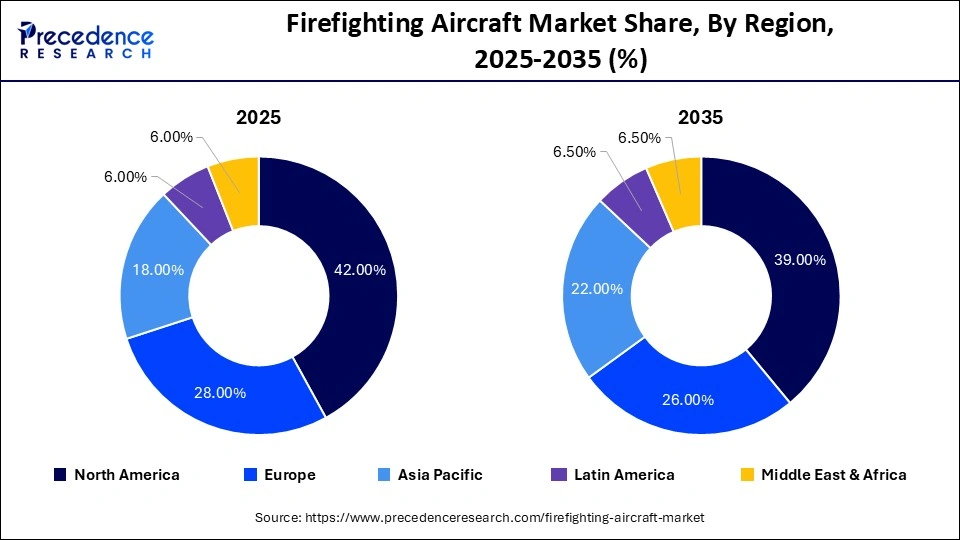
Europe continues to experience steady demand for firefighting aircraft due to recurring wildfires in countries such as Spain, France, Italy, and Greece. Regional cooperation plays a significant role, with multiple countries participating in shared firefighting initiatives and coordinated response efforts. Increasing wildfire intensity and longer fire seasons are prompting governments to modernize existing fleets and invest in advanced aerial firefighting technologies.
Asia-Pacific is witnessing rapid growth in the firefighting aircraft market, supported by rising wildfire incidents and expanding disaster management capabilities. Countries such as China, India, Japan, and Australia are actively investing in aerial firefighting infrastructure and modern aircraft. The region is also adopting advanced technologies, including AI-based monitoring systems, GPS-guided drops, and enhanced surveillance capabilities, to improve response times and operational effectiveness.
Latin America is gradually emerging as a key market, particularly in countries like Brazil and Chile where vast forest areas are susceptible to wildfires. Governments and private organizations are increasingly recognizing the importance of aerial firefighting in minimizing damage and improving response efficiency. However, infrastructure limitations and budget constraints may pose challenges to faster adoption.
The Middle East & Africa region is experiencing steady growth, driven by the need to protect critical assets such as oil infrastructure, urban developments, and natural reserves. Countries including Saudi Arabia, the UAE, and South Africa are investing in advanced firefighting aircraft and technologies. Growing awareness of disaster preparedness and climate-related risks is expected to further support market development in the coming years.
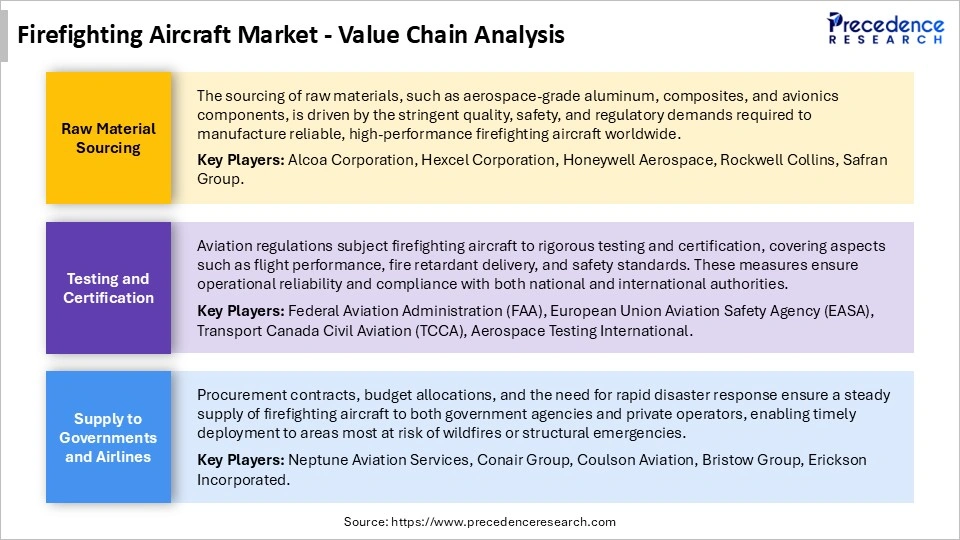
Firefighting Aircraft Market Value Chain Analysis
Firefighting Aircraft Market Companies
- Bombardier Inc.
- Airbus SE
- Lockheed Martin Corporation
- Textron Aviation Inc.
- Aviation Industry Corporation of China (AVIC)
- Erickson Inc.
- MHI (Mitsubishi Heavy Industries)
- Air Tractor, Inc.
- PZL Mielec (a Lockheed Martin Company)
- Conair Group Inc.
- BAE Systems plc
- Sky Aviation LLC
- De Havilland Aircraft of Canada Limited
- Embraer S.A.
- Viking Air Limited
Recent Developments
- In August 2025, Neptune Aviation Services proposed to build a new generation air tanker based on Airbus A319. The change is to enhance the capacity and effectiveness of firefighting, which will result in more efficient aerial wildfire suppression.
- In June 2025, AIRBUS and Space successfully finished test drops and demonstrations of the A400M firefighting demonstrator kit. Its capability to deliver and deploy large amounts of water was also pointed out in tests, which illustrated it to be flexible, quickly deployable, and efficient in operation.
- In January 2025, Conair purchased the Daher TBM 960 to enhance the wildfire suppression efforts. The efficiency, rapid response to fire zones, and the speed of the aircraft are facilitated by its advanced avionics, which enhance the overall mitigation and containment.
Segments Covered in the Report
By Aircraft Type
- Fixed-Wing Aircraft
- Large Fixed-Wing Aircraft
- Small & Medium Fixed-Wing Aircraft
- Rotary-Wing Aircraft
- Helicopters
- Light Aircraft
By Water Tanking Capacity
- Small Capacity (Up to 3,000 liters)
- Medium Capacity (3,000 – 10,000 liters)
- Large Capacity (Above 10,000 liters)
By Application
- Forest Firefighting
- Wildland Firefighting
- Aerial Firefighting Support
- Structural Firefighting
- Agricultural Firefighting
- Fire Suppression in Farmlands
- Others
- Emergency Rescue Operations
- Water Dropping for Flood Control
By End User
- Government Agencies
- Firefighting Authorities
- Military Agencies
- Private Companies
- Aircraft Operators
- Firefighting Service Providers
By Region
- North America
- Latin America
- Europe
- Asia-pacific
- Middle and East Africa
Get Sample Link: https://www.precedenceresearch.com/sample/8287
Also Read : https://www.businesswebwire.com/cranberry-capsules-market/