
What is the Facial Palsy Market Size in 2026?
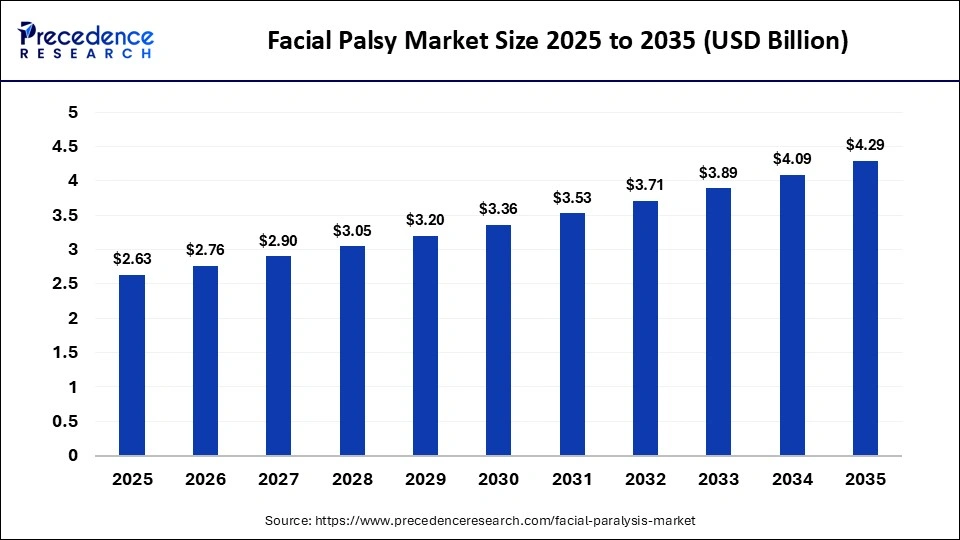
The global facial palsy market size was calculated at USD 2.63 billion in 2025 and is predicted to increase from USD 2.76 billion in 2026 to approximately USD 4.29 billion by 2035, expanding at a CAGR of 5.02% from 2026 to 2035. The facial palsy market has been observed to grow recently due to rising cases of neurological disorders and viral infections globally. Technological advancements to cure the neurological disorders, along with AI-integration for quicker and more effective results, coupled with AI-driven rehabilitation, are also the major market drivers.
Key Takeaways
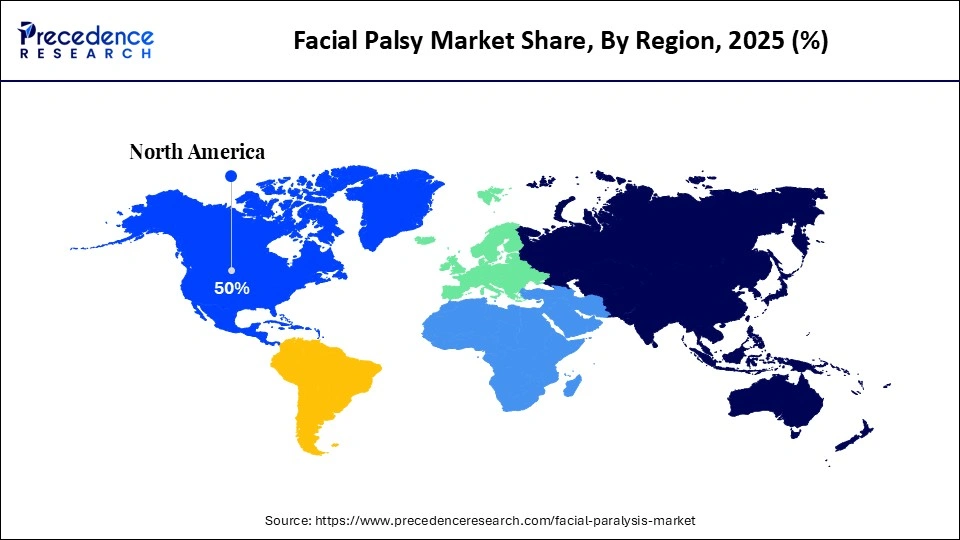
- North America led the global facial palsy market with the major share of 50% in 2025.
- Asia Pacific is expected to be the fastest-growing region in the foreseeable future.
- By application, the rehabilitation segment had a major dominance over the global market in 2025.
- By application, the surgical intervention segment is expected to expand rapidly in the foreseen period.
- By end use, the hospitals segment dominated the global market in 2025.
- By end use, the clinics segment is expected to gain the highest share of the market in the foreseeable period.
- By type of facial palsy, the Bell’s palsy segment accounted for a considerable share of revenue in 2025.
- By type of facial palsy, the trauma-induced paralysis segment is expected to grow with the fastest CAGR in the foreseeable period.
What is the Facial Palsy Market?
The facial palsy market focuses on the diagnosis, treatment, and management of facial nerve paralysis or weakness. Facial palsy occurs when there is damage or dysfunction in the seventh cranial nerve (facial nerve), which controls the muscles responsible for facial expressions. This condition can affect one or both sides of the face and often leads to symptoms such as facial drooping, difficulty closing the eye, drooling, speech impairment, and pain behind the ear.
Facial palsy can result from various underlying causes, including viral infections, traumatic injuries, strokes, tumors, and neurological disorders. The market encompasses a wide range of products and services used in diagnosing and treating the condition, including diagnostic imaging tools, medications, surgical devices, rehabilitation therapies, and specialized medical services. Increasing awareness of neurological disorders, improved diagnostic capabilities, and advancements in treatment technologies are contributing to the growth of the facial palsy market.
Role of Technology in the Growth of the Facial Palsy Market
AI-Driven Monitoring and Analysis: Artificial intelligence is increasingly being used to monitor and analyze facial movements with high precision. Tools such as Emotrics and the Regional Facial Analysis Assessment (RFAA) help clinicians evaluate facial symmetry and measure recovery progress. AI-powered systems can analyze facial “action units,” enabling faster and more accurate diagnosis and monitoring of facial nerve function.
Advanced Therapeutic Technologies: Technological advancements have led to the development of miniaturized implantable devices that provide targeted electrical stimulation to facial muscles, supporting nerve recovery. In addition, digital platforms and mobile applications allow patients to perform guided facial exercises with real-time biofeedback from home. Smart wearable devices, such as FRAME smart glasses, use sensors to monitor facial expressions and provide feedback on muscle movement during daily activities.
Surgical and Imaging Innovations: Modern imaging technologies and digital surgical tools are improving the accuracy of facial nerve repair procedures. Surgeons now rely on advanced imaging techniques such as 3D high-resolution ultrasound and magnetic resonance microscopy to map facial nerves before surgery. These innovations enable more precise surgical planning, reduce operating time, and improve treatment outcomes.
Facial Palsy Market Trends
- Technological Advancements in Rehabilitation: Digital platforms, mobile health applications, and wearable technologies are increasingly used to monitor facial muscle movements and track patient recovery progress. These tools enable continuous monitoring and personalized rehabilitation programs.
- Growing Demand for Minimally Invasive Treatments: Patients and healthcare providers are increasingly opting for minimally invasive treatment options, such as botulinum toxin injections for synkinesis or nerve transfer procedures in severe cases, as they offer faster recovery and fewer complications.
- Improved Diagnostic Capabilities:Advancements in diagnostic and pharmaceutical technologies, including high-resolution electromyography (EMG) and electrotherapy-based assessments, are enabling earlier and more accurate detection of facial nerve disorders. These innovations, combined with improved pharmaceutical treatment options, support timely diagnosis, enhance therapeutic effectiveness, and ultimately lead to better patient outcomes.
Market Scope
| Report Coverage | Details |
| Market Size in 2025 | USD 2.63 Billion |
| Market Size in 2026 | USD 2.76 Billion |
| Market Size by 2035 | USD 4.29 Billion |
| Market Growth Rate from 2026 to 2035 | CAGR of 5.02% |
| Dominating Region | North America |
| Fastest Growing Region | Asia Pacific |
| Base Year | 2025 |
| Forecast Period | 2026 to 2035 |
| Segments Covered | Application, End Use, Type of Facial Paralysis ,and region |
| Regions Covered | North America, Europe, Asia-Pacific, Latin America, and Middle East & Africa |
Regional Insights
North America Facial Palsy Market Size and Growth 2026 to 2035
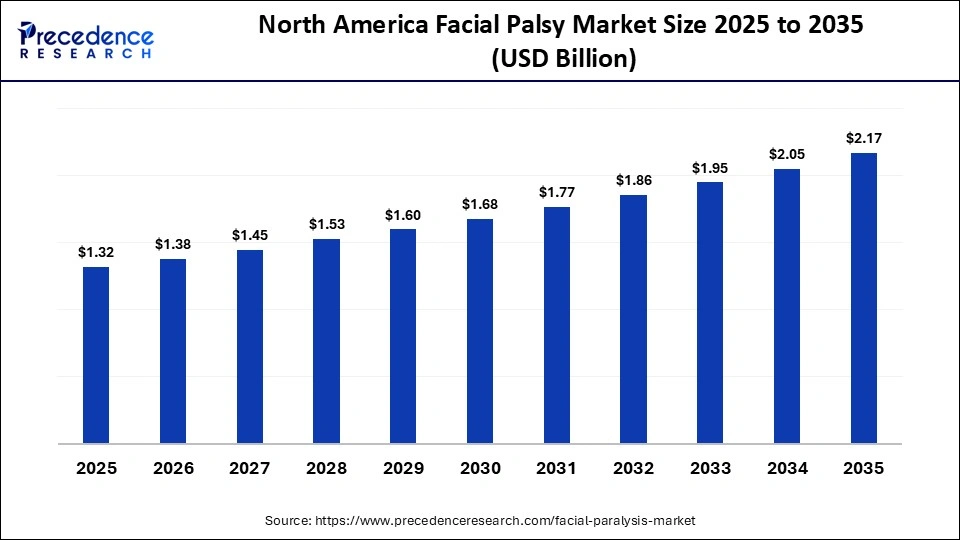
The North America facial palsy market size is estimated at USD 1.32 billion in 2025 and is projected to reach approximately USD 2.17 billion by 2035, with a 5.10% CAGR from 2026 to 2035.
Why did North America lead the Global Facial Palsy Market in 2025?
North America contributed the biggest market share of 50% in 2025. The growing prevalence of facial disorders due to various causes, growing healthcare infrastructure, growing investment in healthcare facilities, and rising demand for botulinum toxin and electrotherapy help to fuel the market’s growth in the foreseen period. Growing adoption of injections such as botulinum toxin for managing symptoms like synkinesis is also a major market driver. Advanced therapy options, such as electrotherapy for rehabilitation, also fuel the industry’s growth. The market’s growth is also propelled by FDA-approved technologies, such as NeuroMend MiniStim, which is a minimally invasive treatment option.
U.S. Facial Palsy Market Size and Growth 2026 to 2035
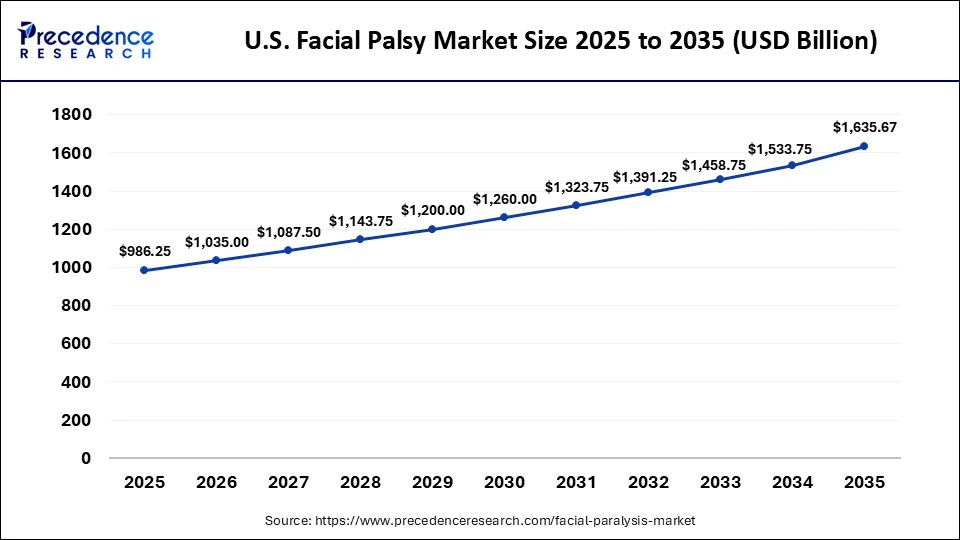
The U.S. facial palsy market size is calculated at USD 986.25 million in 2025 and is expected to reach nearly USD 1635.67 million in 2035, accelerating at a strong CAGR of 5.19% between 2026 and 2035.
The U.S. Facial Palsy Market Trends
The U.S. has a major contribution to the growth of the market due to the growing prevalence of facial disorders, such as Bell’s palsy, due to various causes. The market in the region also observes growth due to the rise of neurodiagnostics , surgical facial reanimation, and non-surgical options such as Botox. Rising cases of viral infections leading to facial disorders and the rising prevalence of strokes are also some of the major market drivers.
Why is the Asia Pacific Observed to be the Fastest-Growing Region in the Foreseen Period?
Asia Pacific is expected to expand rapidly with the highest CAGR. Factors such as the growing prevalence of facial disorders, the growing healthcare infrastructure, and the growing domestic income, which are helpful for advanced healthcare options, are some of the major factors for the industry’s growth. The industry also observes growth due to rising awareness of facial rehabilitation in the region.
The market is also observing growth due to higher investment in hospitals and specialized clinics, especially in urban areas. Growing demand for non-invasive and effective treatment options for traumatic injuries and Bell’s palsy is also a major market growth driver. Local production of treatment options required for effective results is also helpful for the industry’s growth in the foreseeable period. Technological investments in the form of MRI are also helpful to elevate the market.
China Facial Palsy Market Trends
China will make a major contribution to the growth of the industry in the foreseeable period, mainly due to factors such as improving healthcare infrastructure, rising disposable income, rising investment in healthcare facilities, and growing demand for improvement in facial aesthetics with the help of traditional and modern methods. The market is also observing demand in the region due to growing demand for cost-effective and minimally invasive treatment options. The growing use of traditional remedies, such as acupuncture, also helps in the market’s growth.
Recent Developments
- In November 2025, Life Analytics announced the launch of Facial Dynamics, a digital platform designed to transform facial rehabilitation through AR and remote monitoring.
- In May 2025, Facial Palsy UK launched a new campaign demanding urgent action to improve care for people living with facial paralysis in Northern Ireland.
Segments Covered in the Report
By Application
- Rehabilitation
- Surgical Intervention
- Pharmacological Treatment
- Physical Therapy
By End Use
- Hospitals
- Clinics
- Home Care
- Rehabilitation Centers
By Type of Facial Paralysis
- Bell’s Palsy
- Acoustic Neuroma
- Trauma-Induced Paralysis
- Congenital Facial Paralysis
By Region
- North America
- Latin America
- Europe
- Asia-pacific
- Middle and East Africa
Get Sample Link: https://www.precedenceresearch.com/sample/8126